
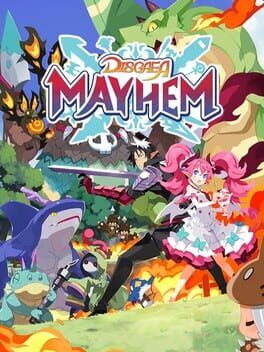

Disgaea Mayhem trades grids and turn orders for real-time chaos, a limited-edition launch, and a heavy dose of Musou-style combat. Here’s how longtime fans are reacting, what NIS is promising post-launch, and whether this spinoff hints at the future of the main series.
Disgaea has tried wild ideas for two decades, but Disgaea Mayhem is the boldest gamble yet. Instead of lining units on an isometric grid and counting tiles, you are now dashing, juggling and magichanging in real time as hordes of Netherworld fodder pour in from every side. It is an action RPG set in the Disgaea universe, built around the Japanese release Kyouran Makaism, and for the first time the series is asking you to swing the sword yourself instead of ordering the hit from a menu.
Early coverage from Push Square, Nintendo Life, Siliconera and MonsterVine paints a surprisingly consistent picture. On paper, Mayhem was inevitably going to split the fanbase. In practice, the initial reaction from longtime Disgaea players is less outright revolt and more wary curiosity mixed with some sharp concern about the combat’s depth and the message this sends about the series’ future.
Real-time mayhem and Musou vibes
The biggest point of friction is obvious. Mayhem replaces Disgaea’s grid tactics with direct, real-time control. You pick a weapon, mash out combos, weave in skills and crowd-control huge packs of demons. Previews repeatedly compare it to Musou-style brawlers. Trailer footage shows broad swings hitting dozens of enemies at once, simple launchers popping mobs into the air and big screen-filling specials that look closer to a Warriors crossover than Disgaea 7’s carefully tuned turn order.
For some veterans, that is a perk, not a problem. Fans who already enjoy Musou and character action games are calling Mayhem a welcome experiment. Threads linked in coverage and comment sections highlight players who bounced off the increasingly number-heavy tactics of late-series Disgaea and now see an easier on-ramp where they can still enjoy Prinny nonsense, reincarnation loops and billion-damage numbers without memorizing grid manipulation.
Others are far less convinced. The most common criticism is that the combat looks basic. Impressions from show-floor demos, like the one cited by Push Square’s Taipei Game Show hands-on, describe it as “pretty basic but not bad if you like Musou.” Community chatter Nintendo Life quotes leans on words like “jank” and “little flow” to describe the footage. Longtime grid-heads are worried the real-time system will flatten the tactical expression that defined Disgaea in favor of simple crowd clearing, with positioning, turn order manipulation and geo-panel problem solving mostly gone.
Veterans are also reading between the lines on budget. Visually, Mayhem looks closer to a late Vita or early PS4 title than a bespoke PS5 showcase. Fans point to stiff animations, simple enemy behavior and sparse arenas in the trailers as evidence that this is a side project rather than a full-scale reinvention. For players already worried about NIS stretching itself thin, that look undercuts confidence that the shift to action has the resources needed to evolve into something as rich as the tactics games.
Grinding stays, grids go
Where Mayhem is winning some skeptics back is how aggressively it preserves Disgaea’s identity outside of the combat layer. Every outlet emphasizes that classic systems are intact. Item World returns as a dedicated dungeon space for powering up gear. Reincarnation and the level cap up to absurd heights are still in play, complete with the promise of pushing stats until you are casually breaking the damage counter.
That means the familiar Disgaea rhythm of overlevelling a favorite character, reincarnating them, and climbing back up through even tougher stages is still here, only now the grinding happens inside a real-time action shell. Fans who treat Disgaea as an endgame sandbox rather than a pure tactical game see this as a decent compromise. If the fun for you is watching ridiculous numbers explode and min-maxing damage formulas, the genre shift looks less like a betrayal and more like a different flavor of the same goal.
Some series diehards are still uneasy. For them, those systems are inseparable from the chess-like layer of grid tactics, complex team compositions and map abuse. Losing tile-based movement, precise tower-stacking tricks and elaborate turn-order setups makes the reincarnation loop feel cosmetic, a stat treadmill that feeds a simpler combat model. The fear is that Mayhem leans on familiar terminology to reassure fans while delivering something that, in moment-to-moment play, behaves more like a straightforward brawler with RPG dressing.
Tichelle, flan and the tone test
If there’s one area where old fans are broadly relaxed, it is the story and tone. Mayhem stars Princess Tichelle, a demon royal whose life is structured around eating flan, and her mercenary subordinate N.A., who is in it for the paycheck. That premise, spotlighted across all the announcement writeups, lands squarely in quintessential Disgaea territory. Absurd food obsessions, selfish protagonists and demon workplace dynamics are part of the series’ DNA.
Commenters pulling quotes from the Japanese release and English press materials generally agree that Mayhem feels like Disgaea in its humor and character writing. The over-the-top key art, noisy UI and full-on anime theatrics are intact. Even among fans skeptical of the action combat, there is real interest in spending time with a new cast that seems tailored to classic Disgaea antics.
What most are hoping is that this familiar tone is backed by meaningful systems rather than used as a cosmetic layer on a generic licensed action game. Early hands-on impressions mention lots of enemies, flashy skills and that ever-present number creep, but dedicated tactics fans are waiting for deeper breakdowns of ability interactions, build diversity and difficulty tuning before deciding if this story is worth grinding through on its own.
Limited-edition hype and skepticism
The Limited Edition has become part of the conversation because of what it implies about NIS’ expectations. In the West, NIS America is leading with a 99.99 dollar LE that bundles the base game with an artbook, soundtrack CD, acrylic stand and keychain featuring Tichelle and N.A., all wrapped in a collector’s box. For Switch 2 buyers, the LE even leans into the still-new hardware with a game-key card format instead of a full cartridge.
On one hand, that is standard NIS strategy. Collectors who have been through Disgaea 4 Complete, 5 Complete and 7 Vows of the Virtueless know the drill. For them, Mayhem’s LE is a comforting sign that NIS is treating the game seriously rather than burying it as a low-profile digital experiment. Preorders selling through on NIS America’s storefront are being treated by some as a vote of confidence that the franchise can support multiple styles at once.
On the other hand, some fans see the premium LE as a hard sell for a spin-off whose combat is still under scrutiny. In comment threads cited by Nintendo Life and community reactions around the announcement, you can find players hesitating to drop collector-tier money on something they are not fully sure they want to play, especially when they are still hoping for more definitive ports of Disgaea 2, 3 and D2. The LE becomes a litmus test: if Mayhem reviews well and word-of-mouth among Disgaea diehards is positive, it will look like a savvy buy. If the game lands as shallow Musou filler, it risks souring some of NIS’ most loyal customers.
What NIS is promising after launch
NIS has not laid out a massive season pass yet, but early messaging and store listings do sketch out a familiar roadmap. The publisher is leaning on Disgaea’s usual long-tail support: challenge content, optional postgame dungeons and incremental balance patches rather than live-service style seasons.
Western press materials and the Steam page stress a robust endgame built around Item World depth, reincarnation loops and unlockable difficulty tiers. The implication is that veteran players will get the same kind of “play forever” sandbox they expect from a numbered Disgaea, just in real time. Given Nippon Ichi Software’s history, fans fully expect DLC characters, cosmetic packs and perhaps cameos from past protagonists to drop over time, even if those have not been formally detailed yet.
More importantly, NIS is positioning Mayhem as an experiment, not a pivot. The branding everywhere, from the trailers to press releases, hammers the word “spin-off.” In interviews around the Japanese launch of Kyouran Makaism and in Western announcement writeups, the company presents Mayhem as a parallel project developed by a dedicated team, while the main strategy RPG series continues on its own track. For now, post-launch promises are less about content drops and more about reassuring players that this one game will not erase the style they fell in love with.
Does Mayhem hint at Disgaea’s future?
The hard question every veteran is asking is whether Disgaea Mayhem is a preview of Disgaea 8’s direction. Officially, the answer is no. Every outlet covering the game is careful to frame it as a side story, and NIS has not announced any change to the core tactical formula for the numbered series.
Unofficially, fans know publishers watch experiments like this closely. If Mayhem’s real-time action finds a substantial audience, it will almost certainly influence how NIS thinks about the brand. That might not mean abandoning grids, but it could lead to more hybrid designs, action-focused spin-offs, or a heavier emphasis on direct control segments inside otherwise tactical entries.
Right now, the best reading of community sentiment is cautious patience. Hardcore grid enthusiasts are not declaring the sky is falling, but they are also not ready to accept Mayhem as “the new Disgaea.” Many are explicitly treating it like Hyrule Warriors or Persona 5 Strikers: a side dish that plays with familiar characters and systems while the main course stays intact.
If Mayhem launches with shallow combat and lackluster support, it will likely be filed next to older offbeat experiments and forgotten. If it lands as a genuinely satisfying action RPG that still delivers on Disgaea’s upgrade obsession and comedic tone, it could become the template for a parallel action line that coexists with the tactics juggernaut. In that sense, the game’s success or failure will quietly answer a bigger question than any single spin-off usually does.
For longtime fans watching from the sidelines, that makes Disgaea Mayhem more than just a pudding-obsessed princess’ side story. It is a test case for how far the Netherworld can stretch without snapping the grid that built it.