
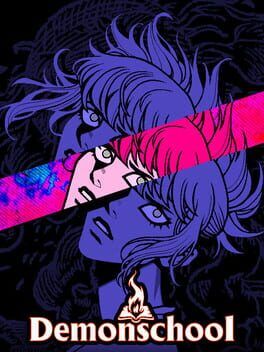
Persona-style school life, Into the Breach‑leaning tactics, and Buffy-tier demon nonsense make Demonschool a smart holiday backlog pick on Nintendo Switch, as long as you can handle its battle-heavy pacing.
If your tactics-RPG plate has been full of Unicorn Overlord, Triangle Strategy, and Persona 5 Tactica, it would have been easy to let Demonschool slide right past you on Nintendo Switch. That would be a mistake.
Necrosoft’s occult campus caper has quietly built up glowing Switch reviews, including a 9/10 from Invision Community, positioning it as one of those word-of-mouth gems that shows up in December recommendations and “How did I miss this?” threads. As holiday downtime and eShop sales roll in, Demonschool is exactly the kind of compact, flavorful tactics title worth slipping into your backlog.
Persona vibes, B-movie soul
Demonschool opens with a premise that sounds like it fell out of a lost PS2-era Atlus pitch meeting. You play as Faye, a deadpan, violence-happy demon hunter who heads to a university on a remote island she is convinced will be the epicenter of an apocalypse in ten months. Instead of a brooding chosen one, you get a protagonist who treats demon-busting like part-time work-study.
From there you assemble a party of aggressively strange students. There is Namako, the pacifist who hates fighting but ends up stunning and shoving monsters around the battlefield, and Knute, a support specialist who hoards VHS tapes and buffs allies like he is programming a late-night horror marathon. Every recruit leans into an archetype but the writing pushes them beyond simple parody, with small personal arcs and layered banter that keep them endearing.
Reviews consistently single out the tone as Demonschool’s defining strength. Jokes land more often than not, NPC chatter is dense with throwaway gags, and even sidequests lean into surreal campus horror. The result is a game that feels closer to Buffy the Vampire Slayer and Italian horror flicks than the melancholy coming-of-age of Persona, even while it borrows that series’ calendar structure and school setting.
If Persona’s social drama can sometimes feel ponderous, Demonschool’s script is brisk and punchy. Conversations rarely overstay their welcome and character bits slide quickly into the next crisis. That makes it an ideal Switch couch game for short holiday sessions: pick it up, enjoy a few sharp exchanges, clear a dungeon, put it back down.
Tactics that play like a puzzle box
For all the chatter about its personality, Demonschool is first and foremost a tactics game. What sets it apart from recent heavyweights like Triangle Strategy or Fire Emblem Engage is how stripped-down and puzzle-like its battles feel.
Each encounter plays out on an isometric grid, but instead of moving units one at a time and watching them act in sequence, Demonschool splits turns into two distinct phases. You have a planning phase, where you position your four-person squad and queue up abilities using a shared pool of Action Points, then an action phase where you commit and watch your plan unfold simultaneously with the enemy’s moves.
The Action Point economy is designed to push you into clever risk-taking. The first action you assign to a character is cheap, but doubling up on a unit’s turn gets increasingly expensive. That naturally encourages lineups and combo chains, like shoving one demon into another to line both up for Faye’s brutal finisher, or using Namako to push enemies into a hazard zone before a teammate’s area attack goes off. Movement is rigid, with set distances instead of free tile-by-tile walks, so grid geometry really matters.
The reviewer praise around Switch versions centers on how readable and satisfying this loop feels on a handheld screen. Demons hit hard, your team can typically only take a few mistakes before being wiped, and yet the game lets you rewind planning freely or restart a mission mid-run. That keeps it tense without turning it into a slog.
Compared with more number-heavy tactics systems, Demonschool is lighter on stat crunch and heavier on spatial problem solving. Fans of Into the Breach or smaller-skirmish games like The Banner Saga will likely feel at home. If you live for min-maxing build trees and granular hit percentages, you may find it breezier than you expect from a 79-average tactics title, but the trade is a faster, snappier combat rhythm that suits Switch pick-up-and-play.
An unapologetically battle-heavy calendar
The main caveat that crops up in Switch reviews is pacing. Demonschool absolutely loves a fight. The flow of a typical in-game day quickly settles into brief visual novel style scenes with your classmates followed by yet another tactical mission, then another.
On paper, that sounds like a win for players who bounced off the downtime of Persona 5 Tactica or the lengthy story interludes in Fire Emblem Engage. In practice, the sheer density of encounters means that if you come to Demonschool seeking a story-first experience, you may find yourself wishing for a few more quiet moments between battles. Some reviewers peg it at roughly a fight every minute or two during certain stretches, which can leave the overarching mystery feeling stretched out even as each mission is mechanically fun.
Exploration is similarly pared back. Instead of wandering a full campus, you move between compact hub screens populated with NPCs and sidequests. For some, that will read as a limitation compared with the fuller cityscapes of Persona or the explorable monasteries of Fire Emblem. Others will appreciate how efficiently Demonschool moves you from story beat to story beat without the filler of aimless errands.
If you are curating a holiday backlog, this tension is worth noting. Demonschool works best if you are happy to treat it like a tactics puzzle anthology with a strong narrative wrapper rather than a life sim where combat is the occasional punctuation mark. Jumping in for a pair of missions and a couple of character scenes during a commute or between bigger holiday commitments feels like its sweet spot.
How it stacks up to other modern school-life tactics games
The comparison points for Demonschool are easy to list but more interesting in the details.
Against Persona 5 Tactica, Demonschool is shorter, sharper, and much weirder. Persona trades in long social arcs, fully realized city life, and a more conventional heroic tone, with tactics missions that often feel like rails for your overpowered team by midgame. Demonschool flips that balance. Its world is smaller and more abstract, but its battles stay dangerous and inventive for longer precisely because your squad is fragile and the Action Point system forces hard choices every turn. If you loved Persona 5’s social side but felt lukewarm on its grid battles, Demonschool may feel skewed the other way.
Stacked beside Fire Emblem Engage, the contrast is between maximalism and focus. Fire Emblem offers sprawling campaigns, romance subplots, and a kitchen’s worth of mechanical side dishes. Demonschool is closer to a tightly designed dessert course, with no permadeath and limited build paths but a strong central hook and a cast that leans harder into outright comedy. It will not scratch the same army-management itch, yet it may be the better pick when you have only a week off and do not want to juggle a 50-hour commitment.
Triangle Strategy and Unicorn Overlord approach tactics from a more traditional, political or high-fantasy angle, with long story scenes and slower-burn battles. Demonschool instead delivers kinetic, puzzle-like clashes and a tone that lives in the overlap between horror and sitcom. If those larger strategy epics already occupy your brainspace this year, Demonschool slots in comfortably as the oddball, lower-investment counterprogramming.
Even in the indie space, it stands apart from tactics-school hybrids like Wintermoor Tactics Club. Wintermoor emphasized narrative and light social mechanics while keeping battles simple. Demonschool meets it halfway, turning the grid into something thankfully trickier and more replayable while still making room for character-driven vignettes.
So, should Demonschool be in your holiday backlog?
If your Switch is your holiday travel companion and you are in the mood for something stylish, offbeat, and mechanically tight, Demonschool is very easy to recommend.
It excels at three things that matter for a December tactics fix. First, its tone is distinct, with writing that leans into sharp, frequently hilarious exchanges without losing sight of an escalating supernatural threat. Second, its combat system is clever and satisfying, earning the “just one more mission” pull that multiple reviewers highlight. Third, its structure respects your time, with minimal exploration bloat and no multi-hour stretches of dialogue before you can flex your brain on the grid.
The trade-off is a campaign that can feel saturated with fights, leaving little breathing room if you prefer your school-life games heavier on calendar management, romance, and exploration. If that is what you are looking for, you are still better served finishing Persona 5 Tactica or revisiting Fire Emblem Three Houses.
But if your ideal holiday backlog addition is a Switch tactics game you can punch through in focused bursts, laughing at demon nonsense between family gatherings or flights, Demonschool earns its recent review buzz. It is not just another Persona-like. It is a confident, stylish tactics-RPG that knows exactly what it wants to be and rarely wastes a turn.