
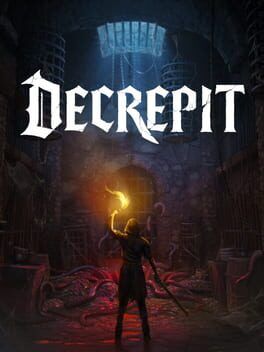

The solo‑developed horror soulslike unveiled at The Game Awards 2025 twists the classic castle crawl by making death itself your progression system.
Decrepit arrived at The Game Awards 2025 in a show packed with big brands and sequels, yet it immediately stood out as something stranger, smaller and far more personal. Developed entirely by a single creator and backed by new label Three Friends, it is pitched as a horror‑soulslike built around a simple, unnerving idea: the only way to escape its cursed castle is to die in it.
A castle you only understand by dying in it
On the surface, Decrepit presents a familiar setup. You are trapped inside a decaying fortress full of twisted creatures and tight, shadow‑drenched corridors. Combat leans on deliberate, stamina‑driven swings and careful blocking, clearly speaking to the same audience that lives for nail‑biting duels in Dark Souls or Bloodborne. Weapon weight, timing and distance all matter. Getting greedy is punished quickly.
Where it diverges is in how it treats failure. In FromSoftware’s classics, death is a slap on the wrist that sends you back to a bonfire with your pockets lighter but your knowledge deeper. In Decrepit, dying is not only expected but required. Each time you fall, the castle shifts. New routes crack open, locked spaces subtly reconfigure and the architecture itself seems to remember the violence that took place there. The loop is not just about reclaiming dropped resources, it is about slowly coaxing the building to reveal its true shape.
That twist turns the traditional soulslike flow on its head. Instead of doing everything you can to preserve a perfect run, you begin thinking about where and how you die. Losing to a particular monstrosity might not be pure punishment, it might be the key that lets you access an entirely new wing. The castle becomes a hostile puzzle box whose solutions are written in your corpse count.
How “escape by dying” changes the soulslike formula
The idea of a level that mutates with every lost life has obvious horror potential. Dying in Decrepit does not reset the board like a classic roguelike run, yet it also does not preserve the static, slowly mastered layouts that define most soulslikes. Instead you exist in a creeping middle ground where your memory is always slightly out of date.
That tension matters. Souls games are built around eventually demystifying their spaces. You start lost and frightened, then you internalise shortcuts, ambush points and safe ladders. Decrepit threatens that comfort. A staircase that saved you ten minutes ago might be gone after your next death. A once‑empty hallway might now be home to a new patrol or a fresh environmental hazard. Progress is still earned through skill, but the world resists being fully mapped.
This could create a very different rhythm to play. Trial and error is no longer a shameful secret that happens on the way to mastery, it becomes the text of the game itself. Choosing to push deeper on low health or to take a risky fight stops being a simple calculation about resource loss. You might welcome a brutal end if it means provoking another twist in the architecture.
Mechanically, that opens interesting doors for progression. Instead of a straight line of stats going up, Decrepit can tie character growth to how you have died, where you have died and what you have faced in your final moments. Perhaps certain enemies only evolve if they have killed you, or specific story beats only trigger after you have bled out in a particular chamber. The castle and its residents become archivists of your failures.
It also has the potential to reframe difficulty. Soulslikes often lean on fixed encounter design to create very specific strains of challenge. Here, the shifting layout means tension is less about memorising spawns and more about managing the unknown. You learn tendencies rather than placements. For a subgenre that frequently struggles with repetition on repeat runs, that is a promising way to keep dread alive.
Horror through uncertainty, not just brutality
Horror‑tinged soulslikes live and die on atmosphere. Decrepit leans into a grounded, oppressive aesthetic. The castle is not a baroque fantasy playground full of grand vistas, it is closer to a rotting institution. Narrow corridors, sickly lighting and heavy stonework create a sense of weight, while enemy silhouettes cut clearly against the gloom so you always know something is there, even if you cannot yet place what it is.
The die‑to‑escape mechanic amplifies that tone. Every time the castle reshapes itself after your death, it drives home the impression that you are trapped inside a living, vindictive structure. Rooms that once felt safe become uncanny. Familiar sightlines are skewed just enough to make you wonder if your memory is failing or the walls are moving behind your back.
That kind of creeping disorientation can be more effective than simple jump scares or sudden difficulty spikes. When the environment itself feels like an unreliable narrator, even walking back to a known landmark carries a low hum of anxiety. For a solo developer without the budget for cinematic spectacle, investing in that psychological angle is a smart way to punch above their weight.
A solo project with serious backing
One of the most intriguing angles on Decrepit is its development story. This is a one‑person project, yet it is arriving under the umbrella of Three Friends, a young label positioning itself as a home for distinctive, creator‑driven games. That combination of tight creative control and external support can be powerful.
Solo‑developed soulslikes are still rare. The genre is notorious for demanding heavyweight systems design, intricate level layouts and careful tuning of animation and hitboxes. Knowing that a single mind is responsible for all of that in Decrepit gives the project a clear identity. There is no dilution of vision through committee, no pressure to chase trends beyond the core idea of that lethal castle loop.
At the same time, Three Friends’ backing suggests resources and time that many one‑person horror projects lack. Marketing support is part of it, but so is the ability to iterate on feedback, invest in performance polish and ensure the game can actually ship in a reasonable window. Being on a TGA stage at all is a sign the label intends to push Decrepit beyond cult curiosity.
This dual nature also fits the game thematically. A solitary protagonist lost in a labyrinth built to break them, guided only by cryptic support, reflects the lone developer carving a path through a difficult genre with a modest safety net behind them.
Why Decrepit is one to watch for 2026
With a planned PC launch in 2026 and no firm date yet, Decrepit sits in an interesting pocket of the upcoming schedule. By then, the soulslike field will be even more crowded, but there are not many projects chasing this specific blend of horror, shifting space and death‑as‑progression.
If the castle loop delivers on its promise, Decrepit could slot nicely alongside the likes of Returnal or Outer Wilds, games where dying is not a failure state but the lens through which you unravel the rules of a hostile world. Here, though, that concept is applied to the close‑quarters cruelty and precise timing that fans of FromSoftware have spent a decade mastering.
There is risk, of course. Making death frequent without making it tedious is a fine line to walk. The castle’s reconfigurations will need to feel purposeful rather than random, and the combat must be sharp enough that players do not feel railroaded into deaths they did not truly earn. The horror dressing will ring hollow if the foundational feel of each swing and dodge does not support it.
Still, there is plenty of reason to be optimistic. The Game Awards reveal proved Decrepit can command attention in a noisy showcase, and the basic pitch is the kind of clear, high‑concept hook that tends to cut through release‑schedule clutter. A solo‑developed horror soulslike where dying is your only route to freedom is a compelling sentence on its own.
If you are the kind of player who enjoys peering at a map and wondering what might change if you lost everything in the next room, Decrepit should be firmly on your radar for 2026. The castle is waiting, and it will not let you walk out alive.