
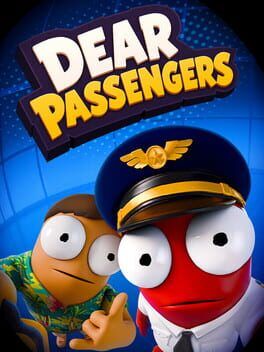

Dear Passengers is getting early attention on Steam by turning a doomed budget flight into a physics-driven co-op party game about bad weather, risky cargo, unruly passengers, and friends making everything worse.
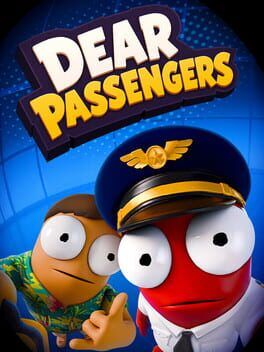
Image: IGDB
Store links: Dear Passengers on Steam
Dear Passengers has a clean, cruel co-op hook
Dear Passengers has surfaced on Steam with the kind of premise that chaotic co-op players understand in seconds: you and your friends are the crew of the world’s worst airline, and somehow the passengers and cargo still need to reach their destination in one piece.
That is the strongest confirmed detail around the Dear Passengers game so far. The Steam description, quoted by Kotaku and GamingOnLinux, frames it as a co-op airline disaster simulator where one player pilots the plane while the rest of the crew works the cabin, serves passengers, handles cargo, and tries to stop small failures from turning into full-blown airborne disasters. GamingOnLinux highlighted Steam’s own joke that passengers expect food, drinks, and a smooth flight, and that players should try to provide “at least two of those.”
The tension is immediate because Dear Passengers is being noticed before players have much hard information about it. FLEXUS has a Steam page live for the game, multiple outlets are pointing to a 2026 PC launch window, and the trailer has already given co-op fans a readable fantasy: the worst budget flight imaginable, except the incompetence is shared among friends. What remains unconfirmed in the provided material is just as important for prospective players: there is no price, no exact release date, no console announcement, and no stated player count in the sources supplied here.
The airline setting gives familiar co-op chaos a sharper shape
The early attention around Dear Passengers co-op is not coming from a complicated ruleset. It is coming from how legible its mess looks. Recent physics-heavy friend games tend to live or die on whether the setup gives players funny jobs, bad decisions, and a space where failure can travel quickly. A plane cabin is almost too perfect for that.
According to the Steam page excerpt reproduced by GamingOnLinux, players choose passengers and cargo before takeoff, with bigger payouts usually bringing bigger problems. That choice matters because it gives the comedy a risk-reward structure rather than pure randomness. Some cargo is hard to handle, some passengers are difficult to please, and some flights can begin going wrong before the plane leaves the ground. That sounds like a small but important design distinction: the crew is not only reacting to chaos, it is partly buying into it for more money.
The cabin also compresses everyone into a tight stage. One person is in the cockpit trying to keep the aircraft moving. Others are in the passenger area, trying to feed people, protect cargo, and keep the flight from collapsing into slapstick. Kotaku’s report, citing the Steam description, says the pitch includes a plane that is falling apart, illegal cargo, and passenger safety barely making the list. It also describes players dealing with hazards like bad weather, turbulence, and crocodiles escaping from shipping crates. That combination of assigned roles and unreasonable emergencies is exactly where an airline party game can turn a simple errand into a story players retell after the session ends.
Physics, weather, and bad passengers are doing the heavy lifting
The common thread across early coverage is that Dear Passengers is being sold as a physics-led comedy game. GamingOnLinux called out funny physics, dynamic weather systems, risky passengers, and risky cargo. Kotaku described ragdoll physics, proximity chat, unruly passengers, and a trailer scenario where a flock of birds overwhelms an airliner and causes an engine explosion. Player.One similarly pointed to ragdoll physics, proximity voice chat, turbulence, bird strikes, equipment failures, and dangerous cargo as central to the experience.
The Steam text quoted by GamingOnLinux gives the clearest confirmed mechanics from the listing itself. Weather can turn a normal flight into a disaster, turbulence and air pockets can throw passengers, luggage, and loose objects around the cabin, and one bad turn can send the entire plane into chaos. That matters because physics comedy needs pressure. If every object, passenger, and piece of luggage becomes a liability when the pilot mishandles the plane, the cockpit and cabin roles can collide in funny ways.
Some reported trailer details go further. NDTV wrote that players may need to step outside mid-flight to repair the hull or use a machine gun against incoming pirates. Those beats should be treated as trailer-reported examples rather than a complete feature list, since the supplied Steam excerpt does not lay out every scenario. Still, they fit the larger pattern: Dear Passengers wants the aircraft to feel like a moving disaster box, where serving snacks and managing a crocodile crate can somehow belong to the same work shift.
The “friendslop” label is helping it travel, but the game still has to prove itself
Several outlets are placing Dear Passengers inside the current wave of cheap, loud, shareable multiplayer games often called “friendslop.” Kotaku explicitly framed it as a possible viral obsession and connected it to games such as R.E.P.O. and Peak. NDTV described friendslop as a term for multiplayer games that are cheap, vibrant, and fun to play with friends, while noting that titles like R.E.P.O., Peak, and RV There Yet built viral followings. NerdZap also positioned Dear Passengers alongside that Steam co-op wave.
That label is useful, but it can flatten what players should actually be watching for. The appeal of a chaotic co-op game is rarely chaos alone. The best ones give each friend a job that sounds easy until another player’s mistake changes the situation. Dear Passengers’ confirmed role split has that potential: the pilot’s bad turn can destabilize the cabin, while the cabin crew’s failure to control passengers or cargo can create emergencies the pilot cannot ignore.
The risk is that the same genre hooks attracting attention can also attract skepticism. Kotaku noted that FLEXUS has no prior Steam projects listed and said the Steam page did not show a generative AI disclaimer at the time of its report. That absence was presented by Kotaku as a reassuring sign, but it is not a review, a quality guarantee, or proof of final scope. For now, the safer reading is that Dear Passengers has a strong trailer pitch and a Steam listing built around proven co-op ingredients. Whether it has the depth, stability, and mission variety to survive beyond the first viral clips is still unanswered.
FLEXUS is entering PC from a different corner of games
Dear Passengers is also drawing attention because of who is making it. Kotaku identified FLEXUS as the developer and reported that the studio is based in Ukraine. Kotaku also said it had no previous Steam projects listed and described Dear Passengers as the studio’s first PC release, while pointing to outside reporting that FLEXUS has made mobile idle games with hundreds of millions of downloads. Player.One and NerdZap likewise describe FLEXUS as a Ukrainian studio moving into PC with this project.
That background cuts two ways. On one hand, a mobile studio with large-scale download experience may understand approachable onboarding, sticky loops, and quick-session readability, all useful traits for a co-op party game. On the other hand, PC co-op brings a different set of demands: networking, voice systems, physics synchronization, input expectations, PC performance spread, Steam community pressure, and post-launch iteration. None of the provided sources include technical requirements or network details, so it is too early to judge how prepared Dear Passengers is on those fronts.
The proximity chat detail, reported by Kotaku and Player.One, is one to watch closely. In a cramped aircraft, distance-based voice could make communication funnier and more fragile, especially if the pilot and cabin crew cannot easily coordinate during a crisis. It could also become frustrating if mission design depends on precise teamwork while the physics engine is already throwing people and luggage around. That balance between readable comedy and unfair noise is where games like this either become weekly friend-group staples or burn out after a few clips.
What is confirmed for Steam, and what players should wait to learn
For practical purposes, Dear Passengers Steam availability is the firmest platform detail in the supplied sources. Kotaku links the Steam page for app 4534960, GamingOnLinux cites the Steam page directly, and multiple outlets describe the game as coming to PC in 2026. GamingOnLinux labels the platform context as Proton/Wine, which is relevant to Linux players watching Steam releases, but the provided material does not include a Steam Deck verification status or official Linux build confirmation.
The release timing is broad. Kotaku wrote that Dear Passengers is supposedly shipping on PC later this year, while the announcement embed cited by Kotaku, NDTV, and Player.One says it is launching in 2026 for PC. Since those statements point to the same year in the current context, there is no real conflict yet, but players should not treat “later this year” as a date. No source here provides a month, price, demo plan, early access status, monetization model, or console roadmap.
The best move for interested players is to wishlist Dear Passengers on Steam if the premise lands for your group, then wait for hard details before making plans around it. The pitch is strong: a co-op crew, a doomed aircraft, risky cargo, dynamic weather, ragdoll turbulence, and passengers who may be part of the problem. The unanswered questions are the ones that decide longevity: how many players can join, how varied the flights are, how fair the disasters feel, how stable online play is, and whether FLEXUS can turn a hilarious announcement into a reliable friends-night machine.