
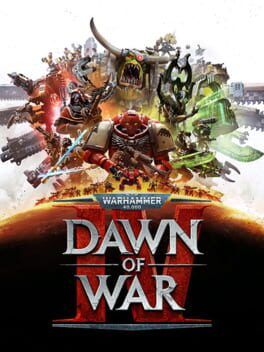

King Art’s latest Dawn of War IV multiplayer Battlefield Reports show Space Marines, Orks, Adeptus Mechanicus, and Necrons in 1v1 matches, revealing the sequel’s early competitive shape.
Image: IGDB
Store links: Warhammer 40,000: Dawn of War IV on Steam
King Art’s 1v1 showcases put asymmetry at the center of Dawn of War IV multiplayer
King Art Games has released two Battlefield Report videos for Warhammer 40,000: Dawn of War IV, and the concrete takeaway is clear: the sequel is positioning its multiplayer around sharply different faction economies, territory tools, and battlefield tempo rather than a lightly reskinned unit roster.
MonsterVine reports that Creative Director Jan Theysen and Senior Game Designer Elliott Verbiest face off across two 1v1 matches. One pits Space Marines against Orks, while the newer showcase features Adeptus Mechanicus against Necrons. MMORPG.com likewise describes the videos as new multiplayer looks at the four announced launch factions, split across Space Marines versus Orks and Adeptus Mechanicus versus Necrons.
That framing matters for competitive RTS players because 1v1 is where faction identity stops being flavor text and becomes match structure. The question raised by these reports is not simply which faction has the strongest army. It is whether Dawn of War IV can make its factions feel strategically distinct while keeping openings readable, comeback windows credible, and map control worth fighting over. Based on the reported showcases, King Art is leaning into classic Dawn of War fundamentals: base construction, force expansion, resource point control, cover, garrisons, squad upgrades, and veterancy, all of which Deep Silver highlights on the game’s official site.
Adeptus Mechanicus look like the setup faction, built around networks and firing lines
The Adeptus Mechanicus may be the most revealing faction in the new Dawn of War IV multiplayer footage because their identity appears to be tied directly to infrastructure. MonsterVine describes them as relying on a Noosphere Network, defensive positions, and superior technology to lock down territory and create punishing firing lines. A Yahoo syndication of Windows Central’s write-up adds a more mechanical detail: Adeptus Mechanicus production buildings can be linked through the Noosphere Network, and the more buildings linked into that network, the cheaper combat unit production becomes and the stronger their turrets become.
That is a major competitive signal if it holds in the final game. A faction that becomes more efficient through connected infrastructure creates a different kind of pressure curve from a faction that simply captures points or masses units. It asks the player to plan base shape, forward positions, and defensive overlap. It also gives opponents an obvious strategic question: do you fight the army, or do you cut the network that makes the army efficient?
The reported unit examples support that control identity. The Yahoo/Windows Central text describes fast Skitarii Rangers that can move around the map to capture Control Points while sniping enemies, alongside heavily armored tanks and walking mechs for harder fights. MonsterVine’s broader description points in the same direction: this is a faction for players who prefer structure, setup, and control.
For ladder play, that kind of design usually lives or dies on timing. If the Adeptus Mechanicus defensive shell comes online too early, opponents may feel forced into desperate all-ins. If the network takes too long to matter, the faction risks being bullied before its identity is visible. The showcase suggests King Art wants AdMech to reward preparation, but the balance question is how vulnerable that preparation remains under real player pressure.
Necrons appear to trade conventional map capture for relentless forward pressure
The Necrons are presented as the cleanest contrast to the Adeptus Mechanicus. MonsterVine reports that they advance a Power Matrix across the battlefield, recover through resurrection, and maintain pressure through constant forward movement. The Yahoo/Windows Central write-up gives additional specifics, saying Necrons do not have to take and hold Control Points for resources in the same way. Instead, they draw resources by spreading a Power Matrix through Necron buildings.
That is a meaningful departure from the usual RTS rhythm of capture, harass, decap, and recap. If a faction’s resource plan is bound to its own expanding structure network, the opponent’s scouting priorities change. You are looking for where the matrix is spreading, which buildings are anchoring it, and whether the Necron player is overextending the grid faster than they can defend it.
The same write-up says the Power Matrix can provide passive health regeneration and faster squad member replenishment to Necron units, and that Necrons can teleport defensive turrets after construction to defend positions. It also describes buildings that can hold combat units in reserve and deploy them from headquarters to any Necron Tomb Pylon on the map. Those details point to a faction that can convert territory into mobility and staying power, rather than simply into income.
The resurrection angle is equally important. MonsterVine highlights Necron recovery through resurrection, while the Yahoo/Windows Central report says Necrons can build structures that revive fallen combat units for free, freeing resources for additional production such as Necron Warriors, Canoptek Wraiths, or Monoliths. In competitive terms, that creates a punishing knowledge check. Opponents cannot merely win a fight by forcing models off the board. They need to understand when a fight is truly finished and when the Necron economy is about to convert losses into renewed pressure.
Space Marines and Orks define the more familiar half of the faction spread
The earlier Battlefield Report, as covered by MonsterVine, uses a cleaner RTS contrast: Space Marines against Orks. Space Marines are described as disciplined, adaptable, durable, and built around direct firepower. MonsterVine says they can erase enemy forces with strong positioning and heavy attacks, which suggests a faction that rewards clean engagements and efficient use of elite units.
Deep Silver’s official Dawn of War IV page describes Space Marines as the iconic Warhammer 40,000 faction and says they have taken the main faction role in previous Dawn of War games. The same page emphasizes their genetic enhancements, power armor, and brutal weaponry. In multiplayer design terms, that reads as the expected generalist anchor: fewer, tougher units with the tools to respond to many situations if positioned correctly.
Orks, by contrast, are described by MonsterVine as a momentum faction. If they are given space to grow, their numbers and aggression can snowball into a threat that overwhelms more controlled armies. Deep Silver’s official page similarly describes Orks as thriving in conflict and dominating through a strength-in-numbers strategy.
That pairing is important because it gives Dawn of War IV a readable competitive baseline. Space Marines represent flexible durability and punishment for sloppy approaches. Orks test whether the game’s economy and reinforcement systems allow aggression to build organically instead of devolving into a single early rush script. If Orks need room to grow, then denying that room becomes a strategic goal. If Space Marines rely on strong positioning, then flanks, map spread, and forced rotations become the natural counters.
The competitive pitch is classic RTS structure with modern readability questions
Deep Silver’s official site explicitly frames Dawn of War IV as a return to classic Dawn of War RTS gameplay refined for modern strategy fans. The listed pillars are familiar but important: build a base, expand forces, upgrade squads with weapons and abilities, capture and upgrade resource points, use cover and garrison buildings, and grow surviving units through a Unit Veterancy System.
Those systems create the skeleton of an RTS multiplayer game that can support long-term mastery. Resource points give players reasons to leave the base. Cover and garrisons make territory tactical rather than purely economic. Squad upgrades create branching roles inside the same faction. Veterancy encourages preservation, which is especially relevant in a game where Space Marines are presented as elite and durable, Orks as snowballing through numbers, Adeptus Mechanicus as infrastructure-driven, and Necrons as capable of recovery and redeployment.
The risk is readability. The reported faction identities are exciting because they are asymmetric, but asymmetry has a cost. A Space Marine player fighting Orks needs to know when Ork momentum is becoming irreversible. An Adeptus Mechanicus player needs clear feedback on how the Noosphere Network is improving production and turrets. A Necron opponent needs to understand the Power Matrix, resurrection, and teleportation rules well enough to make informed attacks.
This is where the Battlefield Report format helps. Having Theysen and Verbiest demonstrate 1v1 matches gives prospective players a better view of pacing than a cinematic trailer would. Still, these are curated developer showcases, not an open ladder environment. They tell us what King Art wants the matchups to communicate. They do not yet tell us how quickly optimal build orders will compress that variety once competitive players start solving the game.
There is still some roster language to watch before launch
The source material also contains a small but relevant roster-label wrinkle. MonsterVine and MMORPG.com describe the showcased multiplayer factions as Space Marines, Orks, Adeptus Mechanicus, and Necrons. Deep Silver’s official page says the game has four factions and highlights new Adeptus Mechanicus and Dark Angels. In the provided official-page text, faction labels include Adeptus Mechanicus, Necron, Blood Ravens, and Dark Angels, while nearby descriptive text also discusses Orks and Space Marines. The page further says Dark Angels are a playable sub-faction in Dawn of War IV and that players will undertake Dark Angels missions during the Space Marines campaign.
Those listings are not identical in wording, so the safest reading is narrow: the multiplayer Battlefield Reports currently show Space Marines, Orks, Adeptus Mechanicus, and Necrons, while Deep Silver’s own marketing also references Blood Ravens and Dark Angels in the broader faction and campaign context. Without a full mode-by-mode roster breakdown in the supplied sources, it would be premature to claim exactly how every chapter, sub-faction, or campaign force maps onto competitive multiplayer.
For RTS players, that distinction matters. A playable sub-faction can be a cosmetic army variant, a campaign-specific force, a commander identity, or a mechanically distinct multiplayer branch, depending on the game. The provided sources confirm that Dark Angels are described by Deep Silver as a playable sub-faction, but they do not provide enough detail here to define the competitive implications.
Release timing, pre-orders, and the first-year plan
According to MonsterVine, Warhammer 40,000: Dawn of War IV launches September 17, 2026. The same report says buyers of the Commander Edition can begin on September 14 through a three-day early unlock, and that both editions are available to pre-order with a 10% discount. The Steam store link cited in the source material points to app 2272360, and the provided Steam Community scrape confirms the game’s Steam app presence, although it does not add usable platform or pricing details beyond that.
MonsterVine also reports that King Art Games has confirmed Year One plans. Those include free updates with Crusade Mode, new maps, modes, Commanders, and the Mission Editor. Two major story expansions are also planned, expanding the conflict on Kronus and adding a new playable faction. The supplied text does not state whether those two story expansions are free or paid, so readers should treat the free-update language as applying only to the listed free updates unless Deep Silver or King Art clarifies otherwise.
For competitive players, the Year One roadmap is as important as the launch build. New maps and modes can reshape pacing. Commanders can alter faction identity, depending on how much power they carry. A Mission Editor can extend the game’s life if the tools are accessible and if the community has places to share and test scenarios. A new playable faction after launch would be the largest balance disruption, especially in a game already built around divergent economies and faction-specific map control rules.
The practical advice is straightforward: players interested in Dawn of War IV multiplayer now have enough footage to begin judging faction fit, but not enough public information to judge balance, ladder health, or long-term meta stability. If you are drawn to prepared positions and economic planning, the Adeptus Mechanicus showcase is the one to study. If you prefer attrition, forward infrastructure, and reinforcement tricks, watch the Necrons closely. Space Marines look like the durable flexible option, while Orks appear aimed at players who want pressure to compound into a map-wide threat. The real test comes when those identities meet thousands of players optimizing every opening, timing, and counterattack after launch.