
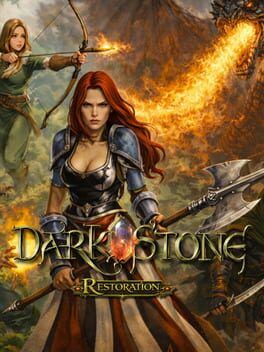

Darkstone Restoration has a free demo and a Steam page, but players should treat the project as a hands-on compatibility and design check before wishlisting.
Image: IGDB
Store links: Darkstone Restoration on Steam
Darkstone Restoration’s demo is the strongest reason to pay attention
The most concrete hook for Darkstone Restoration right now is simple: PC Gamer points readers toward a free, “generous” demo for the restored version of the 1999 action RPG Darkstone. That matters because this is the kind of revival that needs to be felt rather than merely described. A store listing can promise restored compatibility, cleaner controls, and quality-of-life work, but an old school action RPG lives or dies on click rhythm, readability, pickup flow, and whether its older design grammar still feels deliberate on a modern PC.
The DarkStone Restoration Steam page is live, and the project’s own Patreon description says it brings the classic action RPG back to modern PCs with “improved stability, compatibility, controls, readability, and quality-of-life improvements” while preserving the spirit of the original game. RPGWatch’s IndieWatch feed uses the same description and frames the project as having been released into Early Access. Taken together, the public materials point to a restoration built around access and usability rather than a full reinvention.
That creates a useful tension for prospective players. Darkstone Restoration is selling a return to a 1999 hack-and-slash structure, not a modern seasonal action RPG treadmill. PC Gamer’s framing is blunt about the appeal: before action RPGs leaned into ladders and DLC cycles, Darkstone was a game where players clicked enemies until they died. The Darkstone Restoration demo is therefore the right first stop, especially for players who remember the Diablo-era cadence fondly but want to know whether this specific restoration respects their time in 2026.
What the free demo actually lets players evaluate
The available source material does not list the demo’s exact length, character options, dungeon scope, save-transfer support, or build ceiling. That is an important limit. PC Gamer calls the Darkstone Restoration demo generous, but the supplied text does not specify how much of the campaign or progression structure it contains. For a buyer’s-guide reading of the demo, the safer claim is that it gives players a no-cost way to test the restoration’s stated priorities before committing a wishlist slot or eventual purchase.
Those priorities are unusually practical. The Patreon page names stability, compatibility, controls, readability, and quality-of-life improvements. Each one is a meaningful category for a late-1990s action RPG. Stability and compatibility decide whether the restoration is a viable modern PC release instead of a nostalgia project that still fights the operating system. Controls decide whether combat feels intentionally direct or simply dated. Readability decides whether players can parse rooms, loot, enemies, and interface feedback without leaning on memory. Quality-of-life changes are the most delicate part, because they can sand down friction while also changing the tempo that older RPG fans are actually returning for.
That is the work the demo should do for you. Do not treat it only as a taste of Darkstone Restoration gameplay. Treat it as a systems audit. Click through combat long enough to judge targeting, pickup behavior, camera comfort, UI legibility, and how quickly the game communicates progression. If the demo’s loop feels clean, the restoration’s pitch becomes much easier to believe. If the interface or combat feedback bothers you early, the old-school appeal is unlikely to compensate later unless the developers continue tuning it through Early Access.
The appeal is specific: Diablo-era directness without the modern treadmill
PC Gamer positions the project directly toward players who miss “straightforward action RPGs of the past,” and that framing is more precise than a generic nostalgia label. Darkstone comes from a moment when the genre’s pleasures were immediate and tactile: move through spaces, hit enemies, collect gains, and slowly convert repetition into character strength. The supplied PC Gamer excerpt describes the 1999 original as a hack-and-slash where “you clicked on things until they died,” which is reductive in the way genre fans often mean affectionately. It identifies the core contract: combat input, reward, survival, repeat.
For Diablo-era action RPG fans, that directness can be refreshing precisely because modern action RPGs often arrive wrapped in live-service expectations, seasonal resets, event calendars, and expansion planning. The source material does not say Darkstone Restoration will avoid all post-launch additions, nor does it detail the full business model. What it does confirm is that the stated restoration goal is preservation with usability improvements. That distinction gives the project a different promise from a new loot platform chasing endless retention.
From a progression-focused RPG perspective, the key question is whether Darkstone Restoration preserves enough friction to make character growth meaningful. Old action RPGs often rely on sparse feedback, uneven difficulty spikes, and limited convenience to make small gains feel substantial. Modern quality-of-life work can improve that experience, but it can also flatten the decision-making if every rough edge is treated as a bug. The best outcome for this kind of restoration would be one where players can understand the systems faster without being pushed through them faster.
Steam presence and Early Access reporting leave practical questions open
The DarkStone Restoration Steam listing confirms the project’s presence on Valve’s storefront, and the Steam URL gives it a clear place for wishlisting and demo discovery. Patreon describes the target as modern PCs. RPGWatch’s IndieWatch headline says Darkstone Restoration has been released into Early Access, which is a meaningful signal for expectations: players should assume ongoing development unless the Steam page itself says otherwise at the time they visit it.
The source material available here does not confirm a final release date, final price, supported languages, Steam Deck status, controller support details, system requirements, save compatibility between demo and full version, or the full launch scope. Those omissions should shape how cautious players approach the Darkstone Restoration Steam page. A demo can answer feel and compatibility questions on your machine, but it cannot answer every production question unless the store listing or developer updates provide those details.
There is also a platform gap in the reporting. The public descriptions supplied here point to modern PCs and Steam, but they do not confirm console versions or other PC storefronts. If you are interested in playing outside Steam, there is no supported claim in the provided sources that such options exist. For now, the responsible reading is that Steam is the visible storefront and PC is the confirmed target language in the project pitch.
What to check before you wishlist
Before adding Darkstone Restoration to your Steam wishlist, start with the demo and check the areas the restoration explicitly claims to improve. Stability is first. A restored action RPG has to run consistently through repeated combat, area transitions, and inventory use. If you encounter crashes or severe hitching in the demo, that is worth weighing heavily, even if the Early Access label suggests future patches may arrive.
Controls are next. Old-school action RPG combat depends on trust: when you click, move, attack, or interact, the game has to respond in a way that feels legible. If the demo makes you fight the cursor, camera, or interface, the rest of the progression loop will inherit that annoyance. Readability deserves the same scrutiny. Look at how easily you can identify threats, navigate space, distinguish interactable objects, and understand what a new item or stat change is doing. The Patreon page specifically names readability as a restoration target, so it is fair to judge the demo against that promise.
Finally, check how the quality-of-life changes affect your own tolerance for older RPG pacing. Some players want restoration work that keeps the older game almost intact. Others want friction reduced enough that the original design can breathe on modern displays and operating systems. Darkstone Restoration’s own pitch says it aims to preserve the spirit of the original while improving usability. The demo is the best available test of whether that balance works for you.
A restoration worth watching, with limits clearly marked
Darkstone Restoration is appealing because its public pitch is restrained. The confirmed claims are about bringing a classic action RPG back to modern PCs with stability, compatibility, controls, readability, and quality-of-life improvements. PC Gamer’s coverage adds that there is a free demo and frames it as a strong recommendation for players who miss simpler action RPG design. RPGWatch reports the project as released into Early Access. Those are enough reasons for genre fans to investigate, but not enough to treat the full release as a known quantity.
The safest recommendation is to use the Darkstone Restoration demo as your decision point rather than relying on nostalgia for the 1999 original. If you want an old school action RPG built around direct clicking, immediate combat, and a restoration-first philosophy, it belongs on your radar. If you need confirmed final pricing, full release timing, controller specifics, Steam Deck status, or platform expansion, those details are not established in the supplied source material and should be checked on the Steam page or developer channels before purchase.
For completionist-minded RPG players, the most promising sign is that the restoration’s stated goals focus on the unglamorous parts that determine whether a long campaign remains playable: stability, controls, readability, and quality-of-life. The unanswered question is scope. The Darkstone Restoration gameplay shown through the demo can tell us how the old design feels today. The full project still has to prove how well that feel holds over the length of an action RPG progression arc.