
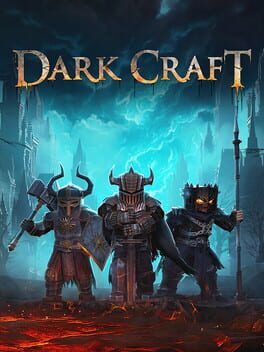
A closer look at Dark Craft, the new indie MMORPG that wants to be the first true Soulslike MMO with Minecraft-style block worlds, live game masters, and free-to-play monetization.
Dark Craft is stepping onto the scene with a pitch that sounds almost too big for a small indie: a free to play MMORPG that claims to be “the first Souls-like MMO,” set in a Minecraft-style block world and overseen by live game masters. Developed by Kazakhstan-based Take Top Entertainment, previously focused on mobile titles, the game has quietly appeared on Steam with a trailer and a laundry list of ambitious promises.
Soulslike combat as the core MMO loop
At the heart of Dark Craft is its attempt to graft Soulslike combat onto a persistent online world. The Steam pitch focuses on tactical, stamina based fighting and boss centered progression. Players are meant to explore an open world of ruined castles, crumbling temples, and monster filled wilderness while engaging in deliberate one on one style duels against enemies.
In theory that means manual dodging, blocking, and timed attacks, closer to Dark Souls or Elden Ring than the hotbar based rotations of traditional MMORPGs. The trailer leans heavily on methodical melee clashes and ominous boss introductions, positioning boss hunts as the primary cooperative activity. The MMO layer sits on top of this, so your journey through these Soulslike encounters is shared with other players and framed around guilds, group runs, and contested areas.
The catch is that the footage shown so far looks rough. Animations are slow and stiff, and combat flow appears choppy rather than weighty. That does not mean the core idea is doomed, but it does suggest Dark Craft has a long way to go before it can sell the precision and impact players expect from anything calling itself Souls inspired.
A blocky, Minecraft inspired world
Where Dark Craft diverges from most Soulslikes is its world style. The landscapes are presented with blocky, voxel like terrain that immediately calls Minecraft to mind. Massive cubic cliffs, stepped plains, and chunky structures form the backbone of the environment, while characters, armor, and weapons lean in a more traditional dark fantasy direction.
The result is a visual mashup that feels like Dark Souls was reconstructed on top of a Minecraft server. It is not clear yet how deeply the block nature of the world ties into gameplay. The Steam description currently reads more like a traditional MMORPG with exploration and boss runs, not a full on sandbox where players mine, craft, or reshape the land in the way Minecraft or Terraria allow.
If the blocks are mainly an art direction choice, then Dark Craft risks feeling like it is borrowing Minecraft’s look without capturing its systemic depth. On the other hand, if Take Top eventually layers in meaningful building, destructible terrain, or player made structures, the game could land closer to survival sandboxes like Valheim, V Rising, or Core Keeper, but with persistent MMO trappings.
MMO structure, guilds, and PvP
Dark Craft presents itself clearly as an MMORPG with a shared open world, not just a co-op Soulslike. Players are promised the ability to roam the world alone or with others, join guilds, fight in PvP, and pursue some form of territorial or social dominance as they “prove [their] right to reign supreme.”
Guilds appear central to the social structure. Although fine details are not spelled out yet, the emphasis on group boss hunting, contested zones, and player versus player combat suggests guilds will function as the backbone for organizing raids and PvP groups. Whether this develops into full territory control, sieges, or guild owned structures is unknown, but the tone of the marketing nods toward competitive endgame goals.
PvP is listed as one of the primary modes, which opens the door to Soulslike style invasions, duels, or open world skirmishes layered on top of the boss hunt loop. In practice, balancing high lethality, timing based combat with large scale MMO PvP is notoriously tricky. Games like New World and Albion Online have wrestled with the tension between skill based combat and the chaos of many players on screen, so Dark Craft will have to prove it can keep fights readable and responsive while still feeling punishing in the Soulslike sense.
Live game masters and a “dynamically controlled” world
One of Dark Craft’s boldest claims is that its virtual world will be “dynamically controlled” by live game masters. The Steam page describes a team of GMs shaping events and scenarios, echoing the earliest days of MMORPGs when staff would appear as monsters, trigger invasions, or orchestrate story arcs directly inside the game.
In a modern context this is a highly ambitious and expensive promise. Hand run events demand staff time, coordination across time zones, and robust tools. Large studios with established MMOs often struggle to sustain GM led content in a meaningful way, so a relatively small indie outfit committing to this raises eyebrows.
If Take Top can deliver even a lightweight version of frequent, reactive GM driven happenings, Dark Craft could differentiate itself from more static, theme park style survival MMOs. Dynamic story events, world changing catastrophes, or impromptu boss appearances would fit nicely with the game’s harsh, Soulslike tone. If the system ends up being little more than occasional announcements and small tweaks, though, the feature may feel more like marketing language than a defining pillar.
Free to play and “chance based” monetization
Dark Craft is planned as a free to play title, supported by in game purchases and what the developers call “chance based in game purchases.” That phrase all but confirms some form of lootbox or gacha style system.
For a PvP heavy MMO with competitive boss hunting, that choice immediately raises questions about pay to win pressure. The developers have not yet detailed exactly what those purchases will contain, how powerful they will be, or whether they are limited to cosmetics and convenience. The lack of clarity is concerning because free to play MMORPGs that lean on random rewards often end up selling power, shortcuts, or rare gear that unbalance PvP and trivialize progression.
The best case scenario is a monetization model closer to Path of Exile or Warframe, where spending accelerates access or offers flashy cosmetics but does not undercut the core challenge. The worst case is closer to mobile gacha MMOs where drop rates, limited time draws, and competitive gear systems heavily incentivize constant spending. Given Take Top’s background in mobile games, genre watchers will be paying close attention to which path Dark Craft takes.
Ambition versus execution
Viewed as a whole, Dark Craft’s feature list is almost startling in scope for an indie studio. It wants to be a Soulslike. It wants to be a full MMO. It wants to evoke Minecraft’s look. It wants live GMs. It wants a big, free to play audience. On paper that reads like a dream project, but every piece of it is hard to get right on its own, let alone all together.
Current footage and marketing copy suggest that execution has not yet caught up to ambition. The trailer is visually choppy and lacks the polish, animation clarity, and sound design that make Soulslike combat feel satisfying. The heavy borrowing from Dark Souls, down to names and character designs that mirror Patches, Alva, and Artorias, makes the project feel more derivative than inventive at this early stage. Minecraft inspired terrain further reinforces the sense of a collage of familiar ideas.
At the same time, the willingness to combine these influences into a persistent MMO space with live moderation hints at genuine enthusiasm for older styles of virtual worlds. If the systems underneath can support emergent encounters and meaningful social structures, Dark Craft might yet appeal to players who miss the days when GMs dropped into your zone to stir up trouble.
Trend chasing or something distinct?
Stacked against the current wave of survival and sandbox MMOs, Dark Craft looks like it is straddling the line between trend chasing and carving out its own niche.
On the trend side, it clearly borrows from some of the biggest and most marketable names in gaming. Soulslikes remain wildly popular, Minecraft’s aesthetic and block based worlds are instantly recognizable, and free to play PvP MMOs are a proven way to chase scale. The art direction and explicit Dark Souls references are so close that they risk overshadowing any original identity the game might have.
Compared to titles like Enshrouded, Valheim, Conan Exiles, and Nightingale, Dark Craft’s surface layer feels familiar. Many survival MMOs already mix melee focused combat, dark fantasy ruins, and co-op exploration in procedurally generated or voxel based worlds. Games like Mortal Online 2 and New World have also promised more skillful, hit scan or action heavy combat in large scale online settings.
Where Dark Craft could stand apart is in the particular combination of features it is aiming for. A fully persistent MMORPG that leans into deliberate Souls style duels and boss fights, wraps them in a blocky world, and promises live GM control is still relatively rare. Most survival MMOs either stop at smaller scale co-op servers or focus on crafting and building rather than boss centric raid play. Few attempt to formally marry Soulslike combat, Minecraft style landscapes, and old school GM storytelling in a single package.
Right now the game reads more like a patchwork of trends with a nostalgic twist than a fully realized, distinct identity. Its uniqueness will depend less on the influences it cites and more on how strongly it commits to specific systems. If the developers double down on precise, responsive combat, truly impactful GM events, and meaningful player agency in shaping the world, Dark Craft could move beyond “Dark Souls in a Minecraft world” and become something that stands out in the survival MMO crowd.
Until then, it remains a wishlist curiosity. The pitch is undeniably intriguing, but the burden of proof is on Take Top Entertainment to show that Dark Craft is more than a collage of popular ideas and that its ambitious systems can survive contact with real players in a live online world.