
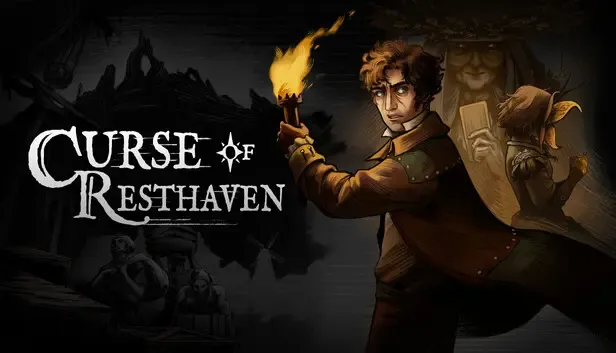

Curse of Resthaven locks its true ending behind three timeline conclusions. Here is what is confirmed, how to approach loops, and whether your PC or Mac is ready.
Image: readygame.com
The true ending is confirmed, but the route is deliberately wider than one loop
Curse of Resthaven’s fourth ending is not reached by solving the island’s central mystery once. According to Hilltop Studios game director Scott Christian, writing on Xbox Wire, players must explore three different timelines and reach all three conclusions before the fourth, true ending unlocks.
That is the key confirmed requirement for the Curse of Resthaven true ending. Christian’s wording is direct: “Solving the mystery is just the first step. You’ll soon discover there are three different timelines to explore, and only by reaching all three conclusions will you unlock the fourth, true ending.” HappyGamer also highlighted that structure in its Oct. 31 report, framing the true ending as a reward hidden behind the three timeline conclusions.
The tension for players is that the sources do not provide a step-by-step route through each timeline. That appears intentional. The available material confirms the shape of the endgame, not the checklist inside it. Resthaven is built around a repeating six-day catastrophe, with Ambrose arriving as the island’s new governor, watching the colony fall, then waking again on the morning of his arrival as the only person who remembers what happened.
For anyone searching for a Curse of Resthaven guide, the practical answer is simple but demanding: do not assume the first complete explanation of the island is the finish line. The true ending requires all three timeline conclusions. Until those conclusions are reached, the fourth ending remains locked.
The six-day loop turns knowledge into your main survival tool
Curse of Resthaven is structured around pressure rather than reflex combat. Christian describes the game as a mix of narrative adventure, trading sim, deckbuilder, and roguelike systems. WindowsForum similarly describes it as a hand-drawn, single-player narrative roguelite built around town management, interrogation, and card-based expeditions.
That combination matters because Ambrose does not simply restart empty-handed. The island resets every six days, but, according to Xbox Wire, players keep what they learn. TechTimes reports that every reset also grants a permanent gain, either through a Boon Card from the island’s fading goddess or an upgrade to Ambrose’s governing capacity or investigative reach. Those gains are presented as part of the loop’s engine, giving each failed or incomplete run a purpose.
Christian’s advice on Xbox Wire makes the intended rhythm clear. Players should talk to everyone, then return after learning more. Residents have motivations, grudges, and secrets, and what they tell Ambrose can depend on what he already knows, which topics he brings up, and what has happened during the current loop. The journal is also described as a tool that can signal when a person should be asked about something again.
In survival terms, information is the lantern. Resthaven’s horror is not only in the thing that arrives at the end of six days, but in how little time Ambrose has to understand a town full of people before the dark closes over it again.
How to think about the three timelines without spoiling the mystery
The confirmed Curse of Resthaven three timelines structure means players should treat the game less like a single mystery board and more like three overlapping cases. Each timeline conclusion appears to represent a different branch of the island’s larger truth, with the fourth ending functioning as the final synthesis once all three are complete. That interpretation follows Christian’s statement that the true ending unlocks only after reaching every conclusion, but the exact contents of those conclusions have not been detailed in the provided sources.
The safest early strategy is to resist trying to optimize one perfect six-day run. The game is explicitly built for repetition, accumulated knowledge, and altered conversations. If a resident refuses to help, Christian says players may need to learn more before approaching them again. Information from one person can open a topic with another, and interrogation topics can advance quests or uncover clues elsewhere.
That suggests a strong practical pattern. Use early loops to map people, systems, and dependencies. Use later loops to pursue specific timeline conclusions once you understand which clues unlock which conversations. If one path stalls, shift attention to residents or locations that changed after a new discovery. Resthaven’s structure rewards revisiting, not brute-forcing.
Players aiming for the true ending should also be careful with assumptions. A first ending may answer one version of the island’s curse, but the developer’s own framing says that is not enough. The fourth ending is confirmed to sit behind all three conclusions, so completion-minded players should expect to see the credits of multiple branches before the game acknowledges the larger resolution.
Cards replace combat, but pressure still comes from resources and timing
TechTimes describes Curse of Resthaven as a gothic mystery where cards replace combat, and the available descriptions support that reading. The game is not presented as an action horror title. Instead, the dread comes from governing a doomed island, managing an economy, questioning residents, and pushing into the wilderness before time runs out.
Christian’s Xbox Wire post says trading should not be treated as a side activity, because Ambrose’s role as governor connects the colony’s condition to the investigation. Although the provided excerpt cuts off before the full explanation, the broader mechanical description from Xbox Wire and WindowsForum makes clear that town management and trading are part of the core loop rather than optional flavor.
That is important for players coming in for the horror. Resthaven’s survival pressure appears to be civic and investigative. You are not simply conserving ammunition in a corridor. You are spending days, attention, clues, cards, and governing capacity while the island’s destruction waits on the calendar. The enemy design described in the sources is atmospheric rather than mechanical, with TechTimes saying something older rises from the wilderness every six days and destroys everything.
The audio and theatrical side of the game may also matter to how that pressure lands. Christian notes that before making games he spent fifteen years as a composer and conductor in Toronto, mainly in theatre, and says that background informs Hilltop’s focus on character, timing, and dramatic reveals. For a time-loop mystery, the timing of a reveal is a survival mechanic in its own right.
Platforms, price, and what is actually confirmed about launch
Curse of Resthaven launched on Steam on Oct. 29, 2026, according to HappyGamer. TechTimes reported on Oct. 30 that the game had launched across PC, Mac, PlayStation 5, and Xbox Series X|S, and listed the price at $19.99. Christian’s Xbox Wire post, published Oct. 30, links to the Xbox store page and presents the game as available to Xbox players.
Taken together, the provided sources support availability on PC, Mac, PS5, and Xbox Series X|S. They do not provide evidence for a Nintendo Switch version, last-generation PlayStation or Xbox versions, or mobile releases. If you are checking platform compatibility, stay with the listed platforms rather than assuming broader availability from the phrase “all platforms” in TechTimes’ report.
There is also some source noise around the system requirements. Gamepur has a guide page for Curse of Resthaven system requirements, but WindowsForum says Gamepur’s own spec lists are repeated and garbled in places. WindowsForum instead follows what it calls Steam’s cleaner rendering of the Windows and Mac requirements. For PC buyers, that means the Steam listing, as relayed by WindowsForum, is the cleanest requirements source in the provided material.
Windows PC requirements are light, except for the recommended GPU jump
The Curse of Resthaven PC requirements are modest on the baseline side. According to WindowsForum’s report on Steam’s listing, the Windows version requires a 64-bit processor and operating system, with 64-bit Windows 10 or 11, a 3.0 GHz quad-core CPU, 8 GB of RAM, DirectX 11, and 4 GB of available storage.
For minimum graphics hardware, Steam lists a GeForce GTX 750 Ti or Radeon RX 460, according to WindowsForum. That is a low entry point by modern PC standards, fitting a hand-drawn narrative roguelite rather than a high-end 3D horror production.
The recommended tier is where players should pay attention. WindowsForum says the recommended Windows specs are identical to minimum in operating system, processor, memory, DirectX, and storage, but the graphics card jumps to a GeForce GTX 1080 Ti or Radeon RX Vega 64. That is a much wider GPU gap than the rest of the requirements would suggest.
The sources do not explain what visual settings, resolution, or frame-rate target the recommended GPU is meant to support. So the practical guidance is this: if your machine meets the minimum CPU, RAM, and DirectX requirements but has an older low-end GPU, the game is at least within the listed entry range. If you want headroom, especially at higher resolutions or with fewer compromises, the recommended GPU line is the spec to compare against. The storage requirement, at 4 GB, is small either way.
Mac players have a clear path, especially on Apple Silicon
Mac requirements are also listed separately. WindowsForum reports that Steam’s minimum Mac specs call for macOS 12 Monterey, an Intel i5 from the fifth generation or newer, 8 GB of RAM, Intel Iris graphics, and 4 GB of storage. The recommended Mac tier moves to macOS 13 Ventura with an M1 chip for both processor and graphics, while keeping the same 8 GB memory and 4 GB storage requirements.
That means older Intel Macs are not automatically excluded, but the recommended target is clearly Apple Silicon. If you are on an M1 or later Mac with macOS 13 or newer and at least 8 GB of memory, the provided requirements place you on the safer side of the listing. If you are on an Intel Mac, the key checks are operating system version, CPU generation, Intel Iris graphics, and available storage.
WindowsForum’s article is framed around checking compatibility before spending money, and that is the right mindset here. Curse of Resthaven is not described as a hardware-heavy game, but the split between minimum and recommended graphics on Windows, plus the Apple Silicon recommendation on Mac, makes it worth checking your system before buying.
For true-ending hunters, that readiness check matters. This is a game about repeated loops, returning conversations, and pursuing all three timeline conclusions before the final ending opens. The less time you spend fighting your hardware, the more attention you can give to the colony’s whispers, the journal’s nudges, and the dreadful arithmetic of six days running out.