

Crusader Kings 3 By God Alone is out with the free CK3 Crozier update, reshaping religion through playable theocracies, rites, heresies, spiritual fulfillment, and a Great Schism arc.
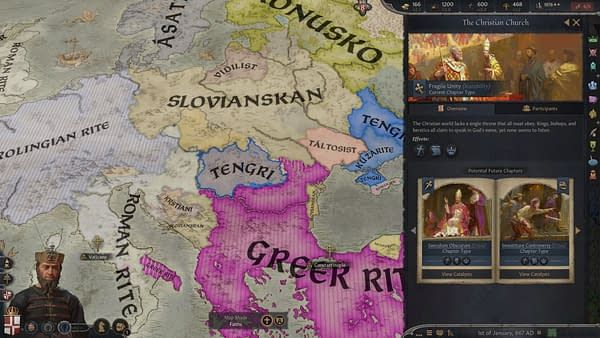
Image: bleedingcool.com
By God Alone is out, but the free patch is the real first stop
Paradox has launched Crusader Kings III: By God Alone alongside the free 1.20.0 “Crozier” update, according to the publisher’s September 30, 2026 announcement carried by Games Press and the public Steam News listing for Crusader Kings III. The paid expansion is the headline item because it adds playable religious rulers, including the Papacy, but the immediate tension for returning players is that the free CK3 Crozier update rewires the religious layer underneath everyone’s campaign.
That distinction matters. By God Alone sells the fantasy of taking the church into your own hands. Crozier changes the rules by which faiths fracture, leaders punish, rulers justify themselves, and religious institutions accumulate power. If you have bounced off Crusader Kings 3 in the past because religion felt like a mostly static menu of bonuses, this is the part of the update cycle worth watching even before you decide whether to buy the Crusader Kings 3 expansion.
The confirmed package, as described by Paradox and reported by PCGamesN, focuses on playable theocracies, a Christian religion-wide “Situation,” the Great Schism in the 867 start, the return of the College of Cardinals, and deeper systems for rites, heresies, excommunication, holy orders, holy sites, antipopes, and character-level spirituality. That is a dense list, but the strategic point is simple: religion is being moved closer to CK3’s core power economy.
Religion now has internal pressure instead of one stable identity
The most important free-system change is the introduction of rites and heresies. PCGamesN reports that Crozier adds rites as distinct traditions within a faith, each with its own head. A faith still has a main rite, but other rites can drift away far enough to be considered heretical and split into a new faith. Heresies can also break out when a faith’s religious fervor falls too low.
That is a major shift for campaign planning because faith identity is no longer defined only by the player’s chosen doctrine package and the slow spread of county conversion. It now has an internal stress model. Rites can compete. Distance from the center can become politically meaningful. Low fervor can create instability. The likely strategic result, based on the confirmed mechanics, is that large realms will have to think about religious cohesion in the same way they already think about succession, vassal contracts, culture, and legitimacy.
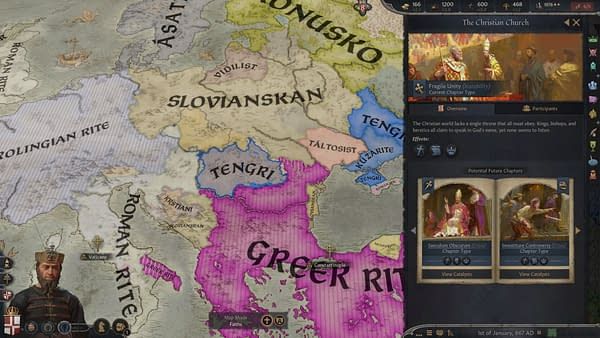
Rock Paper Shotgun’s hands-on account gives the best picture of how this plays out in the Christian setup. In its preview campaign, Christianity is broken into multiple rites before the Great Schism: a Roman Rite in the west, a Greek Rite in the east, a Carolinginian Rite to the north, and smaller Christian strains across the map. The outlet describes these groups as sharing a broader religious framework while competing for followers and authority. In play, that means neighboring Christian realms may be close enough to recognize each other, but different enough to become rivals inside the same religious story.
For lapsed players, that is the key adjustment. Old CK3 habits often treated religion as a settled opening condition unless the player deliberately founded a custom faith. Crozier appears designed to make religious divergence a recurring campaign force. You are no longer only asking whether your duke can afford a pilgrimage or whether your king can convert a county. You are asking whether the faith itself can hold its center.
The paid expansion turns the church into a playable political machine
By God Alone adds the feature players have asked about since CK3 launched: playable theocracies. Paradox’s press release says the expansion lets players control landed realms headed by an archbishop or the Pope himself. PCGamesN similarly reports that the DLC lets players step into the Papacy and play as theocratic or ecclesiastical rulers.
That changes the viewpoint of a CK3 campaign. A feudal ruler uses faith as one pillar of legitimacy, marriage law, casus belli access, vassal management, and succession engineering. A religious ruler sits inside the institution that grants or denies some of that legitimacy. Paradox’s own description frames the expansion around clerical power, saying players can manipulate tenets of faith to expose and weaken rivals, make rulers or priests into puppets, or advance heresies for personal power.
The Papacy is the sharpest version of that fantasy. Rock Paper Shotgun played as a succession of Popes and described a campaign shaped by appointing cardinals, building grand Romanesque cathedrals, and going on pilgrimage. The outlet also notes that papal succession is not like normal dynastic succession: each Pope is elected from a trio of top cardinals rather than replaced by a youthful heir from the player’s bloodline. That alone changes the tempo. Instead of grooming a child over decades and protecting inheritance, theocratic play appears to push attention toward institutional positioning and the quality of the clerical bench.
The expansion also brings back the College of Cardinals from Crusader Kings 2, according to PCGamesN. For veteran Paradox players, that is a meaningful signal. CK2’s religious politics often derived drama from the fact that church hierarchy had its own machinery. By God Alone is aimed at bringing that institutional friction into CK3’s character-first model, where a bishop is also an ambitious person, a useful administrator, a theological problem, or a rival waiting for the right doctrine to become a weapon.
The Great Schism becomes a campaign arc, not a footnote
Paradox confirms that the 867 start can lead Christianity toward the Great Schism, separating Western Catholicism from Eastern Orthodoxy. PCGamesN reports that By God Alone presents the Christian Church as a religion-wide Situation moving through seven chapters, with Papal Bulls and periodic Ecumenical Councils among the DLC systems. Games Press says players can participate in Ecumenical Councils to decide religious tenets and beliefs.
The practical effect is that the schism is being treated as a developing strategic crisis rather than a background date. Rock Paper Shotgun’s preview describes the religious climate moving through different stages before the split, with religious actions and events contributing to what comes next. In one stage, the outlet says the church can exist in fragile unity. In another, crusading becomes more rewarding. In another, mass conversion takes priority. Elsewhere, reformers receive more favorable conditions to reject or rearrange clergy-backed order.
That stage structure is important because it gives religious gameplay a campaign rhythm. CK3 can sometimes flatten long historical pressures into one-off decisions. A Situation, by contrast, gives the designers a container for escalation, reaction, and consequence. If the seven-chapter structure works as described, the schism should create windows where different strategies become optimal: consolidate doctrine, push conversion, exploit holy war momentum, or prepare for an institutional break you cannot stop.
Rock Paper Shotgun’s account also supplies a useful caution. Its preview included an amusing bug in which a Pope had multiple wives who divorced him at the moment of schism. That is a reported preview anecdote, not a confirmed feature and not evidence that every campaign will produce similar chaos. It does, however, underline the technical risk of the design. CK3’s strength is that character law, faith law, marriage rules, succession, AI behavior, and event scripts all collide. A religion expansion touches almost every one of those systems.
Crozier’s character changes may matter as much as the church map
The free Crozier update does not only add religious geopolitics. PCGamesN reports that it adds a per-character “spiritual fulfillment” score measuring how well a character lives up to their own beliefs. Virtuous actions raise it, sinful actions lower it. Characters can also hold personal beliefs alongside the central tenets of their faith.
That is exactly the kind of CK3 system that can reshape the meta quietly. A ruler’s public faith already mattered through opinion, doctrine, available decisions, and piety. Personal belief and spiritual fulfillment add another layer: characters can be judged against the faith’s rules while also carrying their own convictions. For a strategy player, the interesting question is whether this becomes a meaningful constraint on optimal play or another resource to be gamed. The confirmed design points toward a more granular moral economy, where the best political move may create spiritual costs for the person making it.
Excommunication has also been reworked. PCGamesN says the system now has a scaling piety cost, with ways to mitigate that cost and the ability for religious leaders to appeal to heads of faith for absolution. In older CK-style play, excommunication could feel binary: either a devastating status or a button gated by opinion and piety. Scaling cost suggests Paradox wants punishment to sit inside an economy rather than exist as a simple on-off tool.
For returning players, this is where old instincts may mislead. If you previously ignored piety until you needed a holy war, a divorce, or a new faith, Crozier appears to make religious capital more active. Piety cost, fulfillment, personal belief, and rite stability all point toward a game where “sin” is another balance sheet. The stronger players will be the ones who can decide when to pay that cost openly and when to build institutions that make the cost cheaper.
Holy orders, holy sites, and antipopes widen the religious economy
Crozier also changes the institutional side of religion. PCGamesN reports that holy orders have been redesigned and separated into monastic orders and military orders, each with its own government type, patron, and leadership. The update adds actions such as asking specific people to take vows and join the clergy or a monastic order, bestowing temple holdings on an order, and demanding a child for the cloister, which can remove that child from succession.
That last detail is small but strategically explosive. CK3 is a succession game before it is anything else. Any tool that can redirect children away from inheritance changes dynasty management, realm stability, and vassal politics. A cloister demand is not only religious flavor. It is a way to turn family structure into institutional bargaining, assuming the rules and AI responses give it enough weight in live play.
The holy site changes are similarly broad. PCGamesN reports a new, higher “eminent” holy site tier, usually capped at three, while faiths can now recognize up to nine holy sites in total. The same report says players can create holy sites in places where one previously existed. Crozier also adds the ability to declare one of your clerics an Antipope and use a casus belli to try to establish your chosen rite as the mainline rite for the faith.
There is one scope note buyers should watch. PCGamesN describes the holy order redesign as part of the free Crozier update, while Paradox’s press release also lists “Monastic Holy Orders” among the features of By God Alone. Those statements may refer to overlapping free and paid components, but the provided source material does not fully separate which exact holy order options require the DLC. If monastic play is your purchasing trigger, verify the live store description or in-game availability before assuming every order-related feature is free or paid.
Should lapsed CK3 players return now or wait?
If you already own Crusader Kings III, the strongest reason to reinstall is the free CK3 Crozier update. The confirmed free systems, as reported by PCGamesN, touch rites, heresies, excommunication, spiritual fulfillment, personal beliefs, holy orders, holy sites, antipopes, and related religious actions. That is enough to change ordinary campaigns even without buying By God Alone.
The strongest reason to buy the Crusader Kings 3 By God Alone expansion is narrower but clearer: you want religious rulers to be the campaign, not a supporting cast. Playable theocracies, the Papacy, the Christian Situation, Papal Bulls, Ecumenical Councils, the College of Cardinals, and the 867 Great Schism arc are the paid expansion’s confirmed pillars across Paradox’s announcement and PCGamesN’s report. If your favorite CK3 stories come from feudal marriage webs, border wars, and dynastic inheritance, Crozier may be enough at first. If you want to steer church politics directly, the expansion is built for that.
There are unanswered practical questions in the supplied material. The sources confirm availability on September 30, 2026 through Paradox’s announcement and Steam News, but the provided excerpts do not include a price, console availability, performance notes, or system requirement changes. They also do not establish how every overlapping free and paid religious feature is partitioned in the live build.
Community reaction, from the supplied Reddit thread around Paradox’s feature highlight video, shows a familiar CK3 divide. Some commenters express excitement for the changes while acknowledging that the DLC does not cover every desired corner of medieval church history. Others push back on expecting CK3 to model every niche ecclesiastical detail. That is the right lens for By God Alone. It is not a complete simulation of medieval Christianity. Based on the confirmed feature set, it is an attempt to make faith behave like a living strategic institution, with rules that can fracture, punish, absolve, enrich, and destabilize a realm over centuries.