

Why horror fans who love Resident Evil should not sleep on Crisol, a Spanish folklore shooter where every bullet is paid for in blood and smart achievement hunting makes the sacrifice sting less.
If you have ever hoarded handgun rounds in Resident Evil until the credits rolled, Crisol: Theater of Idols is designed to make you sweat. Vermila Studios’ first-person horror shooter takes the familiar rhythms of Capcom’s series and twists them around a single brutal idea: your ammo is your health. Every shot you fire is literally a piece of Gabriel’s lifeblood.
For horror fans sitting on the fence, that sounds punishing, but recent achievement guides and the game’s Xbox Series X|S release paint a different picture. Crisol is less a hardcore pain simulator and more a modern survival horror that wants you to engage with its systems, not bounce off them. If you understand how blood sacrifice, difficulty and achievements line up, the island of Tormentosa becomes a tense but manageable pilgrimage rather than a brick wall.
A Resident Evil-style nightmare wrapped in Spanish folklore
Crisol opens like a classic survival horror. You arrive in a cursed settlement, stalked by impossible creatures and hemmed in by locked doors, heavy gates and cryptic religious puzzles. Structurally it borrows from Resident Evil: narrow streets that fold back on themselves, shortcuts that open later, key items that gate entire wings of the map, and a stalker enemy that can crash your quiet moments.
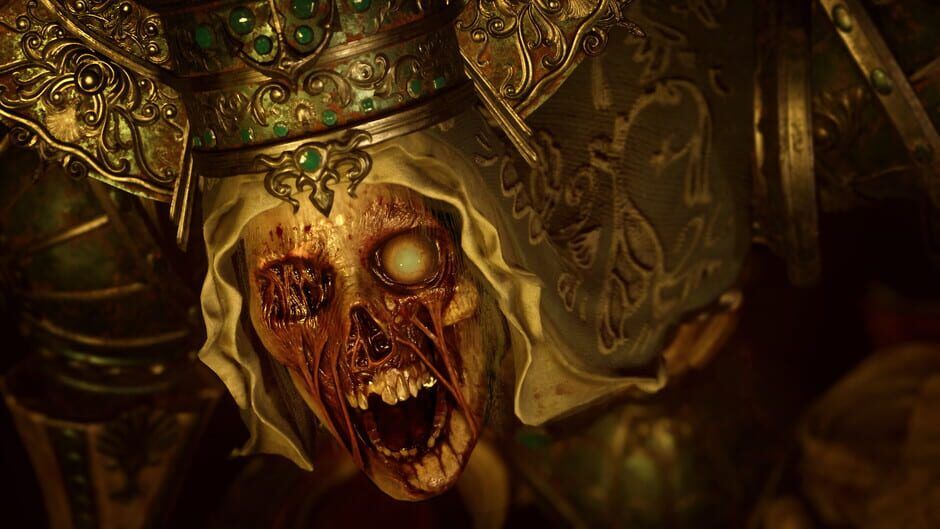
What sets it apart is the distinctly Spanish Catholic horror running through everything. Tormentosa is a nightmarish reimagining of Spain, full of crumbling baroque churches, seaside reliquaries and processional streets lined with idols. Saints and martyrs loom from every wall, their carved eyes following you into courtyards soaked in candle wax and dried blood. The main conflict between the Sun and Sea cults gives the story a folk-tale quality, like you have walked into an apocryphal legend where the gods are both very present and dangerously absent.
Even the basic enemies underline that cultural twist. The Astiados, named after splinters, are not standard zombies. They are jagged wooden figures studded with nails and thorns, animated more like cursed statues than living bodies. You do not aim for the head. You chip away legs, arms and torsos, turning them into crawling torsos that still drag themselves over cobblestones. Bigger set-piece enemies made of stone, wax and twisted cherub forms feel like half-forgotten saints and votive figures torn from church walls and turned into weapons.
The end result feels familiar in pacing and structure to modern Resident Evil, but soaked in a very different religious and regional flavor. If Village’s Eastern European fairy tale was your thing, Crisol’s Iberian nightmare scratches a similar itch.
Your blood is your ammo, your currency and your biggest horror set piece
Crisol’s blood mechanic is not just a gimmick. Every time you reload, Gabriel drains his veins into the gun. Your health bar drops and your damage potential rises in the same instant, which keeps even basic encounters tense. The usual survival horror problem of ending a chapter with a small arsenal you never used largely disappears. If you want to feel safe, you must fire, but firing is exactly what makes you unsafe.
The clever part is how the game lets you buy that power back. Syringes act as standard healing items, but the world is scattered with blood fountains and animal corpses you can harvest. These grisly refills sell the horror fantasy of sacrifice while giving you reliable ways to restock. The Sun God mission pushing you forward is framed through this self-harm mechanic. You are not just killing monsters. You are constantly asked how much of yourself you are willing to spend for each narrow victory.
On top of that loop, Gabriel’s blood fuels supernatural abilities. Reading memories off stained objects or replicating items turns blood into a narrative and puzzle-solving tool rather than a straight combat tax. The best moments come when an achievement nudges you toward using those powers in risky ways: draining yourself low to see one more vision in an otherwise quiet area, or pushing your luck to duplicate a rare resource.
Achievements that reward smart sacrifice instead of mindless grinding
The achievement list for Crisol ties directly into its sacrificial theme. You still get the expected story milestones for finishing chapters and surviving the prologue, but plenty of unlocks ask you to lean into the blood system.
There are achievements for making knife kills, which means deliberately fighting up close to save blood ammo or finishing off crawling Astiados with steel instead of another shot. Speed-focused achievements challenge you to complete the story within a tight runtime, which forces mastery of when to spend blood and when to sprint past threats. Difficulty-related unlocks and completionist goals, like mopping up collectibles and secrets, demand a steady understanding of Tormentosa’s layout so you are not bleeding yourself dry in dead-end alleys.
The important thing for newcomers is that many of the achievements are designed around learning Crisol’s language rather than suffering through extreme punishments. You can clear the campaign on lower settings and still tick off a large portion of the list while building familiarity. Then a second run on a higher difficulty with tighter resource use becomes a purposeful challenge rather than an opaque ordeal.
Playing it like Resident Evil, not a twitch shooter
Despite the first-person perspective, Crisol behaves more like Resident Evil than a modern FPS. Enemies move with deliberate menace, soak up damage and hit hard when they reach you, but they are not bullet-sponge arena bosses meant for constant circle-strafing. The game wants you to pick your fights.
Shooting legs out to slow Astiados is more efficient than burning health on a panicked barrage. Corridors, alleys and stairs are your allies, letting you funnel enemies into narrow lanes. There is a stalker figure in Dolores who will follow you through spaces, just like Mr. X or Nemesis, but evasion and routing matter more than crack aim. Achievement runs that focus on speed or limited healing push you to read the town like a maze and plot safe, bloody-efficient lines between objectives.
This pacing makes it an easy sell for horror fans who loved Resident Evil 2 remake or Village but hesitate around fast shooters. Crisol rarely demands pixel-perfect headshots or constant bunny-hopping. It asks for planning, restraint and a tolerance for being slightly under-healed almost all the time.
Settings and difficulty recommendations for new horror pilgrims
Thanks to robust options, Crisol can be tuned toward classic horror tension or something closer to an exploratory story mode. If you are stepping into Tormentosa for the first time, this setup hits a sweet spot that respects the horror without overwhelming you.
Start on the standard difficulty. This keeps enemies dangerous and the blood economy meaningful, but it does not require frame-perfect execution. The early chapters teach the basics of limb-shot prioritization, knife usage and environmental awareness without locking you into fail-state loops.
Turn on any aim assist or snap-to-target options that the console offers, especially on Xbox. Since you are often trying to pick specific limbs under pressure, even mild aim assist keeps the system readable instead of frustrating. Stick with default brightness unless you are struggling to read the environment; Crisol relies heavily on shadow and candlelight for atmosphere, but its level design is clear enough that a modest bump in brightness will not ruin the mood.
If there are granular options for damage taken or healing efficiency in your version, bias them slightly in your favor for a first run. The core tension comes from the choice to reload and bleed, not from dying to every missed dodge. Once you understand how generous blood fountains and refills really are, you can notch difficulty up on subsequent playthroughs to chase the more demanding achievements.
How to approach achievements on your first run
For your first pilgrimage through Tormentosa, treat achievements as suggestions about how to play rather than strict goals. Focus on story completion trophies, basic combat milestones and anything tied to discovering areas or reading key notes. That will naturally teach you where safe routes are, how often you can realistically rely on knife finishers and how far you can push low-health aggression.
If you are curious about the speed-oriented or high-difficulty achievements, read those descriptions but do not aim for them yet. Instead, mentally note sections where backtracking felt heavy or where you lost time in puzzles so that a later, more focused run can go smoother. Crisol’s notebook system usually contains critical puzzle hints. Making a habit of checking it prevents the kind of stalled progress that can ruin both your nerves and your blood reserves.
A second run is where you can combine all that knowledge with more aggressive settings. Raise the difficulty, accept tighter margins on health and treat blood fountains as checkpoints to sprint between. That is where the game transforms from a tense guided tour into something closer to a personal gauntlet of sacrifice, and where the most satisfying achievements unlock.
Why Crisol is worth the leap for horror fans
Crisol: Theater of Idols is not trying to reinvent horror wholesale. It stands firmly in the shadow of Resident Evil, with familiar pacing, backtracking and stalker threats. What makes it worth your time is how completely it commits to its central idea of blood as both weapon and burden, and how that idea is reflected in its achievements, level design and folklore-heavy storytelling.
If you have been waiting for a modern horror game that feels mechanically grounded like classic Resident Evil but different in flavor from the usual American or Eastern European settings, Tormentosa is a haunting detour. Go in on standard difficulty, embrace the discomfort of bleeding for every bullet and let the achievement list guide you toward bolder, riskier play.
The idols of the Sun and Sea demand sacrifice. In Crisol, learning how much of yourself to give is the whole point.