
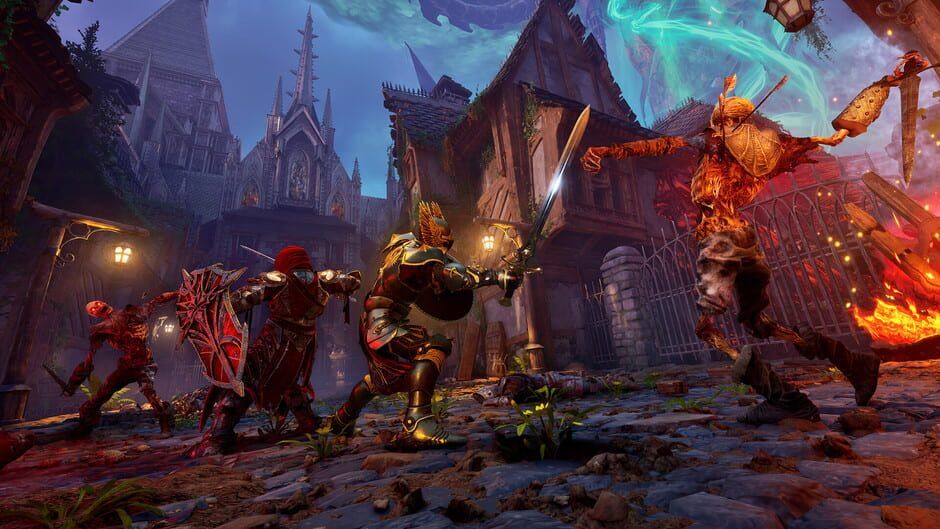

A deep dive into Crimson Moon, the newly revealed gothic action RPG for PS5, covering its angel‑and‑demon mythos, expressive combat, city‑hub structure, and how its co-op focus could set it apart from Bloodborne, Lords of the Fallen, and Remnant 2 when it launches in 2026.
Crimson Moon First Look: Gothic Co-op Hunts Under Dead Gods
Crimson Moon arrived at PlayStation’s State of Play with an instantly readable pitch: a gothic action RPG about violent angels, dead gods, and a cursed city that needs to be taken back one burning ward at a time. It is headed to PS5 in 2026, and on trailer evidence alone it is already angling for the same shelf space as Bloodborne, Lords of the Fallen, and Remnant 2.
Where those games lean fully into eldritch horror, high fantasy, or gun‑slinging multiverse weirdness, Crimson Moon blends all three across a mythic battleground of angels, demons, and ancient gods, while making drop‑in co‑op a core selling point rather than a side feature.
A Nephilim in the crossfire of angels, demons, and dead gods
The trailer frames Crimson Moon’s world as a three‑way collision. On one flank are gleaming but ruthless angels, on another the clawed masses of a demonic Infernal Legion, and towering above them both are the broken remnants of ancient gods whose wars left the city of Gildenarch choking under a supernatural curse.
You step into that mess as a Nephilim, a human‑angel hybrid bound to the Order of the Crimson Moon. The trailer lingers on this duality. One moment your hunterlike figure moves through rain‑slick streets and crumbling cathedrals like a wary mortal; the next, luminous wings and halo‑bright sigils flare as you trigger “angelic arts” that freeze, lift, or shatter the undead flooding tight alleyways.
The enemies showcased run the gamut from ragged undead and feral vampires to armored demon knights and towering abominations stitched from cathedral stone and infernal metal. Visually it feels closest to Bloodborne’s plague‑ridden Yharnam, but with a stronger theological bent: statues of forgotten gods loom over plazas, angelic script crawls along the edges of arenas, and the sky is permanently bruised by the glowing red moon that gives the game its name.
The trailer hints that the Order of the Crimson Moon is not entirely benevolent. NPCs shown around the hub eye your Nephilim with a mix of reverence and fear, and the powers you wield look as corruptive as they are holy. It sets up a tone that is less “pure servants of heaven” and more “weaponized miracles forged in a losing war.”
Fast, improvisational combat that wants you in the thick of it
Combat in Crimson Moon looks closer to aggressive action RPGs than slow, shield‑up Soulslikes. Encounters play out as dense waves of enemies closing in from multiple angles, with the player darting through them using quick dodges, snap‑parries, and wide‑arcing weapon arts.
The developers call it “improvisational, expressive combat,” and the footage backs that up. You are not walking carefully down a corridor for single‑enemy duels. Instead, the game drops you into arenas where undead climb over walls, vampire shock troops divebomb from rooftops, and elites stride through fire with heavy, telegraphed attacks that anchor each wave.
Parries and finishers are a visible backbone of the system. Several clips show last‑second deflects that launch enemies into stagger states, followed by brutal execution moves that scatter nearby foes or restore a chunk of health. Timing appears generous enough to encourage risk‑taking, with animation flourishes that reward players who want to live on the edge rather than turtle up.
Layered on top are angelic arts and transformations. Angelic arts function like short‑cooldown abilities: a radial blast that suspends enemies in mid‑air, a spear of light that pins demons to cobblestones, a barrier that absorbs an incoming wave before detonating outward. Transformations look like limited windows where your Nephilim sheds their human restraint, gaining spectral wings, extended combos, or ranged beams that carve gaps through dense packs.
The trailer text and previews all stress that enemy waves will adapt to your tactics. Though we do not see systemic counterplay spelled out moment by moment, we do get glimpses of different wave compositions reacting to the same player moves: dive‑bombing fliers approaching from blind spots after repeated ground slams, shield‑bearing cultists stepping in to block the most frequently used abilities, and ranged casters hanging further back when players lean on close‑quarters burst.
If the final game delivers on that promise, Crimson Moon could sit somewhere between Lords of the Fallen’s methodical boss corridors and Remnant 2’s frantic shooter arenas, but translated into a melee‑first format that keeps you constantly re‑routing through the mob.
Build variety hinted through holy steel and corrupted light
Early footage naturally keeps exact numbers and talent trees out of sight, but there are several encouraging hints of build variety.
Weapon diversity is the first clue. Across the State of Play trailer and subsequent clips, we see:
Heavy greatswords crackling with red lunar energy, cleaving through undead ranks in slow but devastating arcs.
Slim rapiers and paired blades enabling rapid step‑ins and step‑outs, often coupled with riposte‑heavy parry play.
Large warhammers and flails that knock enemies sprawling, ideal for controlling crowds before triggering area‑of‑effect angelic arts.
The same weapons appear with different visual effects across separate shots, suggesting elemental or thematic attunements like sanctified, lunar‑cursed, or infernal‑tainted variants. Combined with the explicit mention of forging new gear at the Sanctus Clypeus blacksmith, Crimson Moon seems set up for loadouts that meaningfully change your role.
Angelic arts appear modular too, slotted like active abilities rather than hard‑wired to weapons. Some builds in the trailer lean on defensive tools, raising shields of light or projecting wards that slow enemies. Others commit to full aggression, chaining a dash uppercut into a mid‑air combo and then detonating a sigil beneath the landing point to blow up the pack.
Transformations likely sit at the top of this build pyramid. There are moments where the Nephilim sprouts blazing wings for a brief rampage, another where their silhouette elongates into something almost demonic, with claws of light raking through elites. This suggests players will be able to skew their character toward more angelic or more corrupted interpretations of power, potentially mirroring stat allocations that favor survivability, burst damage, or crowd control.
The mention of “experience and mastery” as progression pillars implies you will not just be chasing raw numbers but also unlocking new routes through that kit. Think of Bloodborne’s trick weapons combined with Remnant 2’s archetype skills: fewer, more expressive building blocks that encourage experimentation rather than spreadsheet min‑maxing.
Sanctus Clypeus: a war table hub for a living city
Instead of a pure open world, Crimson Moon uses a structured city‑hub format anchored by Sanctus Clypeus, your home base. The hub is built around a literal War Table, a large tactical map of Gildenarch where districts light up as the Infernal Legion pushes in or is pushed back.
From here you launch expeditions into specific wards of the city. Each mission appears to be a self‑contained incursion: you descend from the safety of the Order’s sanctum into rain‑lashed streets, fight through layered waves of enemies, and eventually confront either a mini‑boss or some form of district climax, like destroying a demonic idol or reclaiming a church.
The War Table evolves as you progress. Early clips show only a handful of pins on the map; later shots are crowded with new markers, branching quest chains, and icons that pulse with red light to indicate escalating threats. Preview text suggests that as the Infernal Legion advances in the background, new high‑risk missions unlock and previously conquered districts can fall back into danger, giving the city a low‑key campaign‑map feel instead of a static level select.
Around the hub, traditional RPG functions slot into the gothic order aesthetic. The Blacksmith stands before a shrine of broken weapons and angel feathers, handling both gear upgrades and the forging of new armaments. Other hinted stations include a chapel for blessing or corrupting gear, an archive where lore and contracts are collected, and potential co‑op matchmaking points where your Nephilim can prepare for joint incursions.
Taken together, Sanctus Clypeus positions Crimson Moon closer to Remnant 2’s Ward 13 than to Bloodborne’s Hunter’s Dream. It is less an ethereal dreamspace and more a practical command center for an ongoing war, with the map of Gildenarch acting as a living record of your campaign.
Solo hunts or co‑op crusades
One of Crimson Moon’s most important hooks is that every mission from the War Table can be played solo or in co‑op with friends. That detail alone creates a different expectation than traditional Soulsbornes, where co‑op often feels like an optional bonus layered on top of fundamentally solitary adventures.
Structurally, Crimson Moon looks built around repeatable sorties. Dynamic difficulty scaling and shifting enemy compositions are tasked with making each run feel different. In a single district, you might first encounter standard undead packs and a mid‑tier vampire captain as a solo player, then return later in co‑op to find additional elites, altered spawn timings, or entirely new wave patterns tuned for multiple Nephilim working in tandem.
The combat design shown so far seems comfortable with this. Wide‑angle attacks, crowd control abilities, and clear telegraphs make sense in arenas where two or three players are all firing off angelic arts. There are several shots where multiple Nephilim channel different colored sigils at once, suggesting that builds can synergize, stacking buffs, stuns, and damage zones for devastating combos.
If the adaptive wave system is as reactive as advertised, co‑op teams who lean too heavily on one approach might see the Legion reshuffle its deck mid‑war, forcing them to rethink roles. That could give Crimson Moon a long‑tail replay value similar to Remnant 2’s adventure rerolls, where the same zone can surprise you across multiple nights of play.
How Crimson Moon stacks up to Bloodborne, Lords of the Fallen, and Remnant 2
From a distance, Crimson Moon immediately invites comparisons. It has Bloodborne’s rain‑soaked streets and clerical monstrosities, Lords of the Fallen’s holy war lens on Soulslike structure, and Remnant 2’s emphasis on replayable runs and dynamic encounters. The question is where it might meaningfully diverge.
Compared to Bloodborne, Crimson Moon looks less about oppressive dread and intricate, intertwined level design, and more about set‑piece arenas, forward momentum, and overt spectacle. Bloodborne’s brilliance lives in its slow discovery of shortcuts and the quiet horror of its transformations. Crimson Moon instead foregrounds a visible holy war between factions, leaning into flashy angelic powers and big wave clear moments, with the War Table structure making each outing feel like an operation rather than a pilgrimage.
Alongside Lords of the Fallen, the overlap is thematic. Both revolve around orders of holy warriors fighting against encroaching darkness, with a focus on punishing melee combat. However, Lords of the Fallen presents a sprawling, interconnected world with a dual‑realm mechanic, and its co‑op is more conventional and less central. Crimson Moon narrows its focus to a single cursed city under siege, carving it into discrete districts you continually revisit, and building its identity around replayable missions and scaling encounters tailored for multiple players.
Remnant 2 is perhaps the closest philosophical neighbor. Both games are built around hubs, repeatable excursions, and adaptive enemy setups. Where Remnant 2 leans into third‑person firearms and randomization across dimensions, Crimson Moon commits to melee‑first combat in a single, highly curated gothic metropolis. Its mythic angle, with angels and ancient gods as much a part of the landscape as demons, could give it a sharper narrative throughline and a stronger sense of place than Remnant’s hop‑between‑worlds structure.
The co‑op emphasis is also a clear separator from Bloodborne and Lords of the Fallen. In those games, playing with others often feels like bending systems that were primarily designed for solitary suffering. Crimson Moon, at least from this first look, seems engineered so that a pair or trio of Nephilim carving a path through Gildenarch is the default fantasy rather than an optional twist.
A promising hunt beneath the Crimson Moon
Pre‑release footage can only tell us so much, and there are still big unknowns. We do not yet know how deep its progression systems go, how varied its mission templates will be after dozens of runs, or whether the adaptive waves will offer genuine counterplay rather than simple stat bumps.
What is clear is that Crimson Moon has a strong initial identity. A cursed city trapped between angels, demons, and dead gods. Fast, expressive combat that wants you dashing headlong into crowds. A war‑room hub that reframes a gothic action RPG as an ongoing campaign rather than a straight march from area to area. And a co‑op backbone that invites you to bring friends along for the ride rather than suffer alone.
If ProbablyMonsters can weld those pieces into a cohesive whole, Crimson Moon could carve out a spot in the crowded Soulslike‑adjacent space when it launches on PS5 in 2026, offering something familiar yet distinct for players who want their grim hunts to feel like a full‑scale holy war.