
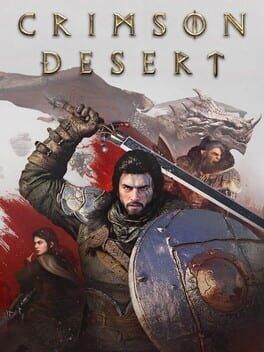

With Crimson Desert going gold well ahead of launch, Pearl Abyss is positioning its brutal new epic as a huge, single-player-focused RPG that steps out of Black Desert’s shadow and aims straight at Red Dead Redemption 2–scale ambition.
Crimson Desert has officially gone gold, and the timing alone says a lot about what Pearl Abyss thinks it has on its hands. Locking in the March 19, 2026 release across PS5, Xbox Series X|S, and PC almost two months in advance is not just a production milestone, it is a statement of confidence for a game the studio is positioning as a massive, single-player-driven open-world RPG distinct from its MMO roots.
This is the same company that turned Black Desert into a long-running live-service success, but Pearl Abyss has been careful to frame Crimson Desert as something different. Instead of a shared online sandbox, this is a story-led adventure centered on Kliff, a weary Greymane mercenary making his way across the war-torn continent of Pywel. The studio keeps repeating that this is a true single-player action RPG first, with any online features clearly secondary to the core campaign. For players who bounced off Black Desert’s MMO grind but admired its tech and combat, Crimson Desert is being pitched as the answer.
Scale is central to that pitch. Pearl Abyss is openly inviting comparison to some of the genre’s biggest heavyweights, describing Pywel as larger than Red Dead Redemption 2’s already sprawling frontier and at least twice the size of Skyrim’s open world. Those are bold reference points for any studio, let alone one making its first major push into a primarily single-player epic. It suggests a world built not just for lateral distance, but for vertical exploration and density, from rugged plains and fortified cities to strange floating islands that hide puzzle-focused encounters high above the battlefield.
The team is not betting everything on size alone. What they keep showing is a world that leans into variety and spectacle. Kliff will traverse Pywel on horseback and on foot, but also with late-game mechs that double as mounts, turning certain encounters into stomping, iron-clad brawls. Combat sequences against mechanical dragon-like bosses push the game toward set-piece territory more commonly associated with big-budget action games than traditional fantasy RPGs. One moment looks like grounded melee, the next veers into wrestling-style grapples layered over elemental magic, all in real time.
This blend of systems is where Crimson Desert tries to distinguish itself from its closest comparison points. Where Red Dead Redemption 2 was methodical and simulation-heavy, and Skyrim leaned into flexible but straightforward combat, Pearl Abyss is chasing something punchier. Their heritage in responsive, combo-heavy MMO combat is clearly bleeding into Kliff’s toolkit. Trailers showcase weapon swaps, aerial juggles, environmental kills and contextual finishers that would not look out of place in a character action game, framed inside a sprawling RPG template that promises dozens upon dozens of factions and regions to tangle with.
At the same time, Pearl Abyss is clear that this web of factions is there for flavor and world-building more than heavy branching narrative. Reports from previews and marketing beats emphasize that your relationships across Pywel color the journey but do not radically alter the ending. That puts Crimson Desert closer to a cinematic, curated RPG structure where the appeal lies in how you get through the world rather than in a matrix of divergent finales. For players, that should translate into a focus on moment-to-moment combat encounters, bespoke side stories and discovery rather than agonizing over missable “true endings.”
Going gold this early has practical implications that RPG fans are already picking up on. Pearl Abyss and its partners have talked about sending review code roughly a month before launch, with marketing reps half-joking that critics will need that much time simply to see enough of the game. That lengthy lead time is often reserved for enormous, confident releases where publishers want deep-dive coverage instead of rushed impressions. It also buys Pearl Abyss room to polish the inevitable day-one patch while console certification and disc production wrap up in the background.
For players hungry for a new blockbuster RPG, the March window is significant. With no new mainline Elden Ring or Witcher on the immediate horizon and Starfield firmly in the rearview for most, Crimson Desert aims to be the next big world you disappear into for dozens of hours at a stretch. Landing on PS5 and Xbox Series with PC on day one positions it as a platform-agnostic tentpole, the kind of release that can dominate conversation across console communities for weeks if it delivers. At a full $69.99 price point, Pearl Abyss is making it clear it sees Crimson Desert as a peer to the very games it is being compared against.
Perhaps the most important thing, though, is how sharply Pearl Abyss is trying to separate Crimson Desert from Black Desert in players’ minds. There is no subscription, no expectation of logging in daily to keep up. Instead the studio talks about a brutal, hand-crafted journey through Pywel that begins and ends with Kliff and his allies, built on top of the studio’s technical strengths in world-building and combat animation. If it can match even part of Red Dead Redemption 2’s sense of place while maintaining the kinetic combat and wild spectacle it keeps teasing, Crimson Desert could be the rare pivot that lets an MMO studio step fully into the single-player spotlight.
With development locked and the countdown to March 19 underway, all that is left is to see whether Pearl Abyss’s ambition translates into an RPG that can stand shoulder to shoulder with its inspirations. For now, players on PS5, Xbox Series, and PC finally have a firm date circled on the calendar for a brutal new frontier to ride into.