
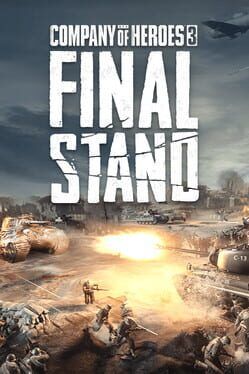

Company of Heroes 3: Final Stand turns Relic’s tactical RTS into a standalone roguelite wave-defense game. Here is how its waves, perks, co-op decisions, and faction progression change the return pitch for lapsed players.
Image: IGDB
Store links: Company of Heroes 3: Final Stand on Steam
Final Stand makes Company of Heroes 3 smaller, sharper, and riskier
Company of Heroes 3: Final Stand is now positioned as a standalone PC release on Steam, rather than a traditional add-on that requires the base game. Relic Entertainment announced it as a roguelite wave-defense game for solo and cooperative play, with Gematsu reporting a July 29 launch on PC via Steam and quoting the Steam overview’s promise of escalating waves, bosses, dynamic battlefield events, and persistent progression.
That standalone framing is the first real shift. Final Stand takes a series built around territory, timing windows, cover, tech decisions, and map control, then compresses those instincts into a survival format where the core question is blunt: can your headquarters live through 12 waves? The Company of Heroes 3 Final Stand pitch is not about replacing the campaign or the ranked ladder. It is about asking whether the best 10 minutes of a CoH match, the desperate defense, the panicked AT reposition, the off-map strike that ruins a plan, can carry an entire mode.
The answer, based on reported impressions from Rock Paper Shotgun and PCGamesN, is that the mode succeeds when it forces ugly tradeoffs. Rock Paper Shotgun described a late-wave British defense where six-pounder anti-tank guns looked perfectly placed against incoming Tigers, only for Luftwaffe strafing runs to scatter the gun crews and collapse the line before the armor reached the HQ. PCGamesN, in its review, describes the same broad structure as “bite-sized” RTS action where randomized units and abilities after each wave shape the army you are allowed to build. Taken together, those accounts make Final Stand sound less like a casual horde mode pasted onto CoH3 and more like a pressure test for the series’ oldest skills: cover discipline, combined arms, threat reading, and recovery after a bad engagement.
The 12-wave structure changes the value of every Company of Heroes habit
Traditional Company of Heroes rewards territory control because fuel, munitions, victory points, cutoff pressure, and timing attacks all pull against each other. Final Stand removes much of that wider strategic layer. According to the Steam overview quoted by Gematsu, each run is built around 12 increasingly difficult rounds, with bosses and dynamic battlefield events. The CompanyofHeroes3.wiki guide similarly describes Final Stand as stripping away the strategic map and ranked ladder in favor of defending a position against escalating enemies.
That does not make the decision tree shallow. It changes where the decisions sit. In a normal match, a bad tech choice can be softened by map control, harassment, or forcing an opponent to answer a flank. In Company of Heroes 3 wave defense, the enemy arrives on schedule, and the HQ’s survival is the hard fail state. Rock Paper Shotgun’s account of the twelfth wave captures that shift clearly: the writer had the correct broad answer to heavy armor, but the Luftwaffe event punished attention drift, forced anti-tank guns to move, and created the opening that let Tigers roll through.
For returning players, that is the central adjustment. Final Stand appears to value layered redundancy over elegant single-answer builds. One anti-tank line is strong until aircraft, smoke, a boss ability, or a side approach makes it late to fire. Infantry in heavy cover can buy time until armor ignores them and heads for the HQ. A medium tank can plug a hole until it meets late-wave heavies and evaporates. The mode’s design, as described across the sources, pushes players away from a perfect build order mentality and toward contingency planning.
That is a healthy fit for Company of Heroes’ tactical grammar. The series has always been at its best when the player is managing imperfect tools under time pressure. Final Stand simply removes the quieter stretches between crises.
Roguelite progression turns faction identity into a draft problem
The most important mechanical change is the run draft. Gematsu’s Steam-page overview says players construct a custom battlegroup from the ground up, choosing randomized units or abilities after each wave that persist for that run. Rock Paper Shotgun reports that early British options can be stark, with the faction starting from a weak position such as engineers and a slow anti-tank gun before expanding through wave rewards. PCGamesN describes being offered choices like an anti-tank squad or stronger anti-infantry troops early, then later passive benefits such as extra healing or automatic reinforcements, plus active tools including strafing runs and naval bombardments.
That structure makes Company of Heroes 3 Final Stand a roguelite mode in a practical, tactical sense rather than a cosmetic one. You are not simply gaining more power. You are being asked to draft coverage. If your early rewards lean into anti-infantry, a tank wave can expose the hole. If you overcorrect into anti-armor, enemy infantry can slip through lanes and overwhelm the HQ before your heavy weapons matter. PCGamesN’s review emphasizes this push and pull, noting that enemy infantry can squeeze through gaps when there are not enough bodies to react.
The more interesting layer is persistent progression between runs. Relic’s overview, via Gematsu, mentions faction-specific progression trees with perks and unique abilities unlocked between attempts. The CompanyofHeroes3.wiki guide says players earn progression currency and upgrade faction trees between runs, and Rock Paper Shotgun describes taking home perk points after a successful match. That gives Final Stand two economies: the short economy of wave rewards inside a run, and the long economy of faction investment.
As a strategy player, I see the risk and the promise in that split. The promise is long-term mastery. British, US Forces, Wehrmacht, and Deutsches Afrikakorps can grow into distinct defensive toolkits, encouraging players to learn faction-specific solutions instead of chasing a single universal build. The risk is balance drift. If persistent upgrades become too mandatory, early runs may feel under-tooled and higher difficulties may be balanced around grind rather than decision quality. None of the supplied sources prove that problem exists at launch, but it is the design tension to watch as the meta settles.
Co-op turns lane defense into a communication check
Final Stand is confirmed for solo and cooperative play in Relic’s announcement as reported by Gematsu, while the CompanyofHeroes3.wiki guide and DLCompare both specify two-player co-op. That matters because wave defense changes dramatically when responsibility can be divided. A solo player has to cover every approach, reposition every support weapon, queue every reinforcement, and read every event marker. A co-op pair can specialize, but only if both players understand what the other is covering.
The obvious split is by lane or by damage profile. One player can anchor infantry and machine-gun control while the other handles anti-armor reserves, mines, repairs, or mobile reaction forces. But Final Stand’s randomized reward structure complicates that. If one player’s draft produces anti-infantry tools and the other also draws anti-infantry tools, the team may need to improvise against armor rather than follow a pre-match plan. If one player receives a strong off-map ability, timing it becomes part of the shared economy. Burning a bombardment to clean up wave seven may cost the team the answer it needed for wave nine.
This is where Final Stand could become a stronger returning-player mode than a standard comp-stomp. CoH veterans already know the pain of two players floating resources while each assumes the other has the answer. In a 12-wave structure, that communication failure is immediate and visible. The HQ dies. The run ends. You keep whatever persistent progression the mode allows, then try to solve the draft more cleanly next time.
For players deciding whether to come back, co-op is likely the cleanest entry point if they have a reliable partner. It lowers the execution load without removing the tactical pressure. For random matchmaking, if supported in practice beyond the general co-op listing, the quality will depend on how clearly Final Stand communicates lanes, boss threats, and event warnings. Rock Paper Shotgun’s missed strafing markers are a useful warning: if one experienced RTS player can lose a run because their attention is elsewhere, two uncoordinated players can absolutely blame each other for the same collapse.
Bosses, events, and difficulty levels are the replayability bet
Relic’s Steam overview, quoted by Gematsu, lists 36 boss units with special abilities and rewards, 18 dynamic in-game events, eight difficulty levels, five battlegrounds, and Endless Mode. The CompanyofHeroes3.wiki guide repeats those launch features and adds examples of events such as Goliath raids, smoke ambushes, and wave-to-wave surprises. Those numbers are the mode’s replayability argument.
The key question is whether those variables create strategic variety or simply more disruption. Rock Paper Shotgun’s Luftwaffe example suggests events can meaningfully change a battle by attacking player attention and formation integrity, rather than only adding spectacle. PCGamesN’s review says no two games felt quite the same, attributing that to faction differences, randomized offerings, enemy composition, and environment. That is the right formula for a Company of Heroes 3 roguelite mode: variation should force different cover use, weapon placement, and reserve planning, rather than only changing the icon on a modifier.
Difficulty scaling will decide how durable the mode feels. Eight difficulty levels give Relic a wide tuning range, from onboarding to veteran challenge, according to the Steam overview. Rock Paper Shotgun’s writer concluded, after being overrun by Tigers in a first Final Stand attempt, that a lower difficulty might have been wiser. That is a small anecdote, but it points to an important design principle. Final Stand should be allowed to punish arrogance, especially from players who know CoH’s systems but underestimate the mode’s pacing.
Endless Mode is the other long-tail feature. It gives the optimization crowd a place to stress-test builds after wave 12, but it also risks exposing dominant strategies faster than the standard mode. If one faction tree or one class of reward consistently outperforms the rest deep into endless runs, that will become the community’s benchmark. Relic’s ability to patch that economy will matter as much as any individual boss design.
Availability, pricing signals, and the return-player calculation
The confirmed platform story in the supplied material is simple: Gematsu reports that Relic announced Company of Heroes 3: Final Stand for PC via Steam. The Steam app ID cited by the CompanyofHeroes3.wiki guide is 4836540, and the Reddit listing excerpt also describes the Steam page as a standalone roguelite wave-defense experience for solo and cooperative play. No supplied source confirms console versions.
The purchase path is slightly more nuanced. Gematsu, quoting the Steam overview, says Final Stand does not require ownership of any previous Company of Heroes title. The CompanyofHeroes3.wiki guide says it is a separate purchase and lists approximate launch pricing of $29.99 USD, £23.99 GBP, and €28.99 EUR, with a launch discount and an additional bundle discount for existing CoH3 owners. Because that pricing claim comes from a guide rather than the provided Steam page scrape, buyers should verify current regional pricing directly on Steam before making a decision.
For existing CoH3 players, the practical question is whether Final Stand offers a reason to reinstall if the campaign or competitive ladder did not hold them. Based on the reported impressions, the strongest case is time shape. PCGamesN calls it a bite-sized side piece to campaigns and skirmishes, and its description of small-map wave defense suggests a cleaner session loop than a full multiplayer evening. If you like Company of Heroes combat but do not want ranked pressure, Final Stand appears built for that gap.
For new players, the standalone access is useful but not frictionless. The CompanyofHeroes3.wiki guide warns that horde modes punish poor cover use quickly and recommends learning CoH basics such as cover and combat first. That advice tracks with the impressions. Final Stand may be easier to buy than the full game, but it still expects you to understand why a squad in the open melts, why support weapons need arcs and protection, and why armor without screening becomes an expensive mistake.
My read is that Final Stand is most compelling for three groups: lapsed CoH3 players who want a lower-commitment tactical loop, co-op pairs who enjoy defensive planning, and RTS players who like roguelite drafting but still want real positioning. Players looking for a new campaign, a replacement ranked ladder, or a pure base-building horde game should be more cautious. The mode’s strength, as described by those who have played it, is that it preserves CoH’s tactical stress while changing the strategic wrapper around it.