

How a long‑gestating “search action” shooter folds deep weapon-building into side‑scrolling exploration, what the Clockwork Ambrosia rebrand says about scope, and why the new Steam demo feels like more than another Metroidvania pitch.
Clockwork Ambrosia is one of those names that has floated around indie circles for so long that it started to feel like vaporware. First teased as simply Ambrosia over a decade ago, Realmsoft’s steampunk passion project finally has a concrete Steam release window in April and, more importantly, a substantial new demo you can download right now.
After spending time with that slice, what stands out is not just that the game exists, but that it arrives with an identity sharpened by fourteen years of iteration. Clockwork Ambrosia is not trying to be the next Symphony of the Night clone. It is a side‑scrolling “search action” game that borrows the map structure and backtracking of Metroidvanias, then welds it to Metal Slug pacing and a Borderlands‑style obsession with weapon builds.
Fourteen years from Ambrosia to Clockwork Ambrosia
The project that is now Clockwork Ambrosia began life as Ambrosia, a far smaller, scrappier idea. Early footage focused on fast, almost arcade‑like shooting in tight stages. Over the years, the scope quietly expanded. The result is what the developers now describe as a fusion of metroidvania and 2D shooter. That shift is baked directly into the name.
The new title foregrounds the game’s clockwork‑steampunk setting and, more subtly, its emphasis on engineered systems. It signals that this is not a quick retro homage, but a world built around complicated machinery, nested subsystems, and deliberate cause and effect. Ambrosia sounded like a one‑off curiosity. Clockwork Ambrosia implies an entire intricate mechanism.
That tracks with the production history. Realmsoft has been iterating on the same core loop for well over a decade, through engine changes, art overhauls, and a gradual broadening of its ambitions. Partnering with OI Games gives the 2026 version a level of visible polish that would have been tough to imagine in the early days. Sprite work is sharper, animations are denser, and the soundtrack by Johnny Stixx wraps it all in a confident, unified tone.
In that sense the rebrand is less a marketing flourish and more a line in the sand. The old Ambrosia was a cool prototype. Clockwork Ambrosia is the finished machine.
What “search action” means here
Plenty of developers adopt the term “search action” as a polite synonym for Metroidvania. Realmsoft uses it in a more literal way. Clockwork Ambrosia retains the familiar loop of exploring an interconnected map, finding abilities that open new routes, and circling back to unravel secrets. But its fundamental rhythm feels closer to a side‑scrolling shooter than a stat‑driven action RPG.
In classic Metroidvanias, your combat growth is dominated by fixed upgrades: a new sword, a double‑jump, a handful of spells added to a mostly static toolkit. Clockwork Ambrosia, by contrast, treats progression as a set of open‑ended experiments. You play as Iris, an airship engineer stranded on the isolated island of Aspida, and every step of progression reinforces that identity. You are not looting ancient relics; you are fabricating machines.
The demo quickly hands you a broad but focused palette of weapon parts. Instead of discovering a single “missile launcher” that becomes your one heavy option for the next few hours, you unlock a family of components that can be recombined. The search is not just outward across the map, but inward through a space of possible builds.
That design philosophy is supported by the level structure. Rooms are not just combat arenas between traversal tests, or vice versa. They are small laboratories that quietly ask, “What if you tackled this layout with a spread cannon instead of a piercing rifle?” The pacing encourages you to revisit areas not only when you acquire a key ability, but when you decide to re‑engineer your approach.
Weapon‑building over loot chasing
If the overall structure is half Metroidvania, half side‑scrolling shooter, the heart of Clockwork Ambrosia lies in its weapon system. The demo makes a point of surfacing that immediately. Within the first stretch you are given access to six archetypal weapon frames and a sampling of the more than 150 mods touted in the press materials.
Each frame has a distinct baseline feel. One fires disciplined, straight‑line shots ideal for precision play. Another vomits a wide, short‑range spread that chews through crowds at the cost of range and ammo economy. There are slower, heavier frames built to anchor missile volleys, and twitchier, semi‑automatic shells tuned for rapid tap‑firing.
The magic happens when you start bolting on modifiers. Splitters turn single shots into multi‑projectile patterns that can fill half the screen. Missile batteries stack homing barrages on top of ordinary fire. Armor‑piercing rounds punch clean through shielded bots and environmental cover. Crucially, these are not flat numerical buffs. They often come bundled with trade‑offs in recoil, reload timing, heat buildup, or ammo drain, which forces you to consider the full behavior of a build instead of chasing the biggest damage number.
In practice, the crafting interface in the demo is quick and readable. You are never more than a couple of button presses away from swapping a core mod, and each change is reflected immediately both in stats and visually in the firing pattern. That ease of tinkering is important because the game clearly wants you to experiment in the middle of a run, not just min‑max in menus between sessions.
It is a different fantasy than the loot lottery of Borderlands. There is no deluge of color‑coded drops to sift through, no vendor trash. Instead, you accumulate a toolbox, then recombine its pieces in response to new threats and environments. It feels more like building a custom controller layout than picking up a marginally better gun.
Hands‑on with the Steam demo
The new Steam demo is substantial enough to establish how that design plays in motion. It drops you into a cross‑section of Aspida that includes surface ruins, a stretch of fungal forest, and a chunk of industrial underbelly, capped by a couple of boss encounters that double as build checks.
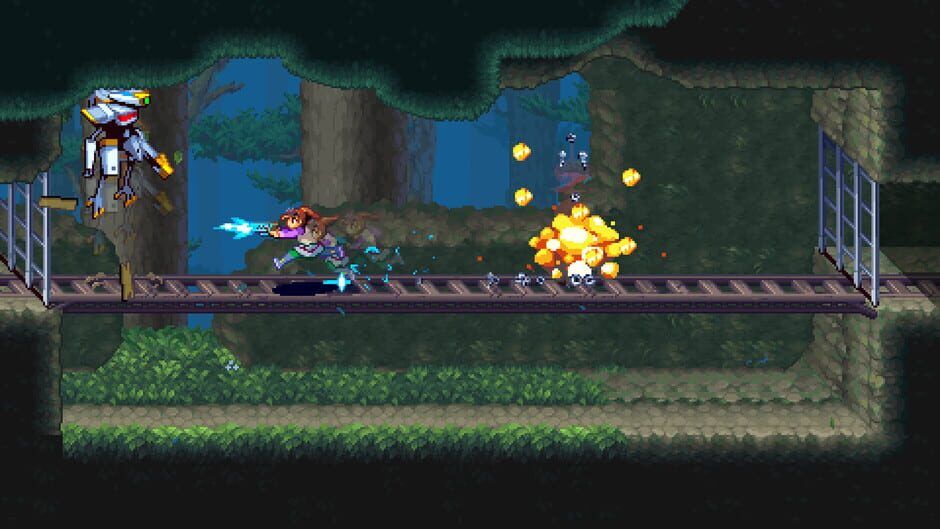
Combat has the clarity and snap you want from something compared to Metal Slug. Iris accelerates quickly, with short, punchy jumps and a midair control profile that feels closer to an action shooter than a floaty platformer. Shots connect with bright hit sparks and a satisfyingly chunky soundscape, and enemies telegraph their patterns with readable sprites and wind‑up animations.
Fights are rarely about memorizing boss‑length pattern scripts. Instead, they lean on overlapping projectile arcs and environmental hazards that reward you for picking the right tool. A corridor filled with shielded drones becomes trivial with a piercing rifle, but awkward if you are still using a short‑range spread. A boss that floods the screen with slow bullets encourages you to equip a mod set tuned for mobility and burst damage, letting you dip in and out rather than facetanking.
Build variety is the other major takeaway from the demo. Even within the limited part catalog on offer, it is easy to assemble wildly different playstyles. One run might center on a high‑recoil cannon that turns every shot into a mini rocket jump, sending you skidding backward as you dump damage into clustered bots. Another might favor a low‑damage, high‑rate rifle stacked with elemental procs that chew through armor over time.
Because crafting is quick, there is almost no friction to swapping roles. Before a boss, you can pivot from a crowd‑control build tuned for the previous corridor into a focused single‑target monster, then swap back afterward. The game’s systems clearly expect and encourage that kind of on‑the‑fly adaptation.
The map design backs all of this up. Rather than a sprawling, immediately intimidating super‑map, the demo presents a layered but legible chunk of Aspida. Shortcuts fold back into earlier hubs, gently teaching you the island’s geography while giving you chances to test new abilities on familiar ground. Side paths frequently hide optional combat challenges or chests that pay out additional crafting resources, tying exploration directly to your appetite for experimentation.
It is less about route‑remembering and more about route‑rethinking. You start to view old rooms as potential test ranges for a new gun configuration, not just connective tissue between the “real” content.
Where it sits in the pantheon of long‑gestating indies
Clockwork Ambrosia joins a very specific lineage of indie projects that spent a decade or more in the oven before finally solidifying into something concrete. Owlboy famously took nine years, evolving from a straightforward pixel platformer into a lavish storybook adventure. Iconoclasts gestated for around seven, reworking its tone and systems until it landed on a confident blend of puzzle design and boss‑centric action.
Those games share two traits that Clockwork Ambrosia seems poised to echo. First, time was used to chase a particular flavor of feel rather than feature creep. Owlboy’s flight controls and animation, Iconoclasts’ wrench‑centric mechanical puzzles and setpiece bosses, all benefited from years of quiet iteration. Clockwork Ambrosia appears to have spent its years fine‑tuning the conversation between aiming, movement, and build tinkering.
Second, each of those projects emerged with a voice distinct from its influences. Owlboy is not just a love letter to 16‑bit platformers, and Iconoclasts is more than a Metroid riff. In the same way, Clockwork Ambrosia does not read as “yet another Metroidvania with crafting.” The “search action” label fits because your curiosity is pointed as much at the edges of the system space as it is at the corners of the map.
If the full release can scale that tension across the rest of Aspida without drowning the player in parts or overcomplicating traversal, it could sit comfortably alongside those long‑gestating success stories. The demo already suggests a confident throughline: a tightly honed shooter wrapped in an exploratory shell, where your core verbs are not just jump and shoot, but tinker and iterate.
Why the demo matters
After fourteen years of slow, often opaque development, a playable demo does more than advertise a feature list. It proves that Clockwork Ambrosia is real, feels good under the fingers, and has a point of view about where Metroidvanias, shooters, and buildcraft can meet.
For players who bounced off loot‑driven shooters, the promise of focused, handcrafted weapon parts is enticing. For genre fans looking for something that respects the search and discovery of a Metroidvania without copying its exact moveset, Clockwork Ambrosia’s blend of side‑scrolling action and deliberate tinkering is an intriguing alternative.
The April launch will determine whether the full machine holds together. For now, the Steam demo is a surprisingly polished window into a game that has spent fourteen years rearranging its gears. It is worth stepping aboard Iris’s wrecked airship for an hour or two to see how that long journey is finally snapping into place.