
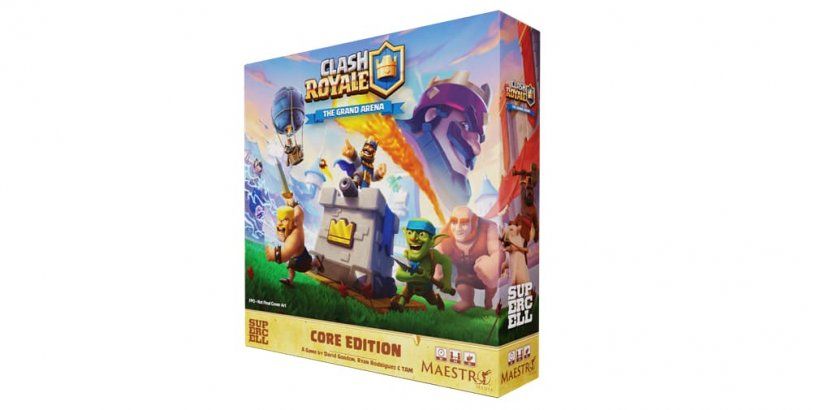

Supercell and Maestro Media are taking Clash Royale to Kickstarter with The Grand Arena, a tabletop adaptation built around lanes, Elixir, decks, Towers and Crowns.
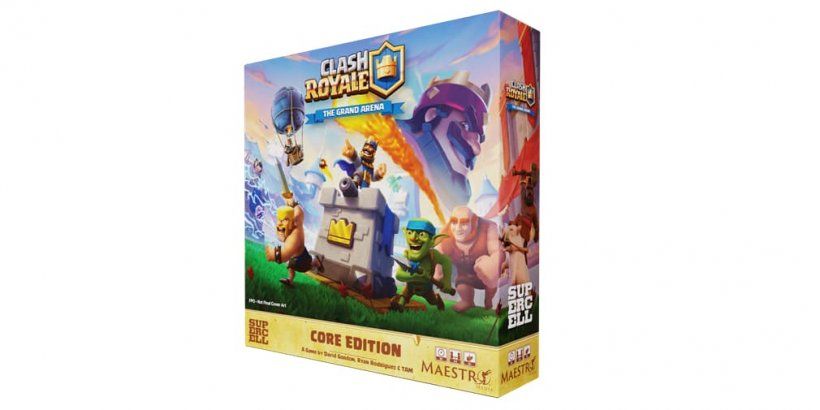
Image: pocketgamer.com
Clash Royale is getting a Kickstarter board game on October 20
Supercell’s next tabletop move is no longer Clash of Clans. It is Clash Royale: The Grand Arena, a board game adaptation being made with Maestro Media and headed to Kickstarter this month. ICv2 reports that crowdfunding starts on October 20, 2026, while IGN says the campaign is aiming to launch on that date. GamingonPhone also points readers to the official Kickstarter page, where fans can sign up for a launch alert.
That date is the most concrete part of the rollout so far, and it creates the main question for Clash Royale players who are used to instant downloads, live balance changes and clear in-app economies: how much of Supercell’s fast, lane-based mobile battler can survive the move to cardboard, fixed components and Kickstarter fulfillment?
The confirmed answer is that The Grand Arena is not being positioned as a loose branding exercise. Across IGN, ICv2, Pocket Gamer and GamingonPhone, the same core structure appears: two-lane battles, eight-card decks, Champions, Elixir spending, Towers, Crowns and direct player confrontation. The open question is how those familiar systems feel when the pressure of real-time play is replaced by turn-based decision-making around a table.
How The Grand Arena translates mobile pressure into tabletop decisions
According to IGN’s interview with lead designer David Gordon, Maestro Media tested several ways to adapt Clash Royale’s real-time tension before settling on the current format. Gordon told IGN that the team tried “actual real time play against a clock,” putting out cubes, simultaneous reveals and other methods meant to reduce player administration. The approach that stuck, he said, was “elixir spending in a turn-based card play system” because it most closely resembled the video game while remaining playable on the table.
That design choice matters because Clash Royale’s strategy has always depended on the cost of committing first. On mobile, an overextended push can be punished instantly. In The Grand Arena, based on the details reported so far, that pressure is moved into turn order, lane commitment and Elixir budgeting. IGN reports that players cannot endlessly cycle through cards because moves are limited by Elixir. Players decide where to play cards across two lanes, using units, defensive plays and items while trying to destroy opposing Towers.
The victory condition also mirrors the mobile game’s language. IGN and GamingonPhone both report that destroying Towers earns Crowns, and the player with the most Crowns wins. ICv2 describes the tabletop version as a game where players deploy cards, destroy opponents’ towers and collect Crowns in the process. For a strategy player, the interesting adaptation is that the board game appears to preserve the familiar push-and-counter rhythm without trying to imitate every second of the app.
Confirmed player count, designers and core format
The Grand Arena is designed for two to four players, according to IGN, GamingonPhone and ICv2. ICv2 adds the currently reported table specs: ages 12 and up, with a 30-minute play time. GamingonPhone and ICv2 identify the designers as David Gordon, Ryan Rodriguez and TAM.
IGN reports that each player controls their own forces through an eight-card deck built around a chosen Champion. GamingonPhone adds that players choose a Champion as the foundation for that deck, and says an Evolution card stays with the player throughout the game. Cards are based on the mobile game’s card list, IGN reports, including characters and items with roots going back to the broader Clash of Clans era.
The board itself appears to lean into visual familiarity. GamingonPhone describes the arena shown as Goblin Stadium, with the bridge and towers visible in the tabletop version. Pocket Gamer reports that The Grand Arena uses a dual-lane design with expanding decks of characters and upgrades as players try to outsmart one another. GamingonPhone says players can upgrade characters or add new ones between battles, which suggests the game may include some progression across a session rather than a single static duel. The exact campaign rulebook will need to clarify how that between-battle growth works, how long a full game lasts with four players, and whether two-player matches feel like the primary mode or a scaled-down version of a larger design.
Supercell and Maestro Media are repeating a tested partnership
This is Supercell’s second tabletop collaboration with Maestro Media, not its first experiment in licensed board games. ICv2 reports that the companies previously worked together on Clash of Clans: The Epic Raid, described as a 2026 release. GamingonPhone notes that The Epic Raid is now available through retailers, while Pocket Gamer says Maestro Media also helped bring Clash of Clans: The Epic Raid to tables.
That context is useful for backers because The Grand Arena is coming from a team that has already worked with Supercell’s visual identity, characters and fan expectations in a physical format. Maestro Media CEO Javon Frazier told ICv2 that the company has spent years building the “experience and infrastructure” to turn ideas into games fans can get their hands on, and said The Grand Arena is another attempt to give the Clash Royale community a new way to play in a world it already knows.
For Supercell, the move also fits a broader brand logic reported by Pocket Gamer: Clash can exist beyond phone screens through physical products and family-table play. That does not guarantee a strong board game, but it explains why Clash Royale is the logical follow-up to Clash of Clans. Royale already thinks in lanes, card hands, counterplay and efficient resource use, which are tabletop-friendly concepts if the pacing is solved.
What Kickstarter backers should inspect before pledging
The practical advice is simple: treat the October 20 campaign as the beginning of the information phase, not the finish line. The sources confirm the concept, collaborators, player count, core mechanics and Kickstarter timing, but they do not provide several buyer-critical details. As of the cited reports, there is no confirmed pledge price, shipping plan, final component list, retail release date, regional availability, language support, deluxe edition structure or fulfillment window.
Backers should look closely at the final rulebook or gameplay overview when the Clash Royale Kickstarter goes live. The key questions are whether downtime stays low at three and four players, how much hidden information exists in deck play, how Elixir refreshes, whether defensive reactions are possible outside a player’s own turn, and how cleanly the game handles multiple opponents attacking across two lanes. Those details will decide whether The Grand Arena captures Clash Royale’s tempo or simply uses its vocabulary.
Component value is another watch point. A Clash Royale board game can easily become expensive if miniatures, upgraded tokens, stretch goals or Kickstarter-exclusive content enter the pledge structure. None of the provided sources confirm those elements, so readers should avoid assuming what will be in the box beyond the reported card, lane, Tower, Crown, Champion and Elixir framework. If Maestro Media offers exclusives, backers should separate cosmetic appeal from gameplay necessity, especially if a retail version follows later as happened with Clash of Clans: The Epic Raid according to GamingonPhone.
Why Clash Royale fans may care even if they never back board games
For Clash Royale fans, The Grand Arena is worth watching because it tests which parts of the mobile game are durable outside the live-service environment. On mobile, balance shifts, card levels, timing windows and meta decks shape the experience. A tabletop game freezes those ideas into printed systems. That can be a strength if the designers build a clean strategic core, but it also means the game cannot rely on patches to fix a stale card mix or an overpowered line of play.
The reported eight-card Champion-based deck structure is the most promising bridge between formats. It gives mobile players an immediate point of recognition while giving tabletop players a defined strategic identity. The two-lane board does similar work: it turns Clash Royale’s map awareness into physical positioning, where a player’s commitment to one lane should create risk in the other.
The biggest remaining uncertainty is balance over repeated play. IGN reports that the team play-tested with both Clash veterans and people with no Supercell experience, and Gordon said it was important that a strategy game fan who had never played the video game would find the tabletop version fun. That is the right target. A licensed strategy game cannot survive on recognition alone; it needs interesting decisions after the novelty of handling familiar cards wears off.
If you are a Clash Royale player, the campaign is worth following on October 20. If you are a cautious backer, wait for the pledge page to show the full rules, contents, price and shipping terms. The confirmed pitch is strong: Supercell’s lane battler is being rebuilt as a two-to-four-player tabletop strategy game by Maestro Media, with Elixir, Towers and Crowns intact. The judgment call is whether the final Kickstarter package turns that familiar arena into a balanced game you will still want to play after the first night.