

Caves of Qud: Diaspora launches December 9 in Steam Early Access, adding playable animals, plants, new systems, and a rare test case for early access DLC.
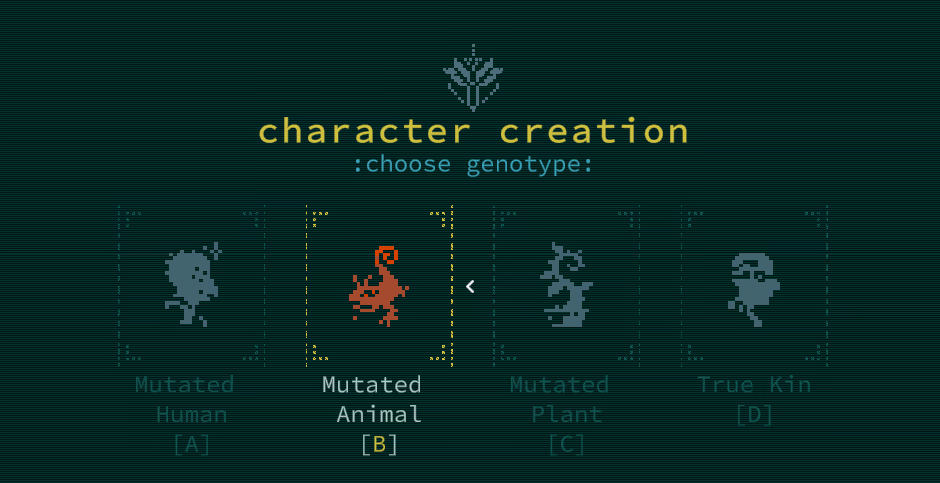
Image: store.steampowered.com
Caves of Qud is returning to early access through its DLC
Caves of Qud: Diaspora will launch on December 9, 2026 as an early access expansion on Steam, a strange and fascinating move for a roguelike that already spent years growing in public before reaching 1.0. Freehold Games and publisher Kitfox Games have positioned the expansion as the first major DLC for Caves of Qud, with RPG Site reporting a $14.99 early access price and a PC Steam release.
The tension is right there in the label. Caves of Qud is no longer an early access game, but Diaspora will be early access DLC. Game Developer reports that this is the first post-launch DLC release on Steam to use Early Access, with Kitfox co-founder and head of publishing Tanya X. Short saying Valve had to make a manual backend adjustment to enable the option. According to Short, Steam’s store page review then flagged that setup as a bug.
That makes Caves of Qud Diaspora interesting beyond its feature list. This is a paid Caves of Qud expansion for one of PC gaming’s densest systemic RPGs, but it is also a test of whether the development model that shaped the base game can be applied to DLC after launch. For players, the question is less whether Qud can absorb another layer of strangeness. It has been doing that for years. The sharper question is whether they want to buy into that layer while it is still being built.
Why Freehold is treating an expansion like a living build
Freehold’s stated reasoning is unusually plain. In the announcement language quoted by Rock Paper Shotgun, Rogueliker, and Game Developer, the studio says Caves of Qud is “an extremely complicated game with many interlocking systems & features and lots of unpredictable, emergent gameplay,” and that Diaspora adds “a whole new layer” to those systems. The developer says the same community stress-testing approach used for the base game will guide the expansion.
Game Developer also quotes Freehold’s press statement on the second part of the decision: Caves of Qud development is slow, and early access gives the team a way to fund Diaspora as development continues without being tied to a timeline that would force compromises. The studio’s phrasing, “watering the flower as it blooms,” fits the expansion’s plant-forward weirdness, but the business point is concrete. Diaspora is being sold before it is finished because the developer believes Qud’s complexity needs public pressure, time, and ongoing funding.
That will sound familiar to anyone who followed the base game. Game Developer notes that Freehold began development on Caves of Qud in 2007, brought it to Steam Early Access in 2015, and reached 1.0 in 2024. Rock Paper Shotgun’s coverage also points to the game’s strong reception there, including Brendan Caldwell’s Bestest Bests review badge for the 1.0 release. Diaspora is trying to reuse a process that has credibility with the game’s audience, but the DLC context changes the bargain. This time, players are not buying the foundation of Qud. They are paying for a new wing of an already vast house while the walls are still moving.
Playable dogs, cats, trees, vines, and the challenge of being Qud-shaped
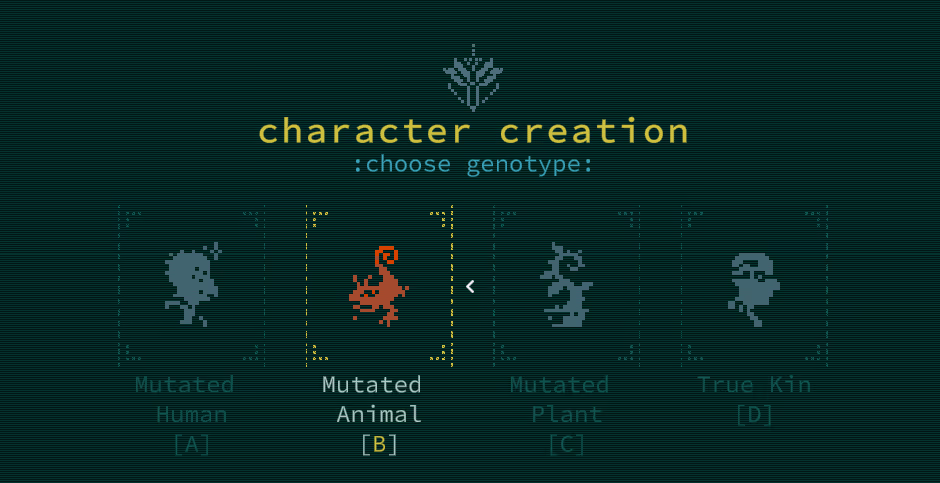
The headline feature is a new set of playable forms. Freehold and Kitfox say Diaspora will let players choose animal and plant stocks, then customize characters as before. The examples given across the announcement coverage include dogs, cats, frogs, chameleons, vines, and trees. Rock Paper Shotgun also notes new mutations such as claws, muzzles, and tails.
For Caves of Qud, this is not a cosmetic swap. The base game’s appeal comes from watching body plans, faction logic, equipment, mutations, geography, and procedural stories grind against each other until something memorable happens. Letting players enter Qud as flora and fauna suggests a design problem with sharp edges: the game has to make those forms feel distinct without snapping the systems that already support mutants, True Kin, factions, items, and emergent encounters.
Diaspora is also adding a new True Kin arcology and castes. RPG Site’s quoted announcement names the Great Rondures on the Ocean of Iber and its denizens: Propeller, Starsteer, Man of Kelp, and Delphine. That matters because the expansion is not limited to the oddball fantasy of playing a frog or a tree. It is widening character creation from several directions at once, which is exactly the sort of addition that sounds delightful in Qud and dangerous to balance.
There is a combat hook too. Spears are coming as a new weapon type, with RPG Site’s announcement text saying they can attack from two tiles away. In a roguelike where positioning can turn a curiosity into a corpse, reach is a meaningful addition. It gives the new expansion a clean tactical promise amid the stranger biological material: some of this DLC will be immediately legible the first time a player pokes something from safer distance.
Diaspora is also rebuilding how travel leads to discovery
The expansion’s worldbuilding changes may end up being as important as its new bodies. Freehold says Diaspora will improve road and river systems with more sophisticated algorithms that snake through Qud, and that following a road has a good chance of leading to an interesting location. That sounds modest beside playable trees, but it touches one of the quiet pillars of a procedural RPG: how the world teaches players to wander.
Qud is already enormous in the practical sense that it can generate long, messy journeys full of interruptions. Better roads and rivers imply a stronger relationship between navigation and reward. If the system works as described, players may be able to make more intentional choices about travel without draining the game of its danger. A road becoming a promise, rather than background decoration, is a powerful thing in a world where curiosity is often punished and rewarded in the same breath.
Diaspora’s launch feature set also includes new creatures and items tied to what the announcement calls “artifacts of disparate cultures.” RPG Site lists dromad caravans and mountable saltbacks, describing the saltbacks as mounts and the dromads as traveling on “motile shell-bazaars.” Those details fit the expansion’s broader focus on movement and migration. They also suggest that Diaspora is not only adding isolated enemy types or loot tables. It is adding moving social texture, which is where Qud tends to be most vivid.
The 2027 roadmap is where the expansion’s premise grows teeth
Freehold and Kitfox are not presenting the December build as the full shape of Caves of Qud: Diaspora. The announced 2027 additions include a new questline centered on migrants’ journey into Qud and a dromad named Je’ome the Bounty. Rogueliker describes the expansion’s theme as migration and population displacement driven by war and climate change, while RPG Site’s quoted announcement confirms the migrant-focused questline and the 2027 timing.
The planned additions also include two new humanoid factions, the foxen and snailfolk, plus more creatures, items, item mods, biomes, cooking ingredients, diseases, and fungal infections. Freehold’s announcement language also names roaming mega-caravans, underground villages, multi-zone dungeons or arcological spaces, new music, and more for the expansion’s later development.
That timeline is important for anyone considering a purchase at launch. December 9 is the start of Diaspora’s public life, not its endpoint. Rock Paper Shotgun reports that updates are expected to arrive weekly, or monthly when larger work is involved, and that a roadmap will come at launch. The same report notes that an update to the base game is planned either slightly before Diaspora leaves early access or when it does, with some free additions appearing in the DLC first because they will drive much of Diaspora’s content.
So the cleanest expectation is this: the early access launch is a playable slice of the Caves of Qud DLC, anchored by new playable stocks, travel systems, creatures, items, spears, and caravan features. The fuller narrative and factional identity of the expansion is scheduled to deepen across 2027.
Who should buy early, and who should wait
The safest audience for Caves of Qud Diaspora at launch is the player who already enjoys watching Qud misbehave in interesting ways. Freehold is explicitly asking the community to stress test an expansion that touches character creation, procedural travel, combat, factions, creatures, items, and future quest content. If you like being part of that process, the $14.99 early access release on Steam is designed for you.
Players who came to Caves of Qud after 1.0 and prefer finished structures should read the early access label literally. The sources do not confirm a final release date for Diaspora, and the 2027 plan contains major features that will not all be present on day one. The upside is a frequent-update model with a roadmap expected at launch. The tradeoff is that you are buying into ongoing development rather than a complete expansion campaign.
Platform expectations also need care. RPG Site reports that Caves of Qud is available on PC and Nintendo Switch, will launch soon for Nintendo Switch 2, and is in development for mobile. Diaspora, however, has been announced for Steam Early Access on PC in the supplied sources. Rogueliker specifies PC across Linux, Mac, and Windows, but there is no sourced confirmation here of a Switch, Switch 2, or mobile release for the expansion.
That leaves Diaspora in a very Qud-like place: promising, odd, and a little hazardous. The confirmed facts are strong enough to make the Caves of Qud expansion one of December’s most distinctive roguelike DLC launches. The unanswered questions are equally real: how stable it will feel at launch, how quickly the 2027 features arrive, and whether Steam’s newly enabled early access DLC path becomes a model other developers follow or remains a strange little tunnel dug for Qud alone.