

Hands-on impressions of the CatLands Steam Next Fest demo, covering its tile-matching puzzle loop, cat collection and village-building hooks, system depth, and performance on Steam Deck.
A Cozy Tile Puzzler With Strategy Under The Fur
CatLands presents itself as a classic cozy game about building a village for adorable cats, but the Steam Next Fest demo quickly shows that it is more of a structured puzzle game than a freeform builder. Every action, from placing a tree to inviting a new feline resident, is driven by its tile-based puzzle boards and the constraints they impose.
Each run begins with a small patch of land and a limited deck of landscape tiles like grass, forest and water. You place these onto a compact grid, trying to satisfy simple goals such as forming certain shapes, chaining similar tiles together, or completing cat-specific requests. Clear a board and it feeds back into your home village with new resources, decorations and cats you can invite to move in.
This loop of "complete a focused puzzle board, return home with new stuff, then tweak your village" is the spine of the demo. It is cozy in presentation and pacing, but turn-based and deliberate in the way a tile-placement puzzler such as Dorfromantik or Akropolis is, instead of a purely decorative sandbox.
How The Core Puzzle Loop Works
In the demo, puzzles are framed as small expeditions away from your village. You choose a location, load into a contained board, and are handed a short queue of tiles and objectives.
The basic rule set is simple. You can rotate and place tiles into empty spaces, trying to create patterns that match the current objective. Some require you to cluster particular terrain types together, others ask you to connect different tiles without breaking chains, and later ones layer multiple conditions at once. You are scored on efficiency and completion, with a gentle fail state if you simply run out of legal placements.
What gives CatLands a bit more texture is its cat-centric twist. Certain cats prefer specific layouts or habitat types and will only join your village if their conditions are met during a puzzle. A cat that loves forests might appear as an optional objective on a board that heavily leans into tree tiles, while another that prefers cozy, enclosed spaces pushes you to build tighter, more compact clusters.
Since the demo only gradually surfaces these conditions, early boards feel almost meditative, but by the midpoint you are weighing tradeoffs. Do you place a suboptimal tile layout to secure a cat you want, or sacrifice that cat to hit a higher board score and bank more general resources? That small bit of friction keeps the puzzles from feeling like a completely frictionless flow of placements.
Village Building And Cat Collection Hooks
Back in the village, your rewards translate into tangible changes. The demo lets you place basic structures, simple decorations and functional tiles that mirror what you see on puzzle boards. New cats show up as residents you can view, talk to and sometimes use to unlock more expedition boards.
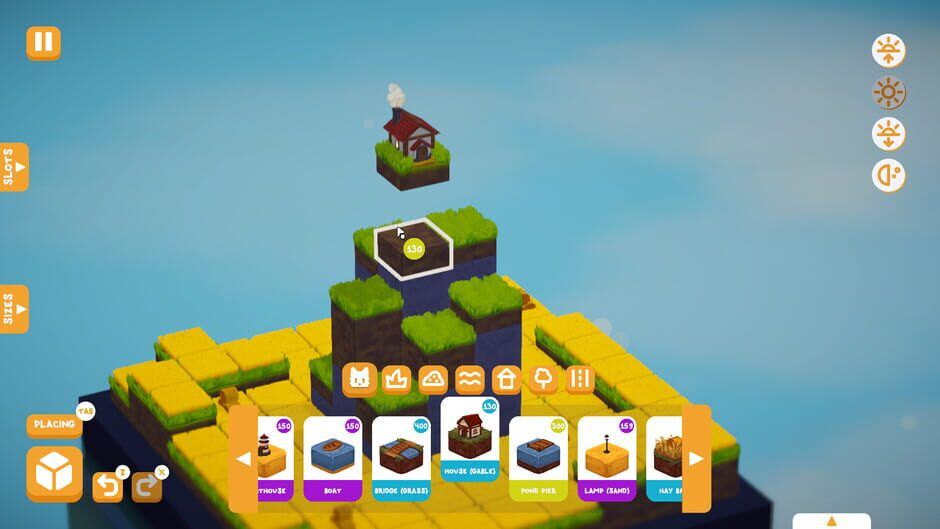
The building layer is intentionally constrained during the demo. Grid-based placement, limited building categories and a small but charming palette of props keep it from becoming overwhelming. Instead of deep city-building management, it leans into the joy of watching your settlement fill up with colorful cats that react to what you place.
Cats are the glue between the two halves of the game. They are the reason to solve puzzles efficiently, since specific cats gate some upgrades and decorative options. They are also the main collectible. Even within the demo window, you get a sense of a growing roster with unique looks and preferences, and it is clear the full game intends to broaden this into a proper collectible compendium.
There is still some repetition in the demo if you play long enough. Objectives remix the same handful of conditions rather than introducing radically new mechanics. What keeps it engaging is the light strategic layer of pursuing particular cats or village unlocks, which subtly nudges you to approach familiar boards in different ways.
How Much Freedom The Demo Gives You
The Steam Next Fest slice is generous in length for a cozy puzzler demo. It offers a string of puzzle expeditions that escalate in complexity, a glimpse of the broader world map, and a village that persists across runs as you add new buildings and residents.
You can replay earlier boards to grind extra resources or chase better outcomes, and the game does not seem to cap how many times you can do so within the demo. That opens the door to light experimentation. You can test how different tile priorities affect cat recruitment, try alternate layouts to see which objective variants appear, and rearrange parts of your village to see how cats respond.
The flip side is that some systems clearly have arbitrary walls to avoid giving away the entire loop. Certain buildings and board types remain locked, tooltips hint at upcoming puzzle modifiers that never show up in this slice, and the village layer stops short of true freeform design. You cannot, for instance, dramatically terraform your settlement or dive into ultra granular interior decoration yet.
Taken as a sampler, though, the demo succeeds at answering the most important questions. You see how the puzzle boards feed the meta progression, how cats function as both reward and light strategy constraint, and how much downtime exists between focused puzzle bursts. For players who want a taste of the full loop without spoiling every unlock, the vertical slice feels well judged.
Does CatLands Stand Out Among Cozy Puzzlers?
The cozy puzzle and builder space on Steam is crowded, so it matters that CatLands does not just reskin an existing formula with cats. Its distinguishing feature is the tight coupling between short, rules-first puzzle boards and a persistent village that meaningfully reflects your successes.
Unlike some neighbors in the genre that lean on purely aesthetic decoration, CatLands anchors your village in the logic of its puzzles. The terrains and layouts that please cats inside a board map directly to how you expand their home outside it. This makes every expedition feel like a focused design challenge with clear stakes, not just a resource faucet.
The art direction also helps it stand apart. Cats are expressive without lapsing into excessive tweened animation, and the soft color palette keeps the screen readable, which is important when boards get busy. Audio stays relaxed and low key, leaning into gentle plucks and ambient loops instead of big melodic lines that might grate during repeated attempts.
It is not, at least in the demo, a radical revelation for the genre. It sits closer to well made comfort food than to a puzzler that aims to twist your brain into knots. What makes it notable is how cleanly it executes on its promise. The puzzle rules are clear, objectives are legible at a glance, and the feedback between systems feels satisfying in a way that many less focused cozy builders struggle to achieve.
Players who want hard optimization and deep mechanical innovation may find the demo a bit straightforward. But if you enjoy the micro strategy of tile placement and the long term reward of filling a diorama like village with personality, CatLands shows more intent and structure than its soft visuals might suggest.
Steam Deck Performance And Handheld Fit
CatLands looks like a natural fit for Steam Deck, and the demo supports that assumption well. Its tile based boards and uncluttered UI scale comfortably to the Deck screen at native resolution, and the muted color scheme helps maintain clarity even when played outdoors or at lower brightness.
Input wise, the game maps cleanly to a controller. Tile selection, rotation and placement all work predictably on the Deck controls, and the cursor speed feels tuned enough that you are not constantly fighting it to hit specific grid spaces. This is important for a game where slightly misaligned tiles can undo a planned layout.
Performance in the demo build appears solid. The game is not technically demanding, leaning on 2D and simple 3D elements, and there are no obvious frame pacing issues during puzzle boards or in the village hub. Load times between boards are brief, and quick suspend and resume on Deck do not seem to confuse the game state.
Battery expectations line up with other light indie puzzlers rather than fast paced 3D action titles. While exact drain will depend on your Deck model and settings, nothing in the demo points to unusual spikes. It appears to be the kind of game you can comfortably chip away at in short handheld sessions without worrying about frequent top ups.
Given its relaxed pacing, clear visuals and low system overhead, CatLands looks well suited to being played almost entirely on Deck, especially for players who associate cozy games with couches and blankets rather than desks and monitors.
Early Verdict From The Demo
From its Steam Next Fest showing, CatLands comes across as a quietly confident entry in the cozy puzzle space. It pairs a gentle presentation with a rules driven tile placement core that has just enough tactical bite to keep sessions engaging, and it backs that up with a village layer that feels more integrated than many of its peers.
The demo stops short of revealing its deepest systems, but it already communicates why collecting cats, arranging their habitats and optimizing puzzle boards might remain satisfying over a longer campaign. Combined with stable Steam Deck performance and a comfortable controller layout, it earns a spot on the radar for puzzle and cozy fans looking for their next low pressure obsession.