
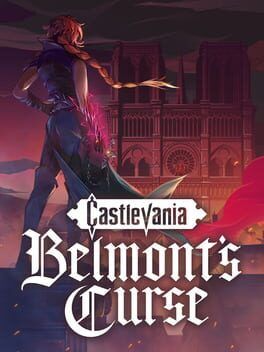

Breaking down the new Belmont’s Curse trailer and developer commentary, with a focus on combat feel, exploration structure, Evil Empire’s influence, and whether Konami finally gets what modern Castlevania fans actually want.
Castlevania: Belmont’s Curse is in a strange position. It has to feel like classic Castlevania but also stand alongside modern action platformers that have eaten the series’ lunch for more than a decade. The new trailer, paired with Konami and Evil Empire’s post-show commentary, is the clearest signal yet that this revival may finally be on the right track.
Set in 1499 Paris, 23 years after Castlevania: Dracula’s Curse, Belmont’s Curse reimagines gothic horror through cathedrals, plague-stricken streets, and a demonic Notre Dame. The pitch is simple: a young Belmont, a cursed city, and a 2D action exploration structure that pulls from both the NES-era whip-crunch and the post-Symphony of the Night lineage.
What matters is how it feels in motion, and the latest footage suggests Evil Empire understands the assignment.
Whip-first combat that actually looks tactile
The most striking thing in the new trailer is how physical the whip looks and sounds. Every swing has a crisp, almost punchy snap. Enemy hit reactions are exaggerated just enough: skeletons are knocked back with visible impact, armors shudder before shattering, and larger demons briefly flinch rather than simply absorbing damage. There is a sense of weight to each strike that older 2D revivals often missed.
Evil Empire seems to be chasing a midpoint between the committed animations of classic Castlevania and the responsiveness of modern action games. The Belmont’s start-up on a standing whip looks deliberate, but the trailer shows quick cancels into backward hops and air control that lets you correct mid-jump. It does not have the stiff, staircase-locked movement of the NES games, but it also avoids the floaty, frictionless feel that can make modern platformers feel disposable.
Sub-weapons and secondary tools are clearly back in a big way. The trailer highlights classic holy water and throwing knives, but also more screen-controlling arc attacks that look designed for crowd management. Several shots show the player weaving these into whip strings, using a vertical whip follow-up to juggle an enemy, then tagging another off-screen with a projectile. The pacing looks closer to a modern character action game framed within a 2D plane rather than a simple left-to-right brawler.
Developer commentary reinforces this intent. Evil Empire repeatedly mentions that they obsess over what it feels like just to hit something, and that they iterated heavily on enemy stun timings, weapon wind-up, and recovery windows. That focus comes through: even brief combos shown in the trailer communicate clear rhythms of risk and reward. Commit to a heavy wind-up for big damage, or poke with faster strikes and rely on positioning and sub-weapons to finish the job.
Boss fights, even from short snippets, lean into this same philosophy. The Joan of Arc encounter is especially telling. Possessed and towering over the arena, she swings a flaming halberd with long, legible tells. The Belmont slides and hops through arcs of fire, lashing out during well-defined punish windows. It is methodical and readable, more about pattern mastery than twitch-perfect air dashing, which fits Castlevania’s identity while still feeling modern.
Exploration that bridges classic stages and modern metroidvania
Structurally, Belmont’s Curse does not appear to be a full Symphony-style castle sprawl, but it also is not a strict level-select throwback. The new trailer and interviews suggest an action exploration format that splits the difference, treating major landmarks around Paris as interconnected zones within a larger web.
Notre Dame is the clear centerpiece. It is not just a backdrop, but a hub-like structure laced with vertical corridors, side chapels, and secret passages that wrap around to open shortcuts. The footage shows the player returning to earlier sections from new angles, now using enhanced mobility to reach previously inaccessible ledges. There are locked gates, destructible walls, and contraptions that look tailor-made for backtracking.
Outside the cathedral, Paris is carved into distinct districts. There are plague-ridden streets filled with shambling undead, riverside docks glowing with occult light, and fortified bridges that double as mini gauntlets. Evil Empire’s commentary makes it clear that progression is not completely free-form. They talk about wanting a directed adventure where players are rarely lost, but still feel rewarded for poking at the edges. Expect branching routes, optional wings of levels, and looping shortcuts rather than a fully open-ended labyrinth.
Importantly, the trailer hints at an evolving toolkit that shapes how you explore. One sequence shows the Belmont using a grappling-style whip swing to cross a large gap, suggesting traversal abilities will unlock new routes. Another shot highlights a downward plunge attack that cracks fragile floor tiles, a clear nod to hidden paths and secret rooms.
If this holds true, Belmont’s Curse could occupy a sweet spot between the stage-based rigor of Castlevania III and the more interconnected, exploratory feel of the GBA and DS games, without simply copying Symphony’s castle yet again.
Evil Empire’s fingerprints are everywhere
Konami partnering with Evil Empire is the single most reassuring aspect of this project. Evil Empire has been effectively curating and evolving Dead Cells for years, learning in real time what keeps a 2D action game engaging over hundreds of runs. Belmont’s Curse is not a roguelite, but the studio’s design habits are clearly influencing its structure and systems.
In the developer segment, the team talks about three pillars: combat clarity, readable danger, and constant micro-rewards. You can see these in the trailer. Enemy attacks are heavily telegraphed with glowing weapon arcs and distinct poses. Environmental hazards such as falling chandeliers and spiked gears are color-coded and animated to stand out from the background. Even small pickups and hearts burst with flashy feedback.
Evil Empire also stresses that they approached Castlevania with humility, treating the series’ history as a constraint rather than a checklist. That shows in the tone of the art and animation. The pixel work is lavish, with richly lit backgrounds and layered parallax, yet it avoids pure nostalgia mimicry. Paris looks infected by Castlevania’s aesthetic rather than simply reskinning Dracula’s castle again.
The choice of Joan of Arc as a boss encapsulates this approach. It is a bold pivot into myth-twisting French history and gives the setting a local identity while still aligning with Castlevania’s love of religious and folkloric remixing. Evil Empire has always been comfortable with playful, referential design in Dead Cells, and channeling that energy into an official Castlevania entry feels like a natural evolution.
Does Konami finally get what modern 2D Castlevania should be?
The big question is whether this is just a pretty nostalgia piece or a genuine attempt to give Castlevania a contemporary identity. Based on the footage and commentary so far, Belmont’s Curse is the closest Konami has come in years to understanding what fans actually want.
First, it treats 2D as a strength rather than a compromise. The trailer is built around thoughtful layout, snappy reads, and expressive animation, not just retro aesthetics. Every frame screams handcrafted, from the flicker of stained-glass light in Notre Dame’s halls to the way enemies dissolve into embers or ash when defeated.
Second, there is a clear respect for deliberate play. Modern action games often chase speed at the expense of clarity. Belmont’s Curse looks fast enough to feel exhilarating, but enemies have discernible patterns, attacks have distinct timings, and the Belmont’s moveset has enough commitment to make positioning matter. That is the heart of classic Castlevania, preserved rather than sanded away.
Third, the exploration structure acknowledges the last two decades of metroidvania design without simply copying the genre leaders. It seems intentionally more focused and legible than something like Hollow Knight, but also more interconnected and curiosity-driven than a strict stage select. If Evil Empire can layer in satisfying secrets, gear upgrades, and maybe some light build variety, this could give Castlevania a modern template to grow from.
Finally, the collaboration itself speaks volumes. Letting Evil Empire steer the design and pace, with Konami supplying the brand, lore, and oversight, is a tacit admission that the publisher needed fresh blood to modernize its oldest formulas. The material shown so far suggests Konami is listening and, perhaps more importantly, willing to get out of the way.
Cautious optimism, but real momentum
There are still big unknowns. We have not seen how progression works beyond snippets of item usage. The extent of RPG systems, if any, remains unclear. Boss variety, difficulty tuning, and long-term depth are impossible to judge from a couple of minutes of curated footage.
Yet compared to Konami’s recent history of underwhelming revivals and low-effort compilations, Castlevania: Belmont’s Curse feels startlingly confident. The combat looks crunchy and readable, the exploration hints at a hybrid structure that respects both old and new, and Evil Empire’s influence is visible in all the right places.
If the full game delivers on the promise of this trailer, Belmont’s Curse will not just be a welcome comeback. It could be the blueprint for what Castlevania, and maybe Konami’s other dormant 2D series, look like in a modern context.