
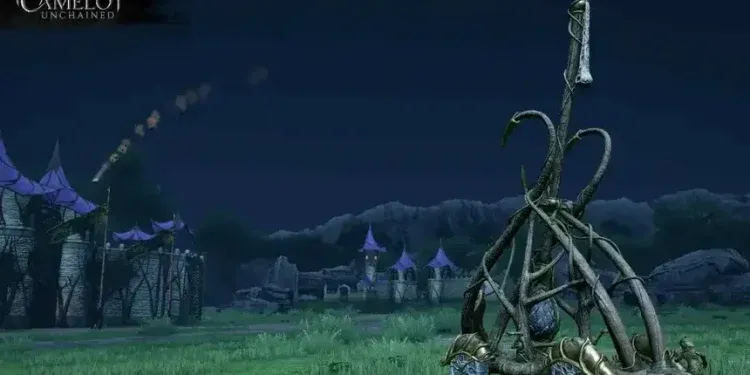

Camelot Unchained update 0.50 adds the Scout archetype and craftable trebuchets, giving the Early Access RvR MMO a clearer battlefield loop while leaving key siege pieces for later.
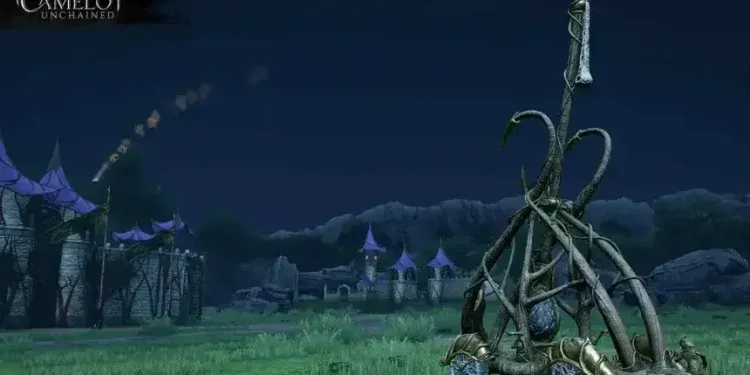
Image: aroged.com
A battlefield update with a very specific promise
Camelot Unchained update 0.50 is live with two additions that cut directly into the MMO’s Realm vs. Realm pitch: the Scout archetype and the first implementation of siege mechanics. In the official patch notes published October 2, Unchained Entertainment says the update adds a unique Scout class for each Realm, craftable trebuchets, a new Action Speed stat, diminishing returns for Control effects, class XP changes, balance tweaks, audio updates, and bug fixes.
The tension is obvious for anyone watching Camelot Unchained from the sidelines or from a backer account that has gone quiet. This is still an Early Access build, and the studio describes the trebuchets as the “first iteration” of siege mechanics rather than a complete system. Yet update 0.50 also introduces a more recognizable RvR shape: mobile intelligence classes scouting the field, crafters producing siege kits, attackers needing war machines to pressure gates, and defenders gaining more reasons to contest placement, terrain, and local respawns.
That makes Camelot Unchained update 0.50 more useful to judge as a systems milestone than as a content drop. It does not answer every question about the game’s long-term cadence, population, or final siege design. It does, however, put several battlefield roles into the same live test environment at once, which is exactly the kind of interlocking design Camelot Unchained has been promising through its RvR identity.
The Scout archetype is built around information, disruption, and survival
Unchained Entertainment describes Scouts as highly mobile classes with utility, debuffs, and crowd control, designed to move quickly around the map and collect information for allies. The official patch notes are careful about their intended combat role: Scouts can manipulate fights to give their side an advantage, but they lack the raw damage output of other classes and are strongest in a supportive role rather than as front-line brawlers.
That distinction matters because the Camelot Unchained Scout archetype is not being framed as a simple damage dealer with stealth. Each Realm receives its own class and passive identity. The Arthurian Spectre gains Self-Possessed, which grants Ghost Form. According to the patch notes, Ghost Form is a toggled, stance-style ability that increases movement speed and physical resistances, applies Stealth while out of combat, and unlocks certain exclusive abilities, while also restricting the player to Scout archetype abilities and Spectre class abilities marked as usable in Ghost Form.
The Tuatha Dé Danann Wisp receives Capricious, which grants Vanish. The official notes say Vanish instantly sends the Wisp to the Veil, but only while the character is below 50 percent health. The Viking Arisen gets Walking Dead, which triggers when the character would die, leaves the Arisen at 1 health, and grants damage immunity, increased movement speed, and increased melee damage for eight seconds before entering a five-minute cooldown.
Taken together, these are three different answers to the same RvR question: how does a lightly damaging utility class stay relevant in a battlefield full of groups, walls, gates, and ranged pressure? The Spectre leans into pre-fight positioning and selective engagement. The Wisp has an emergency escape condition tied to being wounded. The Arisen is allowed to remain dangerous for a brief window after a lethal blow. None of that confirms how strong the classes will feel in practice, but the official design gives each Scout a reason to exist outside a damage rotation.
Trebuchets give crafters a direct role in Keep warfare
The other half of update 0.50 is the first pass at Camelot Unchained siege mechanics. In its September 30 preview, Unchained Entertainment said players would be able to craft and use trebuchets to attack enemies from range. The studio says trebuchets can be placed anywhere with even terrain, which allows them to be used in open-field positioning as well as around Keep assaults.
MMOHuts, citing the update, reports that Weaponsmiths, Woodworkers, and Leatherworkers can craft deployable trebuchet kits as a level 9 recipe. Those kits can then be placed from inventory in RvR zones. MMOHuts and MMOs.com both report that trebuchets are single-use, deteriorate until they disappear after 10 minutes, and can be targeted and destroyed by other players. Friendly fire is disabled, with MMOs.com noting that this followed testing concerns around same-faction griefing.
Those constraints are important. A single-use, 10-minute siege engine is not a permanent battlefield structure. It is a consumable investment, which gives crafters and supply preparation a clearer relationship to the front line. If the placement rules, travel routes, and defensive responses hold up, trebuchets could turn crafting from background preparation into an immediate RvR contribution.
For now, the target list is limited. Unchained Entertainment says trebuchets can currently target and damage players, NPCs, and gates on Keeps and Points of Interest. The September preview adds that future work includes faction-specific trebuchet variants, new siege weapons, and cooperative mechanics such as multiple players operating a ram to batter down a gate. Aroged also reports that destructible walls with multiple damage stages are planned for future updates. The confirmed update 0.50 system, then, is a foundation: deploy, aim, pressure gates or enemies, and force a response.
Gate changes push attackers toward siege instead of brute force
Update 0.50 is not simply adding trebuchets as an optional toy. MMOHuts reports that player damage against outer gates has been reduced, pushing attackers toward siege weapons when trying to break through defenses. MMOs.com similarly reports that front gates now take less damage, making them harder to break.
That is the most consequential design pairing in the patch. If gates remain too vulnerable to ordinary player attacks, trebuchets become spectacle rather than necessity. By lowering direct player damage against those gates, update 0.50 begins moving Keep assaults toward a role-based loop: crafters prepare kits, attackers protect placement and operation, Scouts identify threats and openings, defenders destroy deployed siege, and local respawn rules shape whether a defense can stabilize.
The patch also adjusts Keep respawns. MMOHuts reports that Keep respawns now apply respawn sickness and that local defender respawn timers are longer when defenders do not control the local Chapel. That gives territory control around a siege additional weight, although the sources do not provide enough detail to judge how punishing the new timers are or how strongly Chapels will influence real battles.
The practical question for returning backers is whether this loop will produce reliable fights. The pieces now point in that direction, but the sources describe this as an early siege pass. Walls, additional target areas, faction variants, additional engines, and cooperative rams are future work, not current features.
Combat tuning makes crowd control less stackable
Scouts arrive alongside combat-system changes that directly affect the kind of disruption they are meant to provide. The official patch notes say Camelot Unchained now has diminishing returns for Control effects. Repeatedly applying Control effects to the same target will reduce their effectiveness and eventually make them ineffective for a time through Control immunity. The stated goal is to let Control effects remain valuable while making timing and ability choice more important than simply layering as many disables as possible onto one target.
MMOHuts reports that Snare is no longer treated as a Control effect, so it does not interact with the new diminishing returns system. That separation could matter for Scouts, since the archetype is built around mobility, utility, debuffs, and CC rather than raw damage. If snares sit outside the Control diminishing returns system, movement pressure may operate differently from hard lockdown, although the sources do not provide enough data to evaluate balance.
The new Action Speed stat is also present, but in a narrow form. Unchained Entertainment says Action Speed reduces activation time on non-instant abilities, including spells and weapon skills, while leaving recovery time unchanged. The studio also says the stat is currently provided only by the Blackguard’s Siege Stance ability, with future equipment and abilities planned to offer it later. That makes Action Speed a system to watch rather than a broadly build-defining stat in this build.
Other tuning points suggest update 0.50 is trying to make battlefield pressure less binary. MMOHuts reports class XP adjustments, including XP from NPC kills based on difficulty and XP for applying hostile status effects in RvR, as well as a slight reduction to healing potency across the board. These are not headline features, but they support the same direction: reward participation in RvR actions, reduce some forms of durability, and make control chains less oppressive in larger fights.
Does update 0.50 give backers a reason to log back in?
For backers deciding whether to return for an Early Access weekend, the strongest answer is that Camelot Unchained update 0.50 finally gives several battlefield professions a shared purpose. Scouts have a defined reconnaissance and disruption role. Crafters can make trebuchet kits that matter in RvR zones. Attackers have a stronger reason to bring siege against gates. Defenders can target deployed trebuchets rather than simply absorb incoming damage. Those are concrete systems, confirmed by the official patch notes and corroborated in coverage from MMOHuts, MMOs.com, MMORPG.com, MassivelyOP, and Aroged.
The reason to be cautious is just as concrete. This is the beginning of siege warfare, not the full version. Trebuchets currently focus on players, NPCs, and Keep or Point-of-Interest gates. The broader siege suite, including faction-specific trebuchets, additional siege weapons, cooperative rams, and wider destructible targets, is described as future work. Action Speed exists, but the official notes say it is presently limited to the Blackguard’s Siege Stance. The Scout archetype has strong role definition on paper, but its real value depends on population, map flow, group coordination, and how often information gathering turns into meaningful tactical advantage.
For players who want a finished MMO experience, the sources do not support treating update 0.50 as that moment. For backers who specifically want to test the RvR promise, this is a clearer checkpoint than a routine balance patch. The build adds new roles, new siege objects, new gate pressure, and new anti-lockdown rules in the same update. That combination gives returning players a better reason to evaluate the battlefield again, while keeping expectations anchored to an Early Access system still missing several announced siege layers.