
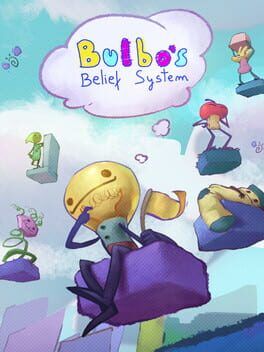

A first-look feature on Bulbo’s Belief System for Nintendo Switch, digging into its belief-flipping logic puzzles, gravity-defying platforming, and why its Q3 2026 release could be a treat for Baba Is You fans.
Bulbo’s Belief System is built on a deceptively simple premise: your little blob hero believes everything he is told, and the world rearranges itself around those beliefs. If Bulbo is convinced a wall does not exist, he can walk straight through the space where it used to be. If he forgets that gravity applies to him, he stops falling and can stroll casually across a chasm.
It is an endearingly silly idea with serious puzzle potential, and this Q3 2026 Switch release is quietly shaping up to be one of the more interesting logic-heavy platformers headed to the eShop.
A platformer where rules are tiles you can rewrite
From the announcement and the recent Latin American Games Showcase trailer, Bulbo’s Belief System presents its logic almost like a scripting language, only without actual code. Levels are simple 2D side-scrolling rooms full of platforms, hazards and text-like prompts that define how Bulbo understands the world.
Bulbo himself is a squat, wide-eyed character that moves with straightforward platformer controls: left, right, jump. What complicates things is that these familiar actions are filtered through what he currently “knows.” Knowledge grants permissions. Forgetting takes them away.
Early levels shown in footage keep the language very plain. Signs or NPCs tell Bulbo things like “There is a wall.” Accepting that statement makes an otherwise invisible block snap into existence, turning a gap into a barrier. If Bulbo instead embraces “There is no wall,” then that same space becomes open air, even if the art still suggests a solid structure in the background.
The clever part is that these beliefs are not just flavor text. They are mechanical toggles that directly control collision, gravity and sometimes even the goal conditions in a stage.
How belief-flipping works in practice
The core of the game is the act of choosing what Bulbo believes at any given moment. Across the currently available demo and showcase footage, this plays out in a few recurring ways.
Some levels treat beliefs as collectible statements hanging in the air or tucked behind simple platforming challenges. When Bulbo touches a glowing thought bubble, he “learns” a new fact. That fact might be displayed at the top of the screen, in a panel that lists every active belief. You can then toggle them on or off, or overwrite them with new information.
Other stages lean on characters that talk directly to Bulbo. A chatty NPC might say, “Bulbo, there is no floor here.” If you accept that idea, the ground vanishes under his feet, turning a safe corridor into a lethal drop but also exposing a previously hidden passage. Sometimes the smartest play is to deny or later forget what you were told, restoring stability.
The interface shown in trailers suggests that each belief is a discrete rule: gravity, walls, platforms, spikes and even the existence of certain doors can all be bound to a statement. Puzzles then become about sequencing and combination. You might need to forget spikes, remember platforms and then briefly disbelieve gravity in that exact order to reach a distant ledge.
Erasing walls and redrawing routes
The most immediately striking mechanic is the ability to erase walls from existence. In both the official trailer and the Steam demo footage, this looks less like Minecraft-style destruction and more like selectively switching off collisions.
Picture a cramped hallway blocked by a solid-looking block. You cannot jump over it, and there is no clear way around. Nearby is a statement that reads “There is a wall.” When that belief is active, the obstacle behaves as expected: Bulbo bumps into it and stops.
Toggle the belief off and Bulbo walks straight through the same tile space as if it were air. Art may remain in the background, which creates a playful dissonance between what you see and what Bulbo, in-universe, thinks is real.
Design-wise, this lets levels hide routes in plain sight. A wall you always assumed to be permanent might be purely a matter of perspective, and the game challenges you to mentally poke at those assumptions. For fans of Baba Is You, it feels similar to the thrill of discovering that a rule you took for granted is just another object you can manipulate.
Later puzzles start to combine multiple layers of existence. Maybe several overlapping walls each have different belief statements attached. Deactivating one opens a shortcut but also removes the ceiling that was protecting you from falling debris. The Switch version should be able to handle this sort of layered collision without issue, and the 2D art keeps it readable on a handheld screen.
Ignoring gravity to solve platforming problems
Ignoring gravity is the other headline trick, and it has some of the most visually playful moments in the current gameplay trailers.
In one early scenario, Bulbo stands at the edge of a long pit. The jump is clearly impossible with standard platformer physics. Instead of looking for a hidden moving platform, the solution is internal: a floating text reads “Bulbo is affected by gravity.” Deactivate it, and Bulbo’s next jump behaves differently.
With gravity disbelief active, Bulbo either floats in place or falls much more slowly depending on the exact rule in play. You can then walk across the “pit” as though it were simply another platform, because from Bulbo’s perspective the concept of falling has momentarily stopped existing.
Later clips show snappier variations. Short pulses of zero gravity let you leap into a vertical corridor and then re-enable gravity at the right moment to land on a tiny ledge. Some puzzles appear to require midair belief-flipping, where you must toggle gravity off to clear a hazard and then back on before you careen into spikes on the ceiling.
Crucially, Bulbo’s Belief System appears to keep its physics grounded in a consistent rule set. Gravity on means normal platformer movement. Gravity off means a predictable alternative behavior. The challenge is directed at your logical reasoning rather than dexterity, which should sit nicely with players who prefer Baba Is You’s measured tinker-and-test rhythm over tight action platforming.
Managing conflicting beliefs
Because Bulbo will believe anything, contradictions are inevitable. The fun lies in how the game treats them.
Across demo footage, several puzzles revolve around statements that cannot all be true at once. For example, you might encounter “There is a bridge over the pit” and “There is no bridge over the pit” as separate toggles. Turning both on usually forces a resolution in favor of one statement, depending on rule priority, or may cause that object to flicker and become unusable. The solution is to reason through which version of reality you actually need at any moment.
Some rules are tied to others, creating little implication chains. If Bulbo believes “I can walk on clouds” then distant, fluffy platforms suddenly become tangible. Combine that with a denial of gravity and you can reach spaces that seemed impossibly high. If he later forgets that belief, the clouds revert to pure background decoration, which can be crucial when you want a hazard to pass harmlessly through them.
Handled well, this could give Bulbo’s Belief System the layered, almost programming puzzle feel of games like TIS-100 or The Talos Principle, but filtered through a friendlier, more approachable side-scroller format.
Why Baba Is You fans should take notice
Comparisons to Baba Is You are not just surface-level. Both games treat rules as manipulable objects and encourage players to think in terms of logic rather than pure reflex.
Baba Is You lets you physically rearrange word tiles that define how the world works. “BABA IS YOU” can become “ROCK IS YOU,” and suddenly you control a rock instead of a sheep. Bulbo’s Belief System uses beliefs instead of grammar blocks, but the core satisfaction seems similar: spot the underlying rule, break it in a clever way, then watch the puzzle crumble.
There are some key differences that might make Bulbo feel fresher rather than derivative. The focus on a single main character creates a tighter connection between narrative and mechanics. Bulbo is not just an avatar you move; he is a naive protagonist whose world literally shifts based on what others tell him. That opens the door to puzzles that feel like conversations, where choosing which character to trust has mechanical consequences.
The platforming layer also gives the game a different texture. Where Baba Is You’s grid-based movement is slow and chess-like, Bulbo’s Belief System plays out in continuous space. That could allow for time-based contraptions, moving hazards and platform cycles that you must sync with your rule changes.
On Switch in particular, the bite-sized level format seen in trailers looks perfect for portable sessions. Each room appears compact and focused around a single logical twist, the kind of design that makes it easy to chip away at a puzzle during a commute and feel like you have made genuine progress.
Footage breakdown: what the trailers reveal so far
Across the Latin American Games Showcase trailer, the Steam page clips and several demo playthroughs, a few patterns emerge that hint at how the full game might structure its campaign.
One recurring element is a hub-like set of levels where simple beliefs are introduced in isolation. First you learn to erase a single wall, then you stack that with a gravity denial, then you mix both with moving enemies. This stepwise teaching is vital for more casual players and helps keep the logic manageable even when several rules are in play.
Another notable detail from the footage is visual clarity. When a belief toggles a piece of the environment, there is usually a clear animation: a wall fades out, platforms acquire a glowing outline when active, or a lightbulb pops on above Bulbo’s head. These little cues should be especially important in handheld mode on Switch, where small text or subtle art changes can easily be missed.
Finally, the demo playthroughs show the game being quite generous with experimentation. There are reset switches and instant restarts for each puzzle room. Trying a bad combination of beliefs rarely punishes you with a long reload. Instead, you snap back to the start of the room, armed with better information. It is a design that encourages playful failure, which fits the whimsical tone.
Big questions for a future hands-on
For all the promising ideas visible in the footage, there are still several questions we will want answered once a Switch build is available.
One big unknown is the scope of the belief system. The trailers mostly show binary toggles like wall or no wall, gravity or no gravity. It will be interesting to see whether later worlds introduce more nuanced rules, such as conditional beliefs that only apply in specific zones, or multi-step logic where you must chain several beliefs to affect a single object.
Level variety is another concern. Logic-heavy games can start strong and then flatten out if they keep remixing the same few tricks. A hands-on will need to probe how often Bulbo’s Belief System adds new rule types, and whether it can surprise players in the back half of the campaign as effectively as in the opening hour.
Accessibility will also matter on Switch. The concept relies heavily on reading and understanding textual statements. That raises questions about font size in handheld mode, colorblind options for belief highlighting and whether the game offers alternate visual cues for players who struggle with lots of on-screen text.
Finally, performance and controls on Switch will be crucial. The 2D art style should run comfortably on Nintendo’s hardware, but input latency and button mapping can make or break a puzzle-platformer. We will be looking for responsive jumps, quick access to belief toggles and a clean interface that does not bury essential actions in deep menus.
If the full Switch version can deliver on those fronts while maintaining the playful, rule-bending spirit seen in current footage, Bulbo’s Belief System could easily become the next cult favorite among fans of cerebral puzzlers like Baba Is You, Patrick’s Parabox and other logic-forward experiments.
With a Q3 2026 release window set, there is time for the team to refine its best ideas and tighten the level design. For now, the demo and trailers already make a strong case: this is a world where thinking about what you believe is just as important as nailing a tricky jump, and that is a belief worth holding onto until we can try it on Switch.