
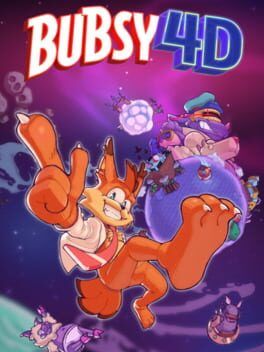

Atari and Fabraz are bringing Bubsy back to 3D with Bubsy 4D, a modestly scoped, multi-platform mascot platformer aimed at 2026’s crowded mid-tier space. Here is how the team is positioning the game, what the trailer quietly says about movement, level design, and humor, and why publishers keep dusting off ’90s mascots.
Bubsy’s Latest Nine Lives
Bubsy is back in 3D, and this time Atari is trying to make the punchline into a proper product.
Bubsy 4D, developed by Fabraz and published by Atari, is targeting a May 22, 2026 launch on basically everything: PS4, PS5, Xbox One, Xbox Series, Switch, Switch 2, and PC. Instead of chasing prestige-platformer status, the game is being framed as a consciously budget-friendly, nostalgia-aware mascot revival that fits into the mid-tier space many big publishers have largely vacated.
Fabraz, best known for Slime-san and Demon Turf, has carved out an identity as a studio that can do tight, characterful platformers with modest budgets. Pairing that with Atari’s increasingly active retro IP strategy makes Bubsy 4D less of a wild swing and more of a calculated portfolio move. Atari does not need this to be the next Mario; it needs it to be a reliable, reasonably priced product that can monetize goodwill around ’90s mascots without requiring blockbuster sales.
Positioning Bubsy 4D As A Modern Budget Mascot
The way Atari is rolling out Bubsy 4D says a lot about expectations. Price points on the physical deluxe editions, the wide platform spread, and the tone of the announcement all point toward a mid-shelf title meant to live comfortably below full-price tentpoles.
On Switch and Switch 2, the deluxe physical editions sit at $39 and $49 USD respectively. That is collector’s edition territory priced like a standard AA game, with the extras focused on low-cost, high-perceived-value items like a manual, poster, and artbook. It is a play tailored for nostalgic thirtysomethings who remember cardboard boxes and printed manuals, not the statue-and-steelbook crowd.
Digitally, Bubsy 4D slots into the growing ecosystem of AA and indie-adjacent 3D platformers. It is designed to be lightweight on hardware, accessible to families, and cheap enough to be an impulse buy during a sale. Where something like Sonic Superstars competes for premium shelf space, Bubsy 4D looks built to quietly accumulate sales across multiple storefronts and generations over time.
Atari’s current strategy has been to extend its catalogue with new spins on old names, from recharged classics to licensed reimaginings. Bubsy 4D fits that approach perfectly: low technical risk, known character, outsourced to a specialist indie studio that already has tools and experience in stylized platformers.
What The Trailer Reveals About Movement
The reveal trailer does more than signal that Bubsy is back; it telegraphs how Fabraz expects players to actually move through this world.
The most important piece is the expanded moveset. Bubsy can still run and jump, but the kit now clearly revolves around flow: gliding to correct awkward trajectories, clawing up walls to maintain vertical momentum, pouncing off enemies to chain through arenas, and using a new hairball rolling form to zip across open spaces.
The hairball roll in particular is a window into design priorities. It functions as both traversal and comedy, letting Bubsy ball up into a fast, physics-aided form that blasts through ramps and curves. It is a cost-effective way to inject dynamism without building an entirely new traversal system, and it plays to Fabraz’s past work with high-speed, precision movement.
Compared to modern mascot revivals that go heavy on combat or scripted setpieces, Bubsy 4D’s trailer skews toward analog control. Shots linger on extended glides over gaps, spiraling ramps built for repeated rolling, and multi-layered platforms that invite experimentation. If Fabraz follows its usual design philosophy, the moveset will be deep enough to reward speedrunners and challenge-seekers while still working for younger or lapsed players who just want to clear levels.
Level Design: Craft Worlds On A Budget
Bubsy 4D’s levels lean into a craft and toy aesthetic, which serves both creative and economic goals. Yarn, cardboard, and colorful plastics feature heavily in the footage: giant spools, patchwork platforms, and mechanical sheep framed like toys gone rogue. It echoes the crafted worlds of games like Yoshi’s Woolly World, but with a cheaper, intentionally kitschy edge.
From an industry perspective, this is clever production design. A craft-themed universe tolerates lower asset density, visible seams, and exaggerated geometry. That means fewer bespoke textures and a lot of reusable, modular pieces. It is a visual style that looks deliberate and playful even when built from a restrained asset library, perfect for a team that has to ship on eight platforms.
The camera work in the trailer hints at large but readable stages. Wide shots of broad pathways, hub-like spaces with multiple routes, and distant collectibles suggest that Bubsy 4D wants to land between tight obstacle courses and open collectathons. There is enough room for players to exploit momentum moves without sacrificing clarity, which is crucial for younger audiences and older players returning after decades.
Platform-friendly silhouettes and saturated colors help on the technical side too. They keep the game legible in handheld mode, on older TVs, and when compressed for streaming, all vital for a title that expects much of its marketing to come from creators revisiting Bubsy as a meme.
Humor: Leaning Into The Meme Without Drowning In It
Bubsy’s reputation is both a liability and a marketing angle. The original Bubsy 3D is infamous, and even later attempts like Bubsy: The Woolies Strike Back and Paws on Fire leaned hard on irony and self-aware jokes. Bubsy 4D does not abandon that history, but the trailer’s tone suggests a more cautious approach.
Quips and wordplay still feature prominently. Bubsy tosses out groan-worthy puns, and the premise involving stolen sheep, robotic BaaBots, and a Golden Fleece is knowingly absurd. But the humor is not just about acknowledging past failures. The narrative framing casts Bubsy as a character who has been around the block enough to treat yet another intergalactic crisis as just another Tuesday, a subtle way to pitch this as a veteran mascot taking another shot rather than a brand-new reboot.
From a production standpoint, this is a cheaper, safer bet than extensive voice-driven comedy. A small number of heavily reused voice lines, paired with exaggerated animation and sight gags, keeps the budget in check. The hope is that creators will do much of the comedic heavy lifting themselves by reacting to Bubsy’s delivery and the legacy of the brand.
Why The Industry Keeps Reviving ’90s Mascots
Bubsy 4D is not happening in a vacuum. The mid-2020s have seen a steady drumbeat of mascot revivals and spiritual successors, from Crash Bandicoot’s return to new entries in Klonoa and Gex. There are clear business reasons why publishers keep revisiting characters that peaked during the 16-bit and early 3D eras.
First, there is brand recognition that can be bought relatively cheaply. Licensing or owning dormant IP means sidestepping the marketing costs of introducing a completely unknown character. Even when the reputation is mixed, awareness is still awareness. Bubsy’s name alone guarantees curiosity clicks, reaction videos, and free social media reach that a brand-new bobcat simply would not receive.
Second, mascot platformers fit perfectly into the AA budget bracket that has become increasingly attractive in a risk-averse market. Compared to massive open-world or live-service projects, a focused, mostly linear 3D platformer is relatively contained. Technical requirements are lower, narrative demands are lighter, and systems design can build on decades of established genre expectations.
Third, the audience for these games is now multi-generational. Parents who grew up with these mascots can share them with children, and the tonal mix of slapstick, bright colors, and mild challenge fills a gap between mobile fare and hardcore releases. Bubsy may not be as beloved as some of his contemporaries, but he still taps into that cross-generational dynamic.
Finally, revivals like Bubsy 4D function as test balloons for broader IP strategies. If the game performs above expectations, it opens the door to merchandising, compilations of older titles, or even animated content. If it underperforms, the damage is limited to a single mid-budget release that can still recoup on long-tail discount sales.
Fabraz, Atari, And The Modern Mascot Playbook
Fabraz’s involvement may be the most important piece of Bubsy 4D’s pitch. The studio has shipped eccentric but mechanically sharp platformers before, and it has proven comfortable working from a constrained budget. For Atari, that makes Bubsy 4D less about reinventing 3D platforming and more about delivering a solid, content-complete product that can rehabilitate Bubsy’s image enough to justify further use of the character.
If Bubsy 4D can land in the same space as other well-liked AA platformers, it will validate a playbook that many publishers are already sketching out: outsource a nostalgic IP to a proven indie, aim for every viable platform, keep the scope tightly controlled, and sell it at a price that makes “why not” a reasonable purchase decision.
In that sense, Bubsy 4D is emblematic of where the mascot platformer sits in 2026. It is no longer a console-selling genre, but it is a dependable, flexible tool in a publisher’s kit. Whether Bubsy himself can finally shake off his punchline status will depend on execution, but his latest comeback is a very modern one, shaped as much by spreadsheets and platform strategies as by yarn balls and bad puns.