
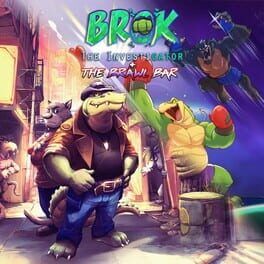
Brok: The Brawl Bar looks like a cheap couch brawler, but it is really COWCAT’s stealthy blueprint for where the Brok the InvestiGator universe goes next. We dig into its underground-bar setting, multiverse riffs, party-focused combat, and Creator Mode to see how this spin-off quietly expands the world and sets up future stories and multiplayer experiments.
Brok: The Brawl Bar could have been a throwaway bonus mode. On paper it is a ten dollar party beat ’em up spun out of Brok the InvestiGator’s combat, with a scrappy underground bar, sixty plus challenges and four player couch chaos. In practice it feels like something more ambitious: a pressure test for the Brok universe, for its characters, and for what this oddball “punch & click” series might become.
In our review we focused on how those ideas land from a critical angle. Step back from ratings and frame data though and The Brawl Bar reads like a design document for the next phase of Brok.
From apartment stairwell to underground bar
The original Brok the InvestiGator kept its cast tight and its world relatively grounded. You saw the Slums and the domed Drumer city from the vantage point of a working class dad detective scraping by. Fights existed, but they were punctuation between dialogue, puzzles and moral choices.
The Brawl Bar flips that balance. Brok follows a lead into a hidden bar tucked beneath the Slums and suddenly you are in a social hub where combat is culture. Every regular has a gimmick. Fights are entertainment, currency and ritual. It is the kind of location you would visit for one clever quest in an adventure game. Here it becomes the entire stage.
That shift matters for the universe. Brok’s world has always been about class divides and manufactured safety under the dome. By dropping you into a secret den where the unwanted blow off steam with bare claws and energy weapons, COWCAT shows a slice of society that the main story never had bandwidth to linger on. You glimpse how the Slummers mythologize fighters, how information travels in whispers between bartenders and bookies, how the law looks the other way as long as trouble stays buried.
It is also the first time the series has a true “hub” space that feels designed for repeat visits rather than narrative progression. The bar changes as you unlock new challenges, characters drift in and out, and the background chatter gestures at life beyond Brok’s latest case. If the original game was a tour through a closed dystopia, The Brawl Bar is a small but dense neighborhood inside it.
Side stories hiding in a party game
COWCAT markets The Brawl Bar as a chaotic, replayable spin off, not a must play story chapter. Yet the framing and incidental details quietly sew more threads into Brok’s fiction.
Brok’s motivation is almost comically simple: he wants to prove he is still top dog in the ring. That mid life crisis conceit is the perfect excuse to bring in the rest of the cast. Characters you know from the adventure show up in fighting roles, with exaggerated traits turned into movesets. Their banter before and after clashes is light, but it works as an epilogue of sorts, showing where everyone lands emotionally once the main plot dust has settled.
The structure of the game feeds this. Each of the sixty plus challenges feels like a tiny vignette. A fight where you cannot jump mimics a nightmare about losing your edge. A bout fought atop exploding barrels plays like a bar legend retold so many times the details turned absurd. Cooperative challenges where one player supports from the sidelines hint at alliances among secondary characters that only ever existed between lines of text before.
This is where The Brawl Bar stops looking like disposable content and starts feeling like an anthology. Nobody is going to buy it for deep lore, but if you already care about Brok’s world it is full of throwaway lines and situational jokes that color in the margins. That, in turn, suggests COWCAT has more confidence that the setting can survive outside strict adventure frameworks.
Party brawling as character study
Mechanically The Brawl Bar is a lean extraction of what made the original’s combat surprising. Brok’s beat ’em up segments were already better than they needed to be for an adventure game, with juggling, specials and light crowd control. The spin off doubles down, then wraps that skill ceiling in a structure meant for newcomers and party players.
Instead of a linear campaign, you get a wall of handcrafted scenarios in the spirit of classic “event matches.” One challenge might force you to use throws only, another might spawn a rain of hazards that reposition you constantly, another might ask you to keep a fragile NPC alive while waves of bots crash the bar. The common thread is that you learn a specific quirk of the system through a ridiculous setup.
In solo play that structure is clever pacing. It teaches you how Brok and his friends move, where their hitboxes shine, how to manage space when meters are limited or enemy patterns change. In multiplayer it becomes a personality test. Put four people in a cramped arena with slippery floors and suddenly the cautious friend, the chaos agent and the secret lab monster all emerge at once.
That approach to brawling feels very “Brok” in how it blends character and mechanics. Brok the character is a former boxer turned PI who solves problems with both fists and empathy. Brok the system teaches you to read space and intent, to pick your moments, then to blow everything up in one loud haymaker when an opening appears. The Brawl Bar exaggerates that ethos and invites your friends into it.
Crucially, this is the first Brok game built from the ground up for four player couch co op. Local multiplayer is the default, not a side mode. The presence of a Support mode specifically for beginners shows that COWCAT is thinking about mixed skill tables: parents brawling with kids, partners who usually avoid fighters, roommates who just want something loud to mash on between rounds of Mario Kart.
If the original Brok proved the combat could carry a story when necessary, The Brawl Bar proves it can carry a room full of people by itself.
Creator Mode and the Brok multiverse
The wild card in The Brawl Bar’s design is its Creator Mode. On PC, players build their own challenges, tweak rulesets and share creations through Steam Workshop. At face value that is a nice bonus for a cheap brawler. From a universe perspective it is more interesting than it first appears.
In fiction terms, you are essentially curating your own urban legends inside this underground bar. Every user made challenge is another tall tale about what “once happened” in that smoky back room. The official sixty plus scenarios are already heightened and silly; community work pushes that energy into fan canon.
Mechanically, Creator Mode asks: what if Brok’s world was defined less by fixed puzzles and more by a wide spectrum of possible situations? The answer is a Brok multiverse, where alternate versions of familiar characters clash in impossible circumstances. One creator might build a gauntlet that recasts Brok as an unstoppable tank. Another might design a puzzle like arena where only precise platforming wins. None of it is canonical, but all of it is experienced through the same cast and backdrop.
That has implications for where COWCAT can go next. Once players get used to seeing Brok and his friends as flexible toys inside a sandbox of variables, a Roguelite brawler spin off, or an episodic anthology of short cases, suddenly feels less like a risk. Creator Mode normalizes the idea that this universe can hold wildly different tones and rule sets without breaking.
On consoles that experimentation is capped by platform limits, with no full blown mod scene. Even there, though, the in game tools and curated challenges showcase that Brok’s mechanics and fiction are robust enough to survive systemic remixing.
What this spin off hints about future Brok stories
Taken as a whole, The Brawl Bar is a small game that sends loud signals about COWCAT’s priorities.
Narratively, it shows a willingness to zoom in. Instead of escalating the stakes beyond the dome, it zeroes in on a single neighborhood and lets character relationships breathe inside a lighthearted frame. A natural follow up would be more self contained vignettes: maybe a mystery that plays out entirely inside the bar, with branching routes based on which fights you pick, or a short campaign focused on a side character who got only a handful of scenes in the main game.
It also shows how Brok’s world can support tonal whiplash. Brok the InvestiGator dealt with systemic injustice, family trauma and environmental decay. The Brawl Bar is about proving you can still throw hands with the kids half your age. Being able to swing between those extremes without losing the cast’s charm suggests future entries could confidently juggle heavier themes with unabashed slapstick.
If COWCAT wanted to push the universe forward chronologically, the bar is a perfect recurring location. You could imagine a sequel that checks in on it every few cases, letting you see the Slums culture evolve. Maybe one arc explores how corporate interests try to sanitize or monetize it. Maybe another follows an up and coming fighter whose rise intersects with Brok’s investigations. The groundwork is already there.
Where the series could go on the multiplayer side
Mechanically, The Brawl Bar feels like a prototype for a full Brok multiplayer pillar.
Right now, it is entirely local, with Remote Play Together on PC filling in for true online. If the community response is strong, it is not hard to picture a follow up that pairs Brok’s combat with proper netcode and a deeper progression layer. Think a Brok themed arena fighter where bar regulars and villains from the main game share a roster, with cooperative boss raids and rotating “story playlists” that remix iconic encounters as party challenges.
Even without going that far, COWCAT has already mapped out a structure that slots cleanly alongside the adventure formula. One lane becomes single player or story focused co op, with exploration, dialogue, puzzles and a light morality system. The other becomes replayable combat content built around creative rulesets, creation tools and regular updates. Progress or cosmetics could flow between them, tying your time in the bar back into Brok’s day job.
The fact that The Brawl Bar shipped as a ten dollar standalone instead of a tiny DLC also hints at confidence. COWCAT seems comfortable treating Brok as a platform: a recognizable universe that can host radically different games without losing its identity. From there it is easy to imagine a tactics spin off about police crackdowns in the Slums, a minigame compilation framed as kids in the dome playing bootleg Brok arcade cabinets, or a visual novel focused on one of the bar’s regulars.
A small bar with big implications
Brok: The Brawl Bar is modest in price and scope, but as an experiment it carries weight. It turns a background detail from Brok the InvestiGator into a living, breathing social space. It proves that the punch half of “punch & click” can stand on its own, support a room full of players and survive wild community remixing. It invites fans to treat the Brok universe less like a single story and more like a playground.
Whether COWCAT’s next step is Brok the InvestiGator 2, another offbeat spin off or something that weaves adventure and party brawling together more tightly, the blueprint is here: a world that can hold both quiet interrogations and loud, ridiculous bar fights without ever losing its heart.