
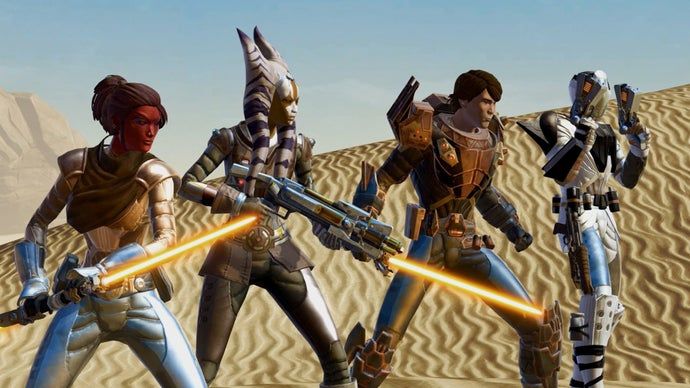

Former BioWare producer Mark Darrah says EA wanted live service games long before the term became standard, and that Star Wars: The Old Republic shaped how the publisher viewed BioWare.
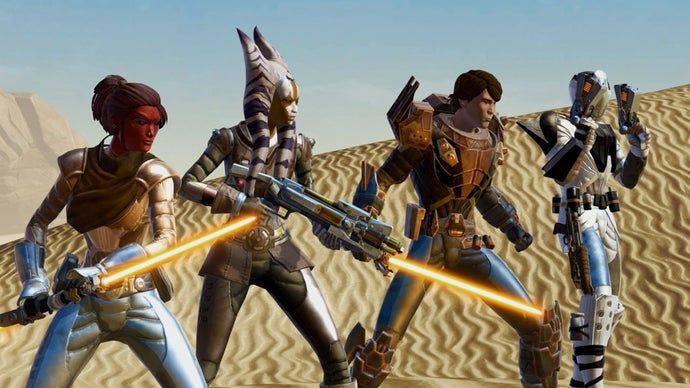
Image: 217gs.com
Darrah says EA wanted the MMO first, and BioWare Edmonton second
Former Dragon Age producer Mark Darrah has put unusually blunt language around a tension BioWare fans have debated for years: according to Darrah, Electronic Arts’ interest in BioWare was tied heavily to live service ambition, with Star Wars: The Old Republic serving as the prize and BioWare Edmonton feeling like an added benefit.
Speaking on Pembridge TV in an interview titled “EA, BioWare, and Dragon Age,” Darrah said, “EA’s always wanted everything to be a live service. They just didn’t use that language in the past.” Rock Paper Shotgun and other outlets reported the comments, which frame EA’s 2007 BioWare acquisition through the business logic of the mid-2000s MMO boom rather than through BioWare’s reputation for single-player RPGs.
Darrah’s core claim is specific. In his view, EA wanted Star Wars: The Old Republic, the MMO being built by BioWare Austin, and also wanted Pandemic, the studio associated with Star Wars: Battlefront. “For me, and for many people in Edmonton at the time of the acquisition, it looked like EA was buying Star Wars: The Old Republic and Pandemic and getting BioWare Edmonton as a side effect,” he said, according to reports of the interview.
That distinction matters for RPG players because BioWare Edmonton was the studio tied to the company’s single-player identity, including the kind of quest design, companion writing, player choice, and party progression that made Mass Effect and Dragon Age the shorthand for a particular kind of western RPG. Darrah is not presenting an EA acquisition document. He frames much of this as his perception from inside the studio, and MMOs.com notes that he was a programmer in that period with limited insight into BioWare’s finances. Still, the account is valuable because it comes from a veteran developer who lived through the transition from independent BioWare to Mass Effect developer EA subsidiary.
The live service language changed, but the target was already clear
Darrah’s most useful observation is historical rather than semantic. He argues that EA did not need the modern phrase “live service” to be chasing the same outcome: a long-running game that keeps players engaged and paying over time. Before Destiny became the obvious reference point for publishers, the model was the MMO.
In Darrah’s telling, World of Warcraft redefined the commercial fantasy for large publishers. “Everyone wanted a World of Warcraft killer,” he said, as quoted by Rock Paper Shotgun and Yahoo Finance. The Star Wars license made that fantasy especially tempting. If any MMO could be imagined as a challenger to Blizzard’s dominant subscription world, a BioWare-developed Star Wars project following Knights of the Old Republic had obvious boardroom appeal.
That is the pressure point for BioWare EA live service history. The studio’s older strengths were built around authored campaigns, branching conversations, party members with questlines, and player identity expressed through builds and moral choices. An MMO asks different questions. How often can content arrive? How long can players be retained? How many systems can support repeat play? How much of the game is designed for launch, and how much is designed for years of maintenance?
None of the provided sources say EA has announced a new live service mandate for BioWare today. The confirmed claim is narrower: Darrah says EA’s appetite for persistent, recurring-revenue games was present long before the industry settled on the current label. For fans watching the future of Dragon Age, Mass Effect, or anything else BioWare may make under EA, that history is a lens, not a roadmap.
SWTOR became the test case EA allegedly resented
Star Wars: The Old Republic sits at the center of Darrah’s account because it was the game that supposedly justified the acquisition logic and then failed to satisfy the expectations attached to it. Darrah said EA wanted SWTOR “really bad,” but soured on it after launch when it did not hit the numbers the publisher wanted.
“EA hated SWTOR from the beginning,” Darrah said, according to Rock Paper Shotgun and MMOs.com. He added that it “always seemed” to him that EA wanted the MMO gone almost from the moment it launched below expectations, that the publisher did not want to invest in it, and that there had been long-running talk of pulling people off the project. MMOs.com reports that Darrah named then-EA studios boss Patrick Söderlund as a driving force behind that hostility. The sources provided do not include a response from EA or Söderlund, so that part remains Darrah’s allegation as reported, not an independently verified corporate record.
The irony is that Darrah also says SWTOR eventually “more than paid for itself,” though it took a long time. MMOs.com likewise describes the game as still running and receiving new content, now developed by Broadsword and published by Electronic Arts. It is listed as free-to-play on Steam, according to that report, and MMOs.com cites a Metacritic score of 85.
For RPG fans, SWTOR is a strange artifact in BioWare history. It is a live service MMO, but it also carries BioWare DNA in class stories, companion arcs, faction identity, and the attempt to translate conversation-driven questing into a shared online world. Darrah’s comments suggest that this hybrid may have been judged less by whether it served BioWare’s narrative strengths and more by whether it could become the massive World of Warcraft challenger EA had imagined.
The acquisition looks different when Pandemic and Austin are kept in frame
Darrah’s version of events depends on remembering that BioWare was not acquired in isolation. Yahoo Finance and N4G both note that BioWare had been acquired in 2005 alongside Pandemic Studios by a private equity fund and placed under a single holding company. EA then bought the package in 2007. Pandemic, known for the original Star Wars: Battlefront games, was shut down by EA in 2009, according to the same reports.
That context changes the way the deal reads. If the package included BioWare Austin’s Star Wars MMO, Pandemic’s Star Wars-associated pedigree, and BioWare Edmonton’s single-player RPG teams, Darrah’s “side effect” phrasing becomes less a throwaway insult and more a description of perceived priority. In his account, Edmonton’s RPG craft was valuable, but not necessarily the reason EA was spending.
Yahoo Finance reports that Darrah also said BioWare had stretched itself by making games larger than other people’s games and continuing to expand its scope by hiring. He said his understanding was that the studio had essentially run out of money and needed funding to continue existing, while stressing that he did not have strong visibility into the company’s finances because he was a programmer at the time.
That caveat is important. Darrah is not giving readers a full balance sheet. He is describing how the acquisition felt from inside BioWare and how EA’s strategic appetite appeared to staff in Edmonton. The distinction keeps the story grounded: the 2007 purchase happened, BioWare Austin was building SWTOR, Pandemic was part of the package, and Darrah says the RPG teams felt secondary to EA’s interest in Star Wars and MMO-scale service revenue.
For BioWare’s RPG audience, the concern is production gravity
The long-term question for BioWare fans is not whether single-player RPGs can coexist with live service ambitions. SWTOR itself proves that BioWare systems can be adapted into an online structure, and Mass Effect and Dragon Age continued after EA bought the company. Darrah’s concern points instead to production gravity: what happens when a publisher values the recurring service model so strongly that every studio is evaluated through that expectation?
RPGs like BioWare’s traditional work are expensive for reasons that do not always line up with service metrics. A branching quest may require writing, cinematic implementation, voice work, animation, combat tuning, state tracking, localization, QA, and long-tail continuity checks for choices only a portion of players will see. Companion arcs and faction decisions create value through specificity and consequence, while live service planning often seeks repeatable loops, scalable content, retention cadence, and monetization durability.
Darrah’s comments do not prove that every BioWare problem after 2007 came from EA chasing live service games. The provided sources do not support that broad claim. They do, however, support a narrower and more useful reading: a major EA purchase involving BioWare was, in Darrah’s view, shaped by the hope that SWTOR could become a huge live service product, while BioWare Edmonton’s single-player RPG teams were not perceived internally as the main attraction.
That helps explain why the phrase Mark Darrah BioWare still carries weight among longtime players. He is not an outside analyst reading the tea leaves from a trailer. He is a former BioWare veteran interpreting the business incentives around the studio’s most consequential ownership change. His account gives fans a better vocabulary for asking whether future BioWare projects are being built around the strengths of authored RPG design or around revenue structures that demand a different kind of game.
The future strategy signal is suggestive, not a confirmed plan
Nothing in the provided source material announces a new BioWare title, a changed Mass Effect release window, a Dragon Age live service pivot, a SWTOR shutdown, or a new EA directive. Readers should be careful about treating Darrah’s interview as a leak. It is retrospective commentary, supported by his experience and reported by several outlets, but it does not confirm EA’s current BioWare roadmap.
What it does suggest is a pattern worth watching. If EA has long preferred games that behave like services, then BioWare’s future will likely be judged by how well its projects fit the publisher’s business expectations as well as by how well they satisfy players who come for character builds, dialogue choices, companion loyalty, faction conflict, and authored campaign structure. That does not mean every future BioWare game becomes an MMO. It means fans should pay attention to the systems that reveal priority: post-launch content plans, online requirements, monetization language, multiplayer framing, update cadence, and how much the studio foregrounds single-player consequence.
SWTOR remains the clearest case study because it is both the live service Darrah says EA wanted and the game he says EA disliked after it failed to reach desired numbers. It survived, paid for itself according to Darrah, and continues outside BioWare under Broadsword development with EA publishing, as reported by MMOs.com and N4G. That endurance complicates any simple story of failure.
For RPG fans tracking BioWare EA live service pressure, Darrah’s comments are best read as a warning about incentives. BioWare’s most beloved work depends on systems that reward patience: quest branches, character investment, build expression, and narrative payoff across dozens of hours. Live service strategy rewards different forms of continuity. The unresolved question is whether EA’s handling of BioWare can leave enough room for both, or whether the studio’s RPG identity will keep being measured against business fantasies that started, in this account, with the search for a Star Wars World of Warcraft killer.