
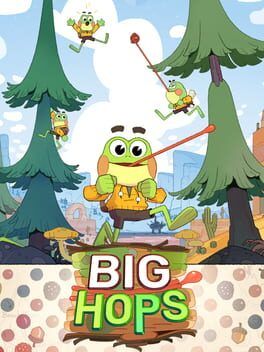

How Luckshot Games’ Big Hops turns a frog’s tongue into both grappling hook and weapon, brings Banjo-style collectathons to PS5, Switch, and PC, and slots into the new retro 3D platformer wave alongside Astro Bot and Wario World’s return.
Big Hops wears its inspirations on its sleeve, but it does it with such gleeful froggy energy that it immediately feels like more than just another retro throwback. Luckshot Games’ upcoming 3D platformer is built around a single idea that holds everything together: your tongue is the most important tool you have.
You are Hop, a small, bright green frog ripped from home by a trickster spirit named Diss and dropped into a patchwork world of chunky platforms, oversized veggies, and industrial oddities. On paper it sounds like a lost GameCube-era mascot pitch. In motion it looks like a modern answer to a simple question: what if the freeform movement of a 3D collectathon was rebuilt around a physics-driven grappling tongue, then stretched across big, open-ended worlds you can pick apart at your own pace?
Tongue-first traversal
The tongue is where Big Hops immediately separates itself from most of its peers. Classic 3D platformers tend to give you a jump, a double jump, maybe a spin or a dive. Big Hops takes that familiar base, then layers a full movement kit on top of it and routes it all through the frog’s mouth.
Hop can flick their tongue out to latch onto anchor points, enemies, and environmental objects. Once attached, you can fling yourself forward, swing across gaps, or vault up and around corners. Because the tongue is physics-driven rather than locked to a single canned animation, getting good with it is about reading angles and momentum as much as timing a button press. In previews, players talk about chaining swings together, snapping from one anchor to the next in midair in a way that looks closer to a grappling-focused action game than a traditional mascot platformer.
You are not limited to obvious grapple points either. A lot of the game’s traversal is about experimenting: can you grab that distant ledge? Can you tongue a passing creature and use its weight to slingshot yourself to a secret above? The mechanics invite improvisation, which aligns neatly with the developers’ stated goal of fostering emergent movement rather than just obstacle courses of floating islands.
Vegetables as platforms and puzzle pieces
Big Hops’ other signature trick leans into the frog’s earthy, slightly grimy charm. Rather than conjuring platforms out of thin air, you grow them.
Throughout levels you plant and nurture oversized vegetables that double as geometry. Pumpkins bulge into round, bouncy footholds, beanstalks stretch upward into impromptu ladders, and root vegetables can bridge gaps or redirect hazards. Growing these veggie platforms is not just a switch-flipping puzzle solution, it is another expression of Hop’s toolkit. You might plant a line of sprouts to extend a tongue grapple route, or raise a fat turnip just high enough to give you a better swing angle onto a distant collectible.
This gardening layer plays into exploration pacing. Instead of just running to the far end of a linear stage, you slowly cultivate routes through spaces, coming back with new ideas for how to route your hops and swings. It evokes the best parts of 90s collectathons, where revisiting a familiar hub area with a new move could reveal entire chains of secrets hiding in plain sight.
Combat built on the same tongue tricks
A lot of retro-style 3D platformers either downplay combat or fall back on simple butt-stomps. Big Hops keeps things light and readable but still rests everything on the tongue.
Enemies can be lashed, pulled, stunned, and repositioned. You can reel smaller foes straight into Hop’s fists or feet, whip them into each other, or use them as living grappling anchors that drag you into the air. Larger enemies sometimes carry shields or projectiles that can be snatched away, turning defense into ammunition.
Because the tongue has reach, the most satisfying encounters resemble little movement puzzles. Instead of standing in place and trading hits, you are ricocheting around arenas, bouncing off veggies you planted earlier, grabbing a stray projectile and sending it back mid-swing. The overlap between traversal and combat is what sells the system. You are rewarded for staying airborne, staying in motion, and treating enemies as part of the level geometry.
A cross-platform frog on PS5, Switch, and PC
Big Hops took a winding path to a full multi-platform launch. It began as a PC-first project, then rode a successful Kickstarter campaign that raised around $50,000, enough to secure a Switch port. Since then, it has grown into a full cross-platform release.
Luckshot Games now plans to launch Big Hops on PlayStation 5, Nintendo Switch, and PC via Steam on January 12, 2026. The Day of the Devs: The Game Awards Edition 2025 showcase locked in that date and confirmed that all three platforms are part of the first wave.
On PC, the Steam version is positioned as the lead build, with a demo already giving players a taste of the early movement sandbox. PS5, meanwhile, appears to be the “high-end console” target, highlighted in PlayStation-centric coverage as a natural next step for Astro Bot fans who want something more open and mechanically demanding.
Switch is where the retro aesthetic really makes sense. The game’s clean, colorful visuals and relatively low-tech effects scale well to the hybrid handheld. Previews from hands-on Switch sessions emphasize stable performance and snappy controls rather than cutting-edge fidelity, which seems like the right priority for a movement-heavy platformer built on precise tongue-grabs and momentum swings.
A 90s collectathon at heart
The moment you see Big Hops in motion, the inspirations come flooding in. It has the wide, chunky geometry and candy-colored palettes of Nintendo 64 classics, the purposeful hub-and-spoke structure of Banjo-Kazooie, and a sprinkling of GameCube-era environmental storytelling.
Hop’s central quest is to build an airship home with the help of a wiry raccoon mechanic. To do that, you scour large, semi-open regions for airship parts and other shiny collectibles. Along the way, you find self-contained pocket adventures: infiltrating the Gulley Gang’s hideout by a vast red desert, signing on as a “Bucko” to rescue DrillCO’s rig workers out at sea, or spelunking beneath a shattered mountain to slip past Haven cultists.
Each area layers objectives and secrets in a way that should feel familiar to anyone who grew up checking off Jiggies or Power Stars. You might go in intending to grab one airship part and come out an hour later with a pile of side collectables and story threads pointing you toward the next region. That is the quiet magic of the 90s collectathon structure, and it is clear Big Hops is leaning into it rather than trying to reinvent progression from scratch.
At the same time, Luckshot talks about wanting to “take a step forward” for 3D platformers instead of just re-creating old tricks. The tongue physics, the veggie-growing systems, and the emphasis on freer, parkour-flavored movement are where that ambition shows. It is an attempt to graft modern systemic design onto the warm skeleton of a mascot-platformer.
Standing out in a new 3D platformer wave
Big Hops is not releasing into a vacuum. The last few years have quietly turned into a mini-renaissance for 3D platformers, capped off by Astro Bot’s breakout as a modern PlayStation mascot and Nintendo’s renewed interest in its quirkier past, including the recent re-release of Wario World.
Astro Bot in particular has reset expectations for what a first-party 3D platformer can look like on modern hardware. It is a dense, propulsive rollercoaster of set pieces, tight levels, and gadget-driven gimmicks. Big Hops feels positioned almost as a counterweight. Instead of rollercoaster pacing, it is about taking your time, testing movement options, and building your own routes through broader spaces. Where Astro Bot constantly swaps toys in and out, Big Hops keeps you grounded in a single, expressive move-set and lets depth come from mastery rather than novelty.
The Wario World comparison cuts another way. Nintendo’s GameCube oddity has won new appreciation for its crunchy combat and weird little arenas that blur the line between beat-em-up and platformer. Big Hops arguably sits between that and classic Banjo-style collectathons. Its tongue-based combat gives encounters a physical snap similar to Wario’s grabs and piledrivers, but all of it lives inside spaces that encourage platforming creativity, not just enemy juggling.
There is also the broader context: Day of the Devs 2025 was full of frog-fronted games, and Big Hops still managed to stand out. That suggests the hook is more than skin-deep. A frog protagonist may be on-trend, but a frog whose entire identity is wrapped around a high-skill grappling kit, grown-platform puzzles, and a sprawling collectathon structure is still rare.
Why Big Hops is worth watching
On paper, Big Hops sounds like a checklist of genre comfort food. There is a mascot hero, a whimsical kidnapping plot, a goofy cast of animal weirdos, a hub area, and a sea of collectibles. What sells it is how tightly those elements are bound to the tongue.
Traversal, combat, and puzzle-solving all feed back into that one mechanic. Every time you discover a new veggie type or enemy behavior, the first question becomes “what can my tongue do with this, and how does it change the routes I can draw through this world?” That is the sort of mechanical throughline that separates the throwback curiosities from the modern standouts.
With its January 12, 2026 launch on PS5, Switch, and PC, Big Hops is arriving right as players are hungry for more after clearing Astro Bot and rediscovering Wario World. If Luckshot Games can stick the landing on performance across platforms and maintain that delicate balance between precision and playful chaos, this froggy adventure could be the next cult-favorite pillar of the 3D platformer revival.