
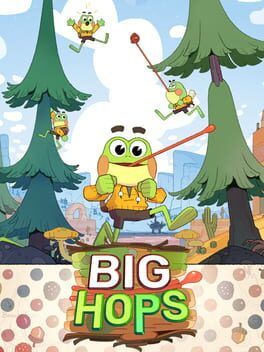

How Luckshot Games built Big Hops as a physics-driven, open 3D platformer that’s welcoming to casual players yet deep enough for hardcore speedrunners.
Big Hops is the kind of surprise that only really happens in the indie space. On the surface it looks like a cute 3D collectathon starring a small frog in a colorful world. Watch a stream for more than ten minutes, though, and it becomes clear why early reviewers are already invoking Mario sandboxes and even The Legend of Zelda’s open-ended traversal. This is a movement-first platformer where physics are the real co-star, and where Luckshot Games has very deliberately built systems that can be enjoyed slowly or utterly broken by players who love going fast.
Mario bones, Zelda blood
In structure, Big Hops is immediately familiar. You play as Hop, a little frog pulled into an alternate realm called The Void, then turned loose in a set of big, self-contained worlds. Each space hides airship parts and other collectibles, plus a light main story involving the enigmatic Diss. It is approachable and readable in the same way a Mario hub world is, with a gentle loop of enter a level, grab something interesting, come back a bit stronger.
What makes it feel Zelda-like is how open those spaces are once you get inside them. Reviewers describe wide, multi-route environments where the intended path is really more of a suggestion. You are rarely locked into a single golden breadcrumb trail. Instead you eyeball a cliff, a tower or a strange gadget and start asking yourself how your current set of moves and fruits could get you there. This is where the Breath of the Wild comparison comes in. Momentum, stamina and improvisation matter as much as any designer-placed platform.
Movement tech that rewards curiosity
Hop’s basic kit sounds simple on paper. You can run, jump, dash, perform a sliding belly flop, climb surfaces with a stamina bar and lash out your tongue to latch onto things. In practice these actions combine into a toolbox that feels closer to a speedrun-friendly platformer than a laid-back mascot game.
Momentum is central. A dash into a jump into a slide will carry you far further than any one move alone. Early players are already sharing clips of chaining moves across huge gaps or launching themselves up slopes that look impossible on first glance. The tongue is more than a cute animation, too. It lets you grab environmental gadgets, swing or fling between bubble nodes and generally treat the level geometry as something to be solved rather than just walked on.
Crucially, the physics here are a little loose and bouncy instead of locked to a grid. That creates occasional jank, as some reviewers note, but it is also what makes Big Hops feel alive. Slightly mistimed jumps might still be salvaged with a desperate tongue lash or last second climb, and skilled players can wring extra distance out of slopes or angled surfaces. It is the kind of system that feels forgiving if you are just experimenting, but also deep enough that dedicated players will spend hours in a single zone, hunting for the perfect line.
Fruits, gadgets and open-ended problems
Rather than stock enemies, Big Hops fills its worlds with environmental toys. Special fruits act as portable level design tools. Plant one type and you grow climbable vines that can turn a bare wall into a route. Another seeds ropes across gaps, creating impromptu tightropes or ziplines. Bubble fruits spawn floating nodes that you can bounce between, slingshotting with your tongue. Peppers and other reactive items introduce fire and chain reactions, letting you burn through obstacles or send objects careening into new positions.
In early footage, these systems are what really make the game look like a sandbox. Designers clearly authored specific puzzles, but they do not feel like single-solution locks. Many players report finding alternative paths using fruit seeds in ways that feel almost like exploits, even when the solution is probably intended. The physics-driven nature of the world means that placing a vine two steps higher or throwing a burning pepper at an unexpected target can completely change your route.
The tradeoff is that this openness sometimes tips into flimsiness. Both GameSpot and Video Chums point out that fruit-based challenges can be finicky when timing or seed placement is unclear, leading to a few trial-and-error-heavy segments. Yet even those criticisms come with an undercurrent of respect, because the same looseness is what enables big skips and creative problem solving. It is a game that occasionally misfires, but almost always in pursuit of giving players more freedom.
Big worlds, sparse spaces
Step back from the moment-to-moment movement and Big Hops looks like a classic 3D platformer collectathon. Levels are large, often surprisingly so for an indie production, with distinct visual themes and little pockets of activity. You are chasing airship parts, grabbing currency, hoovering up a strange resource used to buy backpack patches and hunting down optional secrets.
The early consensus is that these worlds favor breadth over density. Reviewers praise the sense of scale but also note that many areas feel under-populated. There are long stretches of beautiful but relatively empty terrain between points of interest. For casual players who are simply enjoying the vibes and picking up whatever they stumble across, that space can feel calming. For completion-oriented players trying to clear every collectible, the same expanses can be tedious.
It is easy to imagine future patches tightening the experience with more traversal toys, side activities or fast-travel anchors. Even as it stands, there is a certain retro charm to wandering a bit aimlessly, scanning the horizon for the next structure or glint of a pickup, then plotting a route that makes the most of your movement tech.
Made for both chill play and speedrunning
One of the most interesting through lines in early coverage is how cleanly Big Hops splits the difference between being a relaxing platformer and a potential speedrun darling. The minimal enemy presence and forgiving checkpointing make it approachable for anyone. Stealth sections involving guards and security cameras are more like brief changeups than real difficulty spikes, and failures usually bounce you back without heavy punishment.
At the same time, the mechanics are ripe for optimization. Stamina-based climbing that can be temporarily buffed by eating bugs invites resource routing. Physics-heavy movement opens doors for tech like slope boosts, chained slides, and momentum carries. Fruit placement and gadget interactions create countless micro-skips and emergent shortcuts. You can see the skeleton of a robust any-percent and 100 percent meta in how routes can snake through the same terrain in radically different ways depending on your skill and goals.
The backpack patch system reinforces this flexibility. By trading in collected resources, you equip passive perks that can be tuned toward exploration, collecting or raw efficiency. One patch might help reveal pickups on your compass, perfect for slower, methodical clearing. Another boosts coin acquisition, letting you front-load shop items and potentially shave time off future runs. The fact that some upgrades already feel overpowered to reviewers is actually a promising sign for speedrunners, who thrive on toolsets that bend a game to their will.
Inside Luckshot’s design philosophy
Luckshot Games has been candid in early interviews and dev commentary about wanting Big Hops to be a playground first and a challenge second. The absence of traditional enemies is a design statement. Rather than peppering you with combat encounters, they put almost all the budget into traversal, systemic interactions and environmental toys. The world is populated by friendly animal characters, light dialogue and customization options such as dyeing Hop’s clothing, all of which underscore the idea that this is a space to inhabit, not a gauntlet to suffer through.
The Void itself functions as a thematic wrapper for that philosophy. It is a place just strange enough that the rules can bend without breaking. Rope seeds that materialize bridges, peppers that spontaneously ignite, bubbles that suspend you in midair, all of it fits because this is a reality that does not have to make strict physical sense. That gives the team license to push physics in fun directions, then trust players to experiment until movement feels natural.
Crucially, Luckshot seems comfortable letting the community take ownership of Big Hops’ systems. The slightly janky edges, the occasional clipping bug or environmental oddity, are the flipside of a design that values discovery. Glitches that would be unacceptable in a more scripted action game here become fodder for sequence breaks and highlight reels. As long as progression is not completely blocked, the developers appear more interested in seeing what players do with their toy box than in locking every piece down.
Watching Big Hops grow
Big Hops arrives at a moment when 3D platformers are enjoying a quiet resurgence, but very few manage to capture both the clarity of Mario and the systemic freedom of modern Zelda. Early reviews land in the 7-out-of-10 range, reflecting worlds that can feel too sparse and a handful of rough mechanics. Yet streamers and early adopters keep gravitating to the same core strengths: movement that feels great to experiment with and a design ethos that says yes more often than it says no.
For casual players, that means a charming, low-pressure adventure where the cute frog with the big jump can slowly explore strange lands, unlock patches, tweak outfits and gradually master their own little corner of The Void. For speedrunners and mechanical obsessives, it is a physics playground begging to be cracked open, routed, and ultimately broken in the most entertaining ways possible.
If Luckshot Games continues to update and tune Big Hops from here, tightening level density and smoothing its roughest puzzles, this early cult hit could easily hop into the broader conversation around modern 3D platformers. Even in its current state, though, it already sits comfortably next to the Mario and Zelda-inspired sandboxes it clearly admires, powered by one simple, effective idea: give players a joyful way to move, then trust them to find the fun.