
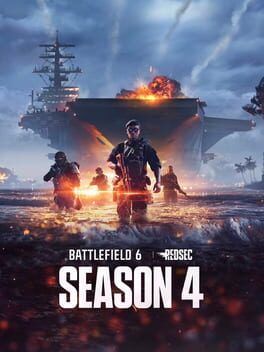
Battlefield 6's Top Gun update arrives August 18 with Wake Island, Carrier Strike, Fighter Sweep, two-seat jets, and control assists aimed at making air combat matter again.
Image: IGDB
Store links: Battlefield 6 Season 4 on Steam
Battlefield 6’s next update puts aircraft back at the center of the fight
The Battlefield 6 Top Gun update launches on August 18, and EA’s own community update confirms the headliners: a reworked Wake Island, two aircraft-focused modes, new two-seat jets, a sniper rifle, and a new REDSEC battle royale point of interest. The tension is clear. Battlefield Studios is adding the kind of air and vehicle-heavy content players expect from the series, but it also has to make those tools readable, fair, and useful in live matches where infantry pacing, map flow, and vehicle dominance can make or break the night.
EA says the update is part of Season 4 and is built around the Top Gun collaboration. GamingBolt reports the same date and frames the patch as the next major Battlefield 6 update, while DualShockers notes that the game has had “ups and downs” since launch, citing player-reported issues with matchmaking, hit registration, and map balance. That context matters for this Battlefield 6 update because adding jets is the easy pitch. Making those jets strengthen the match instead of flattening it is the real test.
Confirmed platforms for Battlefield 6, according to WorthPlaying’s game listing, are PC, PlayStation 5, and Xbox Series X. The sources provided do not list a separate price for the Top Gun update, so there is no confirmed paid upgrade cost to report here.
Wake Island is being rebuilt around carriers, water, and bigger vehicle lanes
EA describes Battlefield 6’s new Wake Island as a modern reimagining of one of the series’ best-known combined-arms maps. The studio says Wake Island has traditionally been known for open combat lanes, island-wide momentum swings, and a mix of infantry, vehicles, and aircraft shaping the fight. For Battlefield 6, EA says this version has a stronger focus on naval warfare and large-scale conflict across land, air, and sea.
The biggest structural change is the carrier setup. EA says carrier-based HQs anchor both sides of the battle, while the surrounding water and island layout create opportunities for vehicle play, infantry pushes, and aerial support. GamingBolt adds that both sides of the new Wake Island map are flanked by aircraft carriers serving as HQs, forcing players to deal with the water around the island while moving toward objectives.
That is the right kind of map premise for stronger vehicle warfare because it gives pilots and boat crews a reason to exist beyond farming infantry. If the sectors are placed well, aircraft can pressure openings, boats can contest routes, and infantry can still decide the capture game. If the geometry is too open or anti-air coverage is too weak, the same setup can turn into a pilot highlight reel with everyone else waiting on respawn. EA has confirmed the framework, but balance details such as vehicle counts, spawn cadence, anti-air strength, and ticket behavior were not specified in the provided materials.
Carrier Strike gives air power a hard objective instead of a scoreboard job
Carrier Strike is the clearest answer to the vehicle-warfare demand. EA confirms it is a new mode where both teams fight to destroy the enemy carrier. Teams capture key sectors across the island, deploy vehicles, and create openings for pilots to strike deeper into enemy territory. As the carrier takes damage, the battle escalates into a final objective inside the vessel.
That structure matters because Battlefield vehicle play is strongest when armor and aircraft are tied to the objective economy. A jet that only hunts infantry is a balance headache. A jet that has to support sector pressure, break a carrier defense, and survive long enough to create a push has a role the whole team can read. Carrier Strike, as described by EA and echoed by GamingBolt and DualShockers, turns the carrier into a damageable match target and then pulls the fight into the ship for the finish.
The question is whether Battlefield Studios can keep the middle phase from becoming a one-sided snowball. Once a carrier starts taking damage, the losing team needs comeback routes, protected spawns, and a reason to contest sectors instead of being trapped by superior pilots. EA’s wording says the match escalates as the carrier takes damage, but it does not detail comeback mechanics or defensive tools. Until players get hands-on time, Carrier Strike should be treated as a promising objective design, not proof that the air meta is fixed.
Fighter Sweep brings dogfighting to REDSEC’s Gauntlet format
The second new mode, Fighter Sweep, is not for standard Battlefield 6 All-Out Warfare. EA says it arrives in REDSEC as a new Gauntlet mission. The objective is to take down enemy jets and destroy stockpiles placed across the playspace to build the team’s score. EA’s description also says players can challenge rivals in dogfights, dive on objectives, or break away under pressure while the squad looks for the next scoring opportunity.
GamingBolt reports the same core setup, noting that Fighter Sweep involves taking down enemy jets and destroying stockpiles across the map while other players coordinate around objectives. DualShockers also identifies it as a REDSEC gauntlet mission centered on destroying enemy stockpiles and aircraft.
This is the riskier of the two additions from a competitive pacing standpoint. Dogfighting is high-skill, high-swing gameplay. In a battle royale-adjacent or Gauntlet scoring format, a strong pilot can create fast momentum, but the mode still needs objective density so non-pilots are not reduced to spectators. EA’s description suggests that stockpiles and squad rotations are meant to solve that problem. Whether it lands will depend on how often ground squads can influence the score compared with pilots who win air control early.
New two-seat jets could help teamwork, but sources conflict on aircraft names
EA’s August 6 community update says the Top Gun collaboration adds the Interdictor sniper rifle plus two new two-seat jets: the F/A-81F Super Spectre and the F-74A Seacat. GamingBolt reports those same names and notes that both jets are two-seat aircraft, giving players ways to support the team by bombarding the battlefield or taking down enemy aircraft.
There is a source conflict worth flagging. IGN’s July 17 Season 4 roadmap coverage reported that the Top Gun crossover would include the F-18 Super Hornet and F-14 Tomcat, along with two new modes and Top Gun: Maverick character skins. EA’s later community update, which is closer to the August 18 release date in the provided material, names the F/A-81F Super Spectre and F-74A Seacat instead. The provided sources do not explain whether IGN’s earlier aircraft names were replaced, whether they referred to cosmetics or inspired variants, or whether both sets appear in different parts of the collaboration. The safest confirmed read is that EA’s latest listed jets for the Top Gun update are the Super Spectre and Seacat.
The two-seat detail is the useful part for match flow. Two-seat aircraft can turn air combat into a squad job rather than a solo ace economy, depending on seat roles and weapon tuning. If the second seat has meaningful spotting, countermeasure, bombing, or gunner value, weaker pilots can still contribute and stronger teams can coordinate strikes. If the passenger seat is underpowered, the feature becomes cosmetic teamwork. EA has confirmed the aircraft seating count, but not the full handling model, weapon loadouts, countermeasure rules, or unlock path in the provided update.
Control assists and weapon feedback target the entry barrier
EA says the Top Gun update also includes gameplay and combat experience changes, including an optional ADS Dispersion Crosshair and Airplane Control Assist. GamingBolt reports that the ADS Dispersion Crosshair is intended to give players a clearer idea of how recoil affects accuracy, while Airplane Control Assist is designed to make airplanes easier to control for newer pilots.
For a Battlefield 6 air combat update, the control assist may be as important as the new jets. Air superiority modes live or die on population. If only the best pilots can stay alive for more than thirty seconds, new modes become hostile to most of the lobby by week two. Airplane Control Assist is a direct acknowledgement that the air game needs an easier ramp. The competitive concern is whether assist settings narrow the skill gap too aggressively or simply help newer players keep the aircraft stable long enough to learn positioning, pursuit, and escape routes.
The ADS Dispersion Crosshair is a quieter but relevant change for infantry. Vehicle-heavy maps still need clean gunfights around sectors, interiors, decks, and final objectives. If players can better read how recoil and accuracy behave while aiming down sights, infantry engagements should feel less opaque. That does not solve hit registration complaints by itself, and EA’s excerpt does not claim it does. It is a feedback tool, not a netcode fix.
The update has the right ingredients, but vehicle warfare needs live balance
On paper, the Battlefield 6 Top Gun update is the most direct swing yet at players who want bigger vehicle warfare. Wake Island gives the update a recognizable combined-arms stage. Carrier Strike makes aircraft part of a carrier-kill objective chain. Fighter Sweep creates a REDSEC space for dogfights and stockpile attacks. The two-seat jets could reward coordination, and Airplane Control Assist could get more players into the air without making every sortie feel like a private club.
That does not guarantee the update can answer the demand by itself. Battlefield vehicle play is a system, not a content checkbox. The decisive variables are the ones EA has not fully detailed in the provided source material: vehicle spawn timing, anti-air availability, carrier health tuning, sector layouts, air-to-ground lethality, infantry cover, REDSEC scoring balance, and how much influence ground squads retain once pilots start controlling the sky.
Players planning around the August 18 launch should watch for the full patch notes and first-day balance behavior before judging the air meta. If Carrier Strike produces contested sectors, risky strike runs, and a final carrier assault that infantry can meaningfully decide, the Top Gun update could be a strong course correction for Battlefield 6 aircraft modes. If air control snowballs too fast, the update may satisfy pilots while reopening the same map-balance complaints DualShockers says have followed the game since launch.