
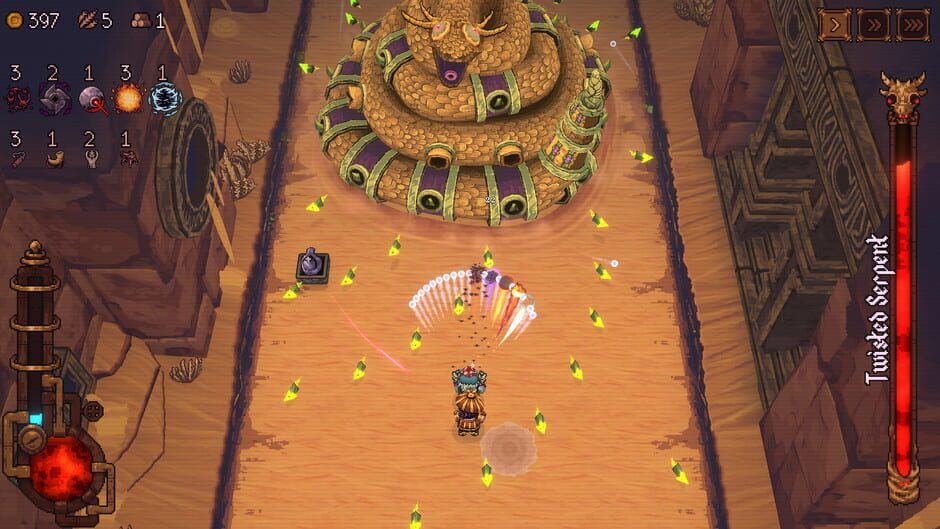

The Regal Update’s new characters, balls, and passives deepen Ball x Pit’s meta while keeping runs fast, expressive, and uncluttered – a blueprint for sustaining 2025’s breakout indie through smart early post-launch support.
Ball x Pit was already a tightly tuned riot of chaos. In a genre obsessed with stacking more systems and more run time, Kenny Sun’s brick-breaking roguelite stood out in 2025 by being fast, legible, and expressive. The upcoming Regal Update, due January 26, 2026 on all platforms, is the first of three major free expansions and it reads like a case study in how to grow an arcade roguelite without smothering it.
Rather than bolt on new currencies or a new meta layer, the update focuses on the pieces players touch every second of a run. Two new characters, eight new balls, and a batch of fresh passives are all pointed squarely at reshaping builds and play styles. It is an update about decision density, not content bulk.
The two new characters are the headline, partly because Ball x Pit’s roster does so much to define its meta. Each character in the launch game already twists the basic loop of aim, fire, and manage the storm of ricochets into something distinct. The Carouser and the Falconer push that design even further while staying readable at a glance.
The Carouser is the closest thing Ball x Pit has to a brawler support. His core hook is simple: balls that would normally snap back into your launcher instead begin to orbit around him. That one change has several knock-on effects. Suddenly, the safe zone is not necessarily behind your wall of bricks but in the swirling halo of projectiles hugging your character. In practice that encourages you to stand closer to danger, to corral enemies into your personal gravity well, and to think about defensive builds in a new way.
Orbiting balls turn certain existing passives into entirely different tools. Effects that trigger on ball return now become sustained auras around the Carouser’s hitbox. On hit and on proximity effects both spike in value because every pass around the orbit is another chance to proc. Where a launch character might thrive on precise angles and long bounces, the Carouser rewards route planning and crowd management in tight spaces. Runs with him are less about threading the perfect shot and more about building a meteor storm that you can shepherd across the pit.
The Falconer goes in the opposite direction, tilting Ball x Pit further toward pure DPS and multitasking. She fights through two pet birds that fire balls of their own, turning your offense into a small squad. Mechanically, this creates more firing vectors on the board, which immediately changes how you value pierce, chain, and split effects. Angles you could never hit from the player position suddenly become reachable when a bird is perched off to the side launching its own volleys.
That extra coverage is a raw damage increase, but it also adds a subtle layer of positional play. Where you stand is no longer only about dodging and lining up your own shot. It is about where your birds end up, how their firing cones overlap, and which side of the screen becomes your kill lane. In meta terms, the Falconer opens the door to builds that lean heavily on multiplicative effects, since each extra projectile source compounds the value of strong on-hit balls and passives.
Together, the Carouser and Falconer broaden the roster without breaking its scale. They do not introduce a new resource to juggle or a parallel progression tree. Instead they remix how balls move, where damage comes from, and how you think about space. That keeps learning overhead low and mastery ceiling high, which is exactly what an early post-launch expansion should aim for.
If characters are how you steer a run, balls are the engine under the hood. The Regal Update’s eight new balls are still largely under wraps, but their impact on the meta is easy to predict because Ball x Pit’s design leans so hard on synergy. Every new ball is a fresh verb that can combine with the existing library in dozens of ways.
With orbiting builds now a thing thanks to the Carouser, expect at least a couple of new balls that explicitly reward proximity play. A ball that gains power or radius the longer it stays in motion, for example, suddenly becomes a natural fit for an orbit where its uptime is maximized. The Carouser also invites balls that care about overlapping hitboxes and sustained contact, the kind of tools that let you turn your spinning arsenal into a literal blender.
The Falconer, meanwhile, makes multi-source projectiles more important. Balls that duplicate on fire, fork mid-flight, or chain between targets all spike in value once you can apply them through three firing points instead of one. A ball that felt too slow or unwieldy on a single-character build might become top tier when each bird is flinging a copy into a different lane. In other words, weak-link balls from the launch meta have a second chance to shine simply by existing in a new structural context.
Crucially, the update adds eight balls rather than dozens. That restraint matters. In long-running roguelites it is easy to bloat the pool until it becomes difficult to intentionally draft a build. By keeping the additions focused, Ball x Pit preserves the feeling that you can chase a concept, see its key components reasonably often, and still be surprised by the occasional off-meta roll.
New passives round out the picture. If balls define what each shot does, passives dictate how the entire run scales and how aggressively you push toward certain synergies. Details on Regal’s passive set are still under wraps, but their role is clear: bridge the new characters and balls back into the core ecosystem rather than sit in their own silo.
For the Carouser, that likely means effects that reward ball uptime, orbit size, or interactions near your character. Passives that trigger when a ball passes a certain range threshold, or that convert close-range hits into shields or resource gains, reinforce the identity of getting right up in the pit’s face. For the Falconer, global projectile modifiers that affect all sources equally, or passives that scale with the number of active balls, suddenly become more explosive. Each new passive is a chance to carve out a slightly different archetype inside characters that already feel defined.
What matters is that these passives live in the existing draft economy. They show up in the same selection spaces as launch passives, which means you keep making the same kind of fast, high-impact choices each run. There is no new meta currency to grind or menu layer to navigate between stages. The meta is deeper without getting heavier.
A lot of modern roguelites confuse more systems with more depth. They grow sideways with meta progression screens, hub areas, crafting layers, and seasonal unlock tracks. Ball x Pit’s Regal Update is notable for what it does not add. There is no battle pass, no permanent power treadmill, and no second game stapled onto the first. Instead, it sharpens the core loop that made people fall for the game in 2025: read the board quickly, fire fast, improvise around the chaos of bouncing projectiles, and finish a run in the time it takes some competitors to get through a tutorial.
Run times stay short because every new element slots into existing pacing. Orbiting balls change how you stand, not how long each stage lasts. Extra firing points from the Falconer add decisions per second without adding downtime. New balls and passives appear as variations in your usual draft cadence. The result is more expressive runs, not longer ones. You are still encouraged to experiment, fail fast, and jump back in for one more go.
The developers have framed the Regal Update as the first of three planned free expansions, and that roadmap says a lot about how they view Ball x Pit’s long-term health. Early post-launch support is often where breakout indies stumble. Either updates arrive slowly and momentum dies, or the additions are so sweeping that they fracture the audience. A measured content beat a few months after launch, focused entirely on the core systems that players are already talking about, is a strong signal that the team understands what people value.
Anchoring the first major update on two characters and a curated set of balls and passives also creates natural talking points for the community. Tier lists get scrambled. Streamers and theorycrafters have new archetypes to pick apart. Players who bounced off late-game repetition at launch have a reason to revisit the pit and see if the new tools click. That kind of low-friction return hook is invaluable for a 2025 breakout trying to survive a crowded 2026 release calendar.
There is also the simple value of trust. By committing to three big, free updates and immediately leading with something that respects players’ time instead of asking for more of it, the team positions Ball x Pit as a platform that will be worth returning to between other releases. In a genre where long-tail success often comes from being the game people default back to after trying the latest hot thing, that can matter more than any single balance patch.
If Regal is the template for the next two updates, Ball x Pit is on track to become a model case of how to support an arcade roguelite. Add new ways to play, not new chores. Keep runs short, builds expressive, and the meta just unstable enough that no one strategy feels solved for long. In a sea of roguelites chasing size, Ball x Pit is trying something different: growing sharper instead of bigger.