
A hands-on style preview of Assassin’s Creed Black Flag Resynced’s rebuilt Havana, visual upgrades, and quality-of-life changes, and how they reshape one of Ubisoft’s best open worlds compared to the 2013 original.
Ubisoft is calling Assassin’s Creed Black Flag Resynced a faithful remake rather than a reinvention, and nowhere is that clearer than in Havana. The 2013 original turned the Cuban capital into one of the series’ most memorable hubs. The Resynced version keeps the same layout and story beats but rebuilds the city so completely that it feels closer to a modern Assassin’s Creed sandbox than a brushed-up remaster.
Havana’s streets feel genuinely alive now
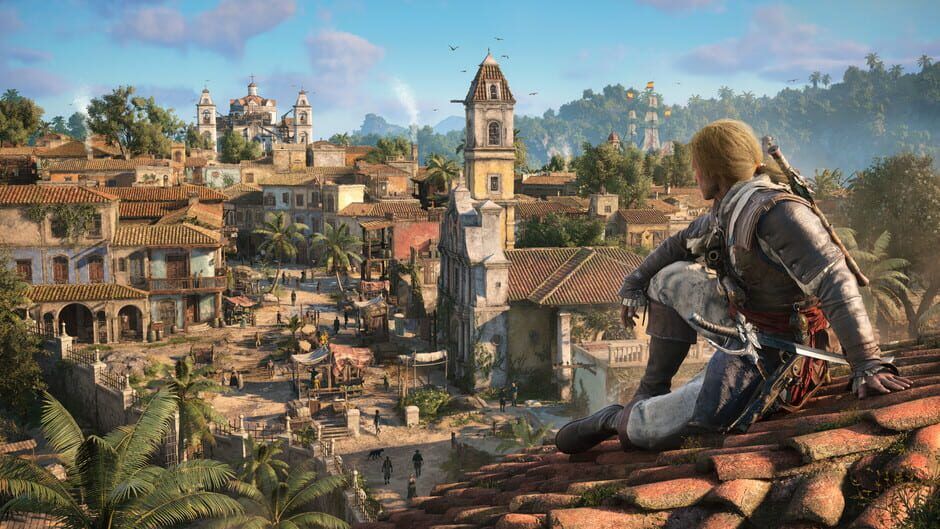
The Havana shown in recent gameplay tours is immediately denser and more atmospheric than the Xbox 360 and PS3-era city many players remember. The street plan is largely identical, but the space within it has changed. Market squares are packed with thicker crowds and more varied NPC routines, carriages roll through intersections, and the docks feel busier with workers, sailors, and guards creating natural pockets of cover.
Architecturally, the city benefits the most from the remake’s visual overhaul. Sun-baked plaster walls now show fine cracks and stains instead of flat textures. Roof tiles catch highlights as the sun moves, and wooden balconies look like you could get splinters from them. Far-off bell towers and forts on the horizon pop with sharper silhouettes and higher object density, which helps Havana feel anchored inside the wider Caribbean rather than isolated from it.
For returning players, the striking thing is how your memory of Havana gets corrected the moment you start parkouring. In the original game, streets could look quite bare once you climbed up high. In Resynced, rooftop gardens, laundry lines, extra awnings, and decorative clutter all fill in that dead space. It makes traversal routes feel more authored without changing where you can actually go.
Lighting, water, and weather show off the remake’s tech
Resynced is built in a modern version of Ubisoft’s Anvil engine, and Havana is the perfect showcase for the new lighting and weather. Sunlight now filters through palm fronds, bounces off light-colored walls, and creates warmer, more convincing ambient light in tight alleys. At night, torches and lanterns spill proper volumetric light, which sharpens stealth play in city missions where darkness actually feels like cover.
Water and reflections stand out whenever the camera catches Havana’s harbor. Sea foam, wet stone, and ship hull reflections are sharper and more dynamic than in 2013, and rain storms do more than just tint the screen gray. Wet cobblestones glisten, puddles form around gutters, and visibility drops slightly in heavy downpours, which subtly alters how easy it is to track guards at distance.
Character models and animation also get a clear bump. Edward’s face and outfit read more clearly in close-ups, with fabric folds, leather textures, and facial hair all looking closer to the series’ most recent entries. Civilians and guards are less stiff, with more animation variety when they bump into each other, gesture during arguments, or react to disturbances. That extra expressiveness helps support stealth, because reading guard states from their posture and head movement is easier than it was in the original release.
Parkour in Havana is faster and more controllable
One of the biggest differences you feel when watching or playing the Havana demo is how much more responsive Edward’s parkour has become. Resynced introduces a proper manual jump and a dedicated crouch, features that are expected today but were absent in 2013. That might sound small, yet it changes the rhythm of rooftop chases and infiltration routes throughout the city.
In the original Black Flag, Edward’s free-run system loved to latch onto anything nearby. Chasing a target across Havana’s rooftops often meant accidentally grabbing a ladder or vaulting a low wall you wanted to skirt. In Resynced, inputs appear more precise. You have clearer separation between climbing, jumping, and simple sprinting along a rooftop edge. Manual jumps let you commit to risky gaps between balconies without relying on sticky auto-assist, which gives the parkour just enough bite to feel skillful without turning it into a platformer.
At ground level, the crouch button opens more options for using Havana’s denser crowds and urban clutter. You can slip into low cover behind stacked crates or garden walls, hop through doorways, and remain crouched while weaving between alleyways. Combined with smoother contextual transitions, the city feels like it was re-blocked for a stealth-first playstyle that the original Black Flag only gestured at.
Stealth and combat feel tuned for the tighter city spaces
Havana’s urban maze highlights the remake’s broader mechanical tweaks. Stealth benefits from more reliable detection cones, better enemy line of sight, and clearer feedback when you are about to be spotted. Guard patrols remain familiar around key hubs like plazas and government buildings, but increased crowd density, new hiding spots, and smarter pathing mean you can improvise more easily when a plan falls apart.
Combat, meanwhile, is less about waiting for counter prompts and more about flowing between parries, strikes, and quick finishers. The Havana footage shows Edward switching from hidden blades to cutlass and pistol without the noticeable animation hitches that used to accompany weapon swaps. Parries look snappier and have less generous timing, which encourages you to pay attention rather than mash. In tight courtyards or narrow streets, that makes fights feel more like brawls and less like the endless counter-kill loops of early Assassin’s Creed.
Importantly, Resynced does not try to retrofit an RPG layer onto the city. There are no sprawling ability wheels hanging over Havana and no damage numbers clogging up the screen. Upgrades exist, but the feel remains rooted in action-adventure systems, preserving the fast, decisive assassinations that defined Black Flag’s best missions in the city.
Smarter mission design inside familiar streets
While the main story arc remains intact, Ubisoft has reworked how some objectives play out inside Havana’s walls. Tail and eavesdrop missions were notorious pacing potholes in 2013. In the remake, several of these sequences have been rebuilt to make better use of Havana’s new geometry and mechanics.
Routes now wind across rooftops, through interior shortcuts, and around busier plazas, giving you more than one viable way to stay close to your target. The addition of manual crouch and cleaner detection systems helps turn what used to feel like rigid stealth exams into more flexible infiltration sandboxes. If a target cuts through a market you can shadow them from above, duck through side alleys, or melt into a crowd and maintain line of sight without feeling like the mission will fail you on a technicality.
Side activities around Havana also benefit from the extra fidelity and systemic polish. Assassination contracts, warehouse infiltrations, and viewpoint syncs offer more dynamic resistance thanks to tweaked guard AI and patrol routes. Climbing the city’s highest viewpoints feels more rewarding when the panorama is filled with extra detail, and dropping into densely populated districts on the other side reinforces why this remains one of the series’ best city designs.
Quality-of-life upgrades reduce friction everywhere
Beyond mechanics, Resynced introduces several quietly important quality-of-life improvements that change how you move through Havana on a meta level. Navigation markers are clearer without being overbearing, route drawing on the mini-map is more legible, and contextual prompts are less intrusive yet more informative. Fast travel is snappier, which makes hopping between the city, your ship, and other islands less of a time sink.
The UI has been cleaned up with sharper fonts, more readable objective text, and better differentiation between mission-critical markers and optional points of interest. Menus respond quickly and group related options more logically, particularly around gear management and map filters. For a city as busy as Havana, this matters more than it might sound, because it lets you focus on the physical space in front of you instead of wrestling with overlays.
Accessibility features have also expanded relative to the 2013 release. Customizable controls, more granular subtitle options, color-blind modes, and aim or parkour assists help a wider range of players enjoy Havana’s vertical puzzle box without compromising the baseline experience.
How Havana compares to the 2013 original
Side-by-side comparisons of Havana show how much of Resynced’s work is about memory versus reality. If you only played Black Flag at launch, you likely remember its Havana as vivid and full of life. Revisiting footage exposes just how flat many textures were, how sparse the crowds could be, and how often the city’s geometry repeated. Resynced brings the location closer to that idealized memory.
Lighting alone changes the tone of key story moments. Early scenes that originally played out in relatively even daylight now benefit from deeper shadow contrast and better color grading, which sell the oppressive heat and colonial atmosphere. Interior spaces like taverns, estate halls, and warehouses gain depth from more complex light sources, so sneaking across rafters or blending among patrons looks and feels more convincing.
From a gameplay perspective, Havana’s layout remains nearly identical, which is good news for purists. The real difference is how much more the city does with that space. Smarter pathfinding, additional props, more nuanced climbing lines, and richer civilian behavior mean you are not just running the same routes with nicer textures. Small pockets of emergent chaos, like a patrol getting distracted by a scuffle or a carriage blocking a street, create more opportunities for improvisation in missions you might otherwise play by rote.
Resynced treats Havana as the benchmark for the remake
Taken together, these changes position Havana as the litmus test for Assassin’s Creed Black Flag Resynced. If the rest of the Caribbean world receives the same careful treatment, this remake has a real chance to stand beside modern entries rather than just riding on nostalgia. The city feels like a bridge between classic stealth-focused Assassin’s Creed design and the production values of Ubisoft’s current open worlds.
For veterans, returning to Havana in Resynced should feel like visiting a favorite city and discovering new alleyways that were always supposed to be there. For newcomers who have only known the series’ later, larger RPG-style games, it is an opportunity to experience one of Ubisoft’s tightest city sandboxes with the visual and mechanical polish they expect in 2026.
Either way, Havana proves that this remake is more than a texture pass. It is a careful reconstruction of one of the genre’s most beloved open-world cities, tuned to play the way you remember rather than the way it actually was.