
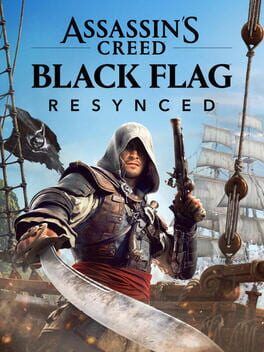

Ubisoft says Assassin's Creed Black Flag Resynced drove Q2 net bookings above guidance, showing both the power and risk of leaning on familiar franchises.
Image: IGDB
Store links: Assassin's Creed Black Flag Resynced on Steam
A remake beats guidance while the wider half-year falls
Assassin's Creed Black Flag Resynced was the main reason Ubisoft beat its own Q2 bookings forecast, even as the publisher's first-half results moved in the opposite direction. In its first-half FY2026-27 earnings release, Ubisoft reported Q2 net bookings of €389 million, above guidance of around €370 million, and said the outperformance was “mainly driven” by Assassin's Creed Black Flag Resynced.
That is the cleanest headline in a messy report. GamesIndustry.biz, citing Ubisoft's figures for the six months ending September 30, 2026, reported H1 net bookings of €644.7 million, down 16.5% year-on-year. Digital net bookings fell 20.1% to €548.2 million, while back-catalogue net bookings dropped 40.8% to €438.8 million. Ubisoft also posted an IFRS operating loss of €189.2 million, compared with a €120.2 million loss a year earlier, and a non-IFRS operating loss of €155.9 million, compared with €27.1 million in income a year earlier.
So the story is not simply that Ubisoft found a hit. The tension is sharper than that. A single Assassin's Creed remake helped pull one quarter above guidance while the broader half-year showed pressure across the business. For a publisher reorganizing its creative structure, cutting costs, and still relying on a few globally recognizable brands to carry the weight, Black Flag Resynced landed like a well-timed boarding action in otherwise rough water.
How Black Flag Resynced became Ubisoft's cleanest Q2 hit
Ubisoft's own framing is unusually strong. According to GamesIndustry.biz, the company said new Assassin's Creed leadership within its Creative House structure “made clear, decisive choices in the final stretch of development,” which contributed to the outcome. Ubisoft said those choices helped the game reach “an elevated level of quality” and a commercial performance that places Black Flag Resynced “among the industry's most successful action-adventure remakes.”
That claim is about commercial standing, not a review score, and it should be read that way. The earnings materials and reports do not provide technical breakdowns, platform-specific performance, or critical consensus data. What they do provide is a business case: Ubisoft says the Assassin's Creed remake exceeded expectations in its launch quarter, Investing.com reported, and GamingBolt separately reported that Black Flag Resynced sold over 3.5 million copies in two weeks, surpassing annual expectations in 14 days.
The Black Flag remake sales picture also appears to have been helped by how players bought the game, not only by how many bought it. GamingBolt, citing Ubisoft's commentary, reported that the launch was supported by solid in-game spending and a higher-than-expected share of premium editions. The same report noted Ubisoft's reference to a “more targeted marketing approach,” which GamingBolt interpreted as likely appealing to old-school fans of the original. That matters because remakes live or die on trust. A player returning to a known name is buying memory, polish, and the promise that the rhythm still holds.
The recognizable franchise did the heavy lifting
Ubisoft's Q2 was not carried by Black Flag Resynced alone, but the supporting cast reinforces the same point. In its earnings release, Ubisoft said the rest of the catalog, including the Assassin's Creed catalog, the Ghost Recon franchise, and Invincible: Guarding the Globe, also saw strong performance. GamesBeat reported that excluding partnerships, net bookings were up over 50% year-on-year.
The pattern is clear. When Ubisoft needed momentum, the names that steadied the ship were familiar ones: Assassin's Creed, Ghost Recon, Rainbow Six, and licensed mobile work. GamesBeat reported that Rainbow Six Siege ranked in the top 10 across Xbox and PlayStation combined by monthly active users during the first half of FY2026-27, with Ubisoft crediting a stronger focus on gameplay and anti-cheat over the past year. GamesIndustry.biz also reported that Ubisoft maintained stable monthly active users and active players during the period, at 34 million and 88 million respectively.
This is where Assassin's Creed Black Flag Resynced becomes bigger than one action adventure remake. Ubisoft's Q2 bookings show that established franchises still give the company its fastest route to measurable results. The upside is obvious: a known brand can focus marketing, bring lapsed players back into the fold, and support premium edition uptake. The risk is just as visible: when the broader catalog declines, the pressure on the next recognizable title grows heavier.
A strong launch did not erase Ubisoft's restructuring pressure
The success of an Assassin's Creed remake arrived alongside another wave of internal change. GamesIndustry.biz reported that Ubisoft amended its Creative House structure by merging House 3, focused on live service games, and House 5, focused on casual games, into a single unit meant to “leverage synergies between Live experiences across platforms.” The company also said the Creative House structure was now fully in place, with the remaining general manager for Creative House 4 set to join in January.
Ubisoft also established Motherbrain, described in the same reporting as a subsidiary focused on AI-driven “gameplay innovation,” and launched a separate business unit intended to maximize the value of brands outside the Creative House system through what it called an agile and investment-light model. Those moves sit beside the company's ongoing cost reduction program. GamesIndustry.biz reported Ubisoft's fixed cost base for the period was €660 million, down 6% year-on-year, with a target of €1.25 billion on a run-rate basis by March 2028.
The human cost remains part of the same report. GamesBeat and GamesIndustry.biz both reported layoffs affecting 166 staff at Ubisoft's Montréal and Québec City locations. GamesIndustry.biz also noted that Ubisoft's headcount was down close to 1,100 over the first half, following layoffs and studio closures including Winnipeg and Belgrade, along with job losses elsewhere. That context changes the shape of the win. Black Flag Resynced gave Ubisoft a Q2 beat, but it did not remove the pressure driving the company to consolidate teams, reduce costs, and extract greater value from proven intellectual property.
The action-adventure remake market rewards certainty
Ubisoft's description of Black Flag Resynced as one of the industry's most successful action-adventure remakes fits a wider market logic, even if the company's statement does not disclose a ranked comparison set. Remakes can give publishers a narrower development target than wholly new games: the world, tone, brand identity, and audience memory already exist. The challenge shifts toward execution, modernization, and convincing players that a familiar adventure has enough craft to justify another purchase.
That is especially important for an Assassin's Creed remake. The series carries expectations around traversal, stealth, melee timing, historical spectacle, and large-scale set pieces. Ubisoft's earnings comments do not spell out which creative decisions changed Black Flag Resynced in the final stretch, so it would be wrong to invent design specifics. What can be said is that Ubisoft tied those late decisions to both quality and commercial performance, which suggests the company sees the remake's finishing pass as central to its launch outcome.
For players, the useful distinction is between a commercial verdict and a buyer's verdict. Ubisoft has numbers showing demand. It has not, in the cited material, provided detailed public evidence on frame rate targets, PC requirements, upgrade paths, or pricing. A strong sales curve can indicate confidence and appetite, but it does not replace the practical checks players still make before buying a remake of a game they may already know.
The pipeline question now follows Assassin's Creed
Black Flag Resynced also lands at a sensitive moment for Assassin's Creed's future. GamingBolt reported that the next mainline entry, Assassin's Creed Codename Hexe, has allegedly been delayed to 2028, while noting that Ubisoft said it would provide an update next year. The same report described a new Ancient Rome-set game as reportedly in development. Those are not confirmed release plans in the cited material, so they should be treated as reports and rumor until Ubisoft announces details.
Assassin's Creed Jade remains another unresolved thread. GamingBolt reported that the game, announced in 2022, still appears to be in development, with Ubisoft's CFO saying the current focus is on PC and consoles. That detail matters because Ubisoft's platform strategy around Assassin's Creed is no longer only about the next boxed or premium release. It is about how the company sequences remakes, catalog activity, mainline entries, mobile-linked projects, and platform pivots without exhausting the brand.
Readers looking for immediate buying information have only a partial picture from the provided sources. GamingBolt's page tags Black Flag Resynced for PC, PS5, Xbox Series X, and Xbox Series S. The earnings and reporting cited here do not provide a price, performance mode breakdown, PC specifications, physical edition details, or upgrade path from any prior version. If those details determine whether this Assassin's Creed remake is worth buying now, players should wait for storefront listings, platform pages, and technical analysis before treating Ubisoft's sales success as a personal recommendation.
Ubisoft's Q2 win shows strength and dependency at once
Assassin's Creed Black Flag Resynced gave Ubisoft the kind of quarter publishers want to present: above-guidance bookings, a high-profile remake that exceeded expectations, and a commercial label that places it near the top of its genre category. It also gave Ubisoft a clean example of its reorganized Assassin's Creed leadership producing a tangible result, according to the company's own earnings messaging.
But the surrounding numbers keep the celebration contained. H1 bookings were down. Digital bookings were down. Back-catalogue bookings were down. Operating losses widened under the reported IFRS and non-IFRS measures. The company is still cutting costs, merging parts of its creative organization, and reducing headcount.
That is the real read on Ubisoft Q2 bookings. Assassin's Creed Black Flag Resynced became a standout action adventure remake because it converted recognition into immediate spending, with premium editions and in-game spending reportedly strengthening the launch. It also underlined how much Ubisoft still depends on franchises players already understand. In a business quarter with rough seas all around it, the familiar black flag flew highest.