
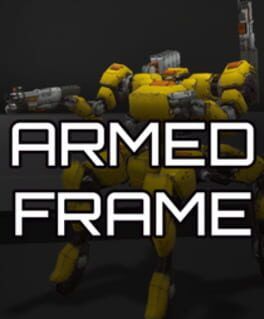

Armed Frame open beta access is being handled through Steam’s Request Access button. Here is what the mech shooter playtest offers, what is confirmed, and what remains unannounced.
Image: IGDB
Store links: Armed Frame on Steam
Armed Frame beta access is open through Steam, but key details are still thin
The Armed Frame open beta is available to request now through the game’s Steam page, according to Alpha Beta Gamer, which directs players to click Steam’s “Request Access” button to join the beta. That is the concrete takeaway for anyone trying to get hands on with this new mech shooter: access is being routed through Steam, not through a separate code giveaway or publisher portal in the source material provided.
The tension is that the listing gives players a clear sign-up route without answering several of the questions competitive shooter players usually ask first. Alpha Beta Gamer describes Armed Frame as a fast-paced mech combat game with both third-person and first-person perspectives, deep machine customization, aerial movement, wall running, and six weapon slots. It does not list beta dates, server regions, supported modes, map count, player count, progression carryover, minimum PC requirements, or an Armed Frame release window.
That leaves the current Armed Frame playtest in a familiar but important position. It is accessible enough to put on your Steam radar today, but anyone going in should treat it as a beta in the practical sense: a chance to test movement, loadouts, aiming feel, readability, and online stability before the developer locks down the broader launch plan.
How to request access to the Armed Frame open beta
Alpha Beta Gamer’s sign-up instruction is simple: visit the Armed Frame Steam page and click “Request Access.” The source describes this as joining the Armed Frame beta, which suggests Steam Playtest-style access rather than a purchase-gated early access period. No preorder requirement, paid founder’s pack, external account link, or beta key process is mentioned in the provided source material.
That distinction matters for players deciding whether to bother. A Steam request is low friction. You can add your interest without committing money, then wait for Steam or the game’s page to indicate whether access has been granted. Since the source does not specify whether everyone is accepted instantly, whether invites are staggered, or whether there is a cap, players should not assume a guaranteed download the second they click.
The only platform clearly supported by the available sign-up information is Steam, because Alpha Beta Gamer links directly to the Steam app page for Armed Frame. The provided sources do not confirm console plans, other PC storefronts, cross-play, or controller support. If those details matter to you, the practical move is to request access on Steam now and watch the store page for updates before making release-day plans.
What the playtest is selling: speed, vertical control, and perspective switching
Alpha Beta Gamer describes Armed Frame as a fast-paced mech combat game that blends third-person and first-person perspectives. For shooter players, that is the first design hook worth watching. Third-person mech combat can make spatial awareness cleaner, especially when movement is built around boosters and vertical repositioning. First-person combat can raise the pressure on aim discipline, target tracking, and weapon feedback. If Armed Frame lets those perspectives serve different combat situations, the feel of swapping between them could become one of its defining tests.
The movement suite is the bigger signal. The source lists wall running, rapid boosts in multiple directions, quick turns, extended boosts, and ascending and descending boosts. That is a lot of mobility vocabulary for a mech shooter, and it points toward fights built around height, angles, and acceleration rather than slow armor trading. In plain shooter terms, this is the difference between winning by holding a lane and winning by breaking the lane before your opponent can process the threat.
The beta will need to prove that speed is readable. Fast mechs are exciting only if hit feedback, silhouettes, boost trails, audio cues, and camera behavior keep up with the pace. The source confirms the mobility tools, but it does not confirm map design, time-to-kill, lock-on behavior, or weapon tuning. Those are the systems that will decide whether Armed Frame feels sharp or chaotic once real players start abusing every movement option.
Customization could be the real meta test
Armed Frame’s customization pitch is broad. According to Alpha Beta Gamer, players can equip interchangeable heads, torsos, arms, legs, boosters, fire control systems, and six weapon slots. The same report says players can personalize colors for both the mech frame and its armaments. That combination gives the game two separate jobs in beta: making builds feel meaningfully different and making those differences legible in a fight.
The most interesting confirmed detail for competitive-minded players is the fire control system. The source does not explain exactly how those systems work, but in a mech shooter, anything tied to targeting, weapon handling, lock behavior, accuracy, or engagement range can become a meta-defining slot. Pair that with six weapon slots and the question becomes less “Can I build a cool robot?” and more “Can the game prevent one loadout from solving every matchup?”
That is where the Armed Frame beta should be useful even before the final feature list is public. If the playtest exposes players to a wide enough spread of parts, the community will quickly find which boost patterns, weapon combinations, and body configurations control the pace. The source promises customization depth, but balance is still unproven. Mech shooter fans should watch for whether heavy builds can survive mobility pressure, whether light builds pay a real durability cost, and whether weapon slots encourage deliberate roles instead of spam loadouts.
The shooter questions the source cannot answer yet
The provided material gives Armed Frame a clear mechanical identity, but it leaves several launch-critical shooter questions unanswered. Alpha Beta Gamer does not identify beta modes, maps, match structure, ranked support, private lobbies, bot options, team size, or netcode model. It also does not provide PC system requirements or performance targets. For a speed-focused shooter, those missing details are not cosmetic. They affect whether the game can support clean duels, stable aerial tracking, and fair reactions under pressure.
Netcode is the biggest unknown. A mech game with rapid multidirectional boosts and vertical movement needs strong hit registration and convincing reconciliation when players change direction at high speed. If Armed Frame leans on projectile weapons, the feel of leading targets and reading boost vectors becomes central. If it leans on hitscan or lock-on systems, the tuning has to protect movement skill from being flattened by easy tracking. None of that is confirmed in the source material, so beta players should go in ready to evaluate feel rather than assume a specific competitive structure.
Map design is the second pressure point. Wall running and ascending boosts only matter if arenas give players useful surfaces, cover layers, ceiling pressure, and flank routes. Three-dimensional battlefields are mentioned by Alpha Beta Gamer, but the source does not name any maps or environments. A good Armed Frame playtest should make it obvious whether vertical routes create smart engagements or simply turn fights into camera wrestling.
Why mech shooter fans should put Armed Frame on the radar
Armed Frame is worth tracking because its confirmed feature set targets the parts of mech shooters that often separate cult favorites from forgettable arena experiments: movement expression, modular builds, and weapon commitment. Alpha Beta Gamer’s description points to a game where the machine is built around your combat style, then tested through high-speed positioning and split-second decisions. That is exactly the lane mech shooter players usually want explored.
The caveat is that the Armed Frame open beta is still carrying unknowns around availability, scope, and release timing. The current public information supports a Steam beta request and a broad description of the game’s systems. It does not support claims about launch date, price, final content, esports intent, cross-platform support, or how long the beta will remain available. Anyone presenting those details as settled is getting ahead of the sources.
For now, the smart play is simple. If you are into Armored Core-style build experimentation, high-speed arena shooters, or movement-heavy third-person action, request access through Steam and use the beta to judge the fundamentals: boost feel, camera control, weapon impact, target readability, and whether customization produces real tradeoffs. If you need confirmed modes, specs, or a firm Armed Frame release date before investing time, wait for the Steam page or the developer to publish more detail.