
What the new launch trailers reveal about Endfield’s combat flow, Talos‑II exploration, and PS5 console experience, and how Gryphline is positioning it against giants like Genshin Impact and Wuthering Waves.
Arknights: Endfield has quietly turned into one of 2026’s biggest launches. Gryphline confirmed the game has passed 35 million pre-registrations across PS5, PC and mobile, a number that plants it firmly in the same conversation as Genshin Impact and Wuthering Waves before anyone has even touched the live servers.
The new pair of launch trailers released alongside that milestone finally show what that interest is actually buying into. Between the cinematic “Back to Endfield” trailer and the more grounded “New Horizons” gameplay cut, we get a clear look at how real-time combat flows, how Talos-II is structured as a space to explore, and how the PS5 version is being framed as the “premium” way to play without losing the free-to-play core.
35 million pre-registrations and what that really signals
On paper, 35 million pre-registrations sounds like just another big gacha number, but the context matters.
Endfield is a spin-off of a hardcore tower-defense mobile game, not a new IP marketed to everyone on Earth. It’s also arriving into a market already saturated with anime-styled live service ARPGs. Hitting that scale of interest before launch suggests two things.
First, Arknights as a brand has more reach and retention than many console-first players realize. Years of consistent events, music collaborations and story updates have built a fandom that is willing to follow Hypergryph into an entirely different genre.
Second, Gryphline has learned from how miHoYo and Kuro Games warmed up their communities. Long betas, creator-focused previews and a drip-feed of high-end trailers have let Endfield gradually transition from “Arknights curiosity project” to a front-line gacha ARPG. When a press release can comfortably mention 35 million players waiting on day one, it stops reading like a mobile spin-off and starts reading like a tentpole live-service launch.
For players on PS5, it also hints at a crucial point: matchmaking queues, co-op content and the social economy are unlikely to feel empty in the first months. Live-service fatigue is real, but Endfield is at least not starting from cold.
What the new trailers say about combat flow
The latest gameplay trailer finally stitches together the pieces shown across earlier tests into something that looks like an actual moment-to-moment loop.
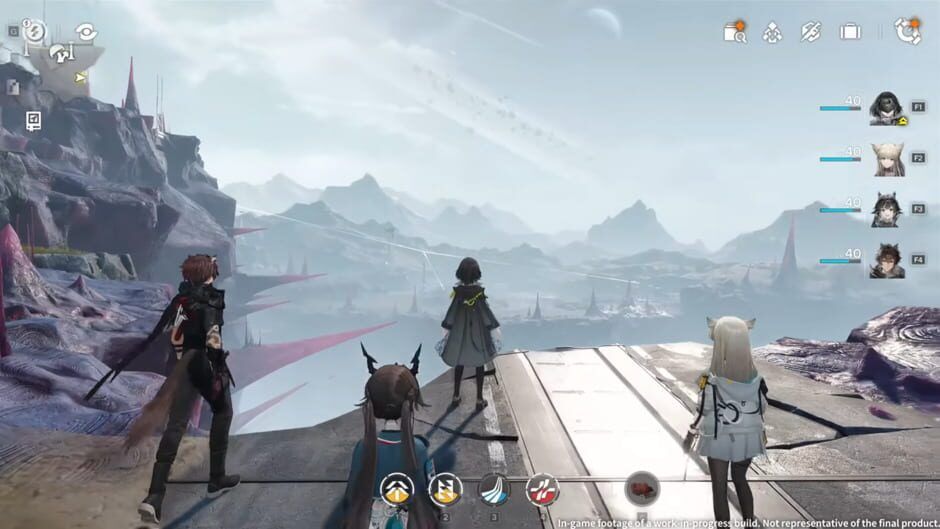
Combat is built around small, composition-driven squads in real time rather than the lane-based tower defense of classic Arknights. You directly move your controlled Operator in a 3D space, stringing together basic attacks, dodges and skill activations, while the rest of the squad automates their roles and reacts with AI-driven abilities. The camera work in the trailer emphasizes short, readable attack strings and clear telegraphs, which feels closer to Wuthering Wavelengths than Genshin’s more animation-committed weapon styles.
What stands out is how often the action pauses for targeted skills or mode shifts. There are micro-moments where the UI surfaces radial options or directional skills, letting you aim crowd control or deploy gadgets without completely losing combat flow. It’s not purely twitch action and it’s not purely macro strategy, instead sitting somewhere in the middle.
The trailers also highlight elemental and status interactions in a way that feels very intentional. Explosive canisters, environmental hazards and enemy armor states react clearly when the right combination of skills is used, suggesting Gryphline wants players to think in terms of “industrial synergies” rather than just color-coded elements. Where Genshin leans on elemental reactions and Wuthering Waves leans on rhythm and echo builds, Endfield seems to be pushing a more utilitarian combat fantasy built around tools, turrets and controlled space.
Boss encounters shown in the trailers further reinforce this. Wide, circular arenas with destructible cover and clear danger zones invite a measured dance of repositioning and skill cycling. It is still flashy, still character-driven, but less about solo heroism and more about team throughput and zone control.
Talos-II as an explorable frontier
If combat is where Endfield distinguishes itself mechanically, Talos-II is where it tries to separate itself thematically from the gacha field.
The “New Horizons” trailer leans heavily into hard industrial sci-fi imagery. Massive refineries loom over wind-blasted plains, modular platforms rise out of nowhere, and cable-laced settlements claw at the edges of uninhabitable zones. It is not the postcard tourism of Teyvat or the high-style urban sprawl of New Eridu, it is a frontier in the middle of being built.
Exploration looks closer to an instanced or segmented open world rather than a single continuous landmass. The trailer cuts between distinct biomes connected by clearly marked routes and loading gates. Within those zones, however, you see standard open-world language: resource nodes to harvest, interactable machinery, small camps with NPCs and side objectives.
Where things get interesting is how often construction and logistics appear in regular exploration footage. The UI periodically surfaces build prompts around damaged infrastructure, and you see the Endministrator’s squad restoring power lines, deploying temporary platforms or placing industrial equipment. That suggests the base-building layer is not confined to a single menu-driven headquarters but instead bleeds into the field in a way most gacha ARPGs don’t attempt.
Compared to Genshin’s Serenitea Pot or Wuthering Waves’ more traditional upgrade hubs, Talos-II feels like a map that is constantly being rewritten by the player’s industrial footprint. You are not just a hero passing through scenic environments, you are the person physically expanding a civilization’s reach across a hostile planet. That fantasy is backed up visually every time a new pipe network lights up or a production line roars back to life mid-mission.
How the PS5 experience is being framed
The new trailers and accompanying PS5-focused coverage paint a consistent picture of how Gryphline wants console players to perceive Endfield.
Visuals are clearly staged to highlight 4K presentation and stable performance, with large draw distances across Talos-II’s open zones and dense particle effects in combat. Camera sweeps across industrial skylines and smooth transitions into combat are there to reassure that this is not a bare-bones mobile port.
The PS5 UI footage shown in recent previews points to a tailored console shell. Menus are widened out for television viewing, text is scaled sensibly and selection highlights are bold enough to read at distance. Radial sub-menus and shoulder-button shortcuts are emphasized so that squad management, inventory and gacha access do not feel buried behind cursor-emulated controls.
Load transitions are another quiet selling point. Fast travel jumps between exploration nodes cut quickly, which matters when your loop involves hopping back and forth between fieldwork, combat trials and industrial base management. In a world where gacha ARPGs often live or die on how tolerable their daily grinds feel, shaving a handful of seconds off every transition has real impact.
All of this is wrapped in very clear messaging that PS5 is not a second-class citizen. Feature parity with PC and mobile is being pushed hard, along with shared events and launch timing. Where some gacha titles have treated console as a late expansion, Endfield is arriving on Sony’s hardware on day one and is being promoted as a flagship live-service addition to the PS5 slate.
Gryphline’s positioning against Genshin and Wuthering Waves
With 35 million players pre-committed, Endfield is not trying to sneak into the conversation, it is trying to claim a distinct slice of the market.
Genshin Impact sells an escapist fantasy of freeform exploration and character-driven story arcs across bright, painterly regions. Wuthering Waves trades in kinetic combat, tight timing windows and an almost character-action style expression of builds and echoes. Both have deep progression, but moment-to-moment, they are about motion and spectacle.
Arknights: Endfield, at least as presented in these latest trailers, is putting its weight behind a different pitch. It is focused on industrial colonization, logistics and the feeling of managing a frontier operation under constant pressure. The combat is real-time and visually appealing, but always foregrounds team roles, zone control and gadget usage. The world is open enough to explore, but its most memorable sights are half-complete megastructures and scarred battlefields rather than postcard vistas.
That positions Gryphline to go after players who like the gacha ARPG structure but want more systemic texture in how their world evolves. If Genshin is the road trip and Wuthering Waves is the concert, Endfield is the worksite where the stakes are measured in tons of ore moved and sectors brought online.
The 35 million pre-registrations tell us there is an audience ready to test whether that pitch can sustain a live service. The new trailers, with their focus on squad-based combat flow, Talos-II’s active reconstruction and a confident PS5 showing, suggest that Gryphline knows exactly which strengths it wants to lean on as it steps onto the same stage as the genre’s biggest names.