
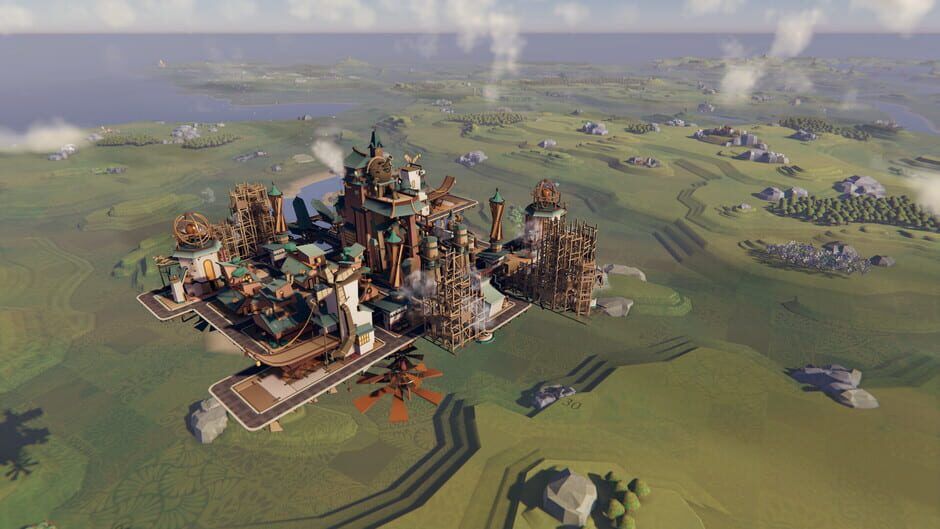

After 15 months in Early Access, Airborne Empire’s 1.0 launch finishes its story, expands its world, and sharpens its systems. Here is what changed on the road to full release and why this skybound city-builder now deserves a second look.
Airborne Empire has officially graduated from Early Access, lifting its flying city out of the iterative churn and into a full 1.0 release on Steam. After roughly 15 months of updates and community-led tuning, The Wandering Band’s airborne blend of city-building, RPG exploration, and light tactics finally feels like a cohesive whole instead of a promising prototype.
What Changed On The Road To 1.0
When Airborne Empire first touched down in Early Access back in January 2025, its pitch was already eye-catching: manage a drifting city in the clouds, scouring a shattered world for resources while keeping your citizens aloft and alive. The core loop of building platforms, balancing lift, and ferrying between sky islands was there, but the long-term arc and systemic variety were still thin.
Across its Early Access life the game grew into something far more robust. The most visible changes are structural. Major content updates filled in the open world with new biomes and discoveries, culminating in the 1.0 debut of Kingsfell, a late-game region that pushes both navigation and survival. Kingsfell’s harsher conditions, denser enemy presence, and narrative climaxes give the endgame a sense of escalation that earlier builds lacked.
Story framing, largely a sketch at launch, now carries a full beginning, middle, and end. The 1.0 build closes the narrative loop through a final confrontation with the Pirate Queen, the recurring antagonist whose raids and looming presence have been simmering in the background of previous updates. Rather than a simple boss fight tacked on at the end, this showdown works as a culmination of your city’s growth, demanding a mature economy and a carefully tuned fleet layout.
The biggest invisible overhaul is in options and structure. Over Early Access, the developers layered on multiple ways to inhabit this world. Creative Mode was overhauled into a relaxed sandpit where lift physics and fuel concerns are present but not oppressive, giving players space to sculpt ornate sky metropolises at their own pace. Survival Mode leans in the opposite direction, foregrounding harsh resource scarcity, weather hazards, and combat encounters. Pacifist Mode, added partway through the journey, shifts the focus away from direct battles altogether, favoring careful routing, diplomacy, and avoidance.
By the time version 1.0 landed, these modes had been iterated on through community feedback. Early complaints about punishing spikes and grindy progression have been softened by better pacing, clearer signposting of threats, and more meaningful tech unlocks, while still preserving the stakes that make a skyborne city precarious.
On the technical side, the launch version is more approachable. Mac support joins the PC version, widening the audience. Performance has been tightened across the board, with the game holding higher frame rates even as your city expands into a sprawl of interconnected platforms and thrumming engines. Quality of life upgrades line the seams: snappier UI interactions, better construction feedback, and a more stable simulation when running at speed.
Accessibility and inclusivity have also improved. New language options, including Brazilian Portuguese and Russian, make the game readable to more players. Steam achievements now track long-term goals across modes, giving structure for anyone who likes clear milestones or needs an extra push to experiment with alternate playstyles.
There are also very tangible toys to play with. The 1.0 build introduces new buildings like the Jet Engine combat module, a late-game piece of kit that adds speed and punch to your city’s defense grid. This complements evolving enemy threats and gives veteran players a reason to retool their designs instead of coasting on early-game layouts.
How A Flying City-Builder Stands Out In A Crowded Strategy Market
The city-building and strategy space is more saturated than ever, with survival colonies in every climate and economy sims covering everything from medieval hamlets to orbital stations. Airborne Empire’s hook is not just its floating setting; it is how it binds mobility, verticality, and survival into a single systemic package.
Your city is not a static grid waiting on delivery routes. It is a vehicle, constantly drifting, steering, and climbing through a stitched-together open world. Every expansion choice has literal weight. Add another housing block, defense turret, or refinery and you are forced to reconsider lift, balance, and propulsion. Building outward means adding drag, while stacking upward risks stability and makes you more susceptible to certain hazards. Instead of a sprawling map covered in satellite outposts, the city itself is your entire footprint.
This mobility fundamentally changes how you think about strategy. Traditional builders often ask you to push ever outward to secure new resources. In Airborne Empire, you pick up your entire infrastructure and move. Rich deposits, trade hubs, and narrative hotspots are dispersed across the skies, and your path through them dictates both your economic trajectory and the challenges you face. Route planning becomes as important as city planning, especially in Survival Mode where fuel, food, and lift interact to determine whether you can afford a detour to a lucrative ruin or must beeline to a safe harbor.
The RPG layer adds another wrinkle. You are not just juggling abstract citizen happiness metrics. Named characters, factions below your flight path, and quest chains pepper the world, making your choices feel more grounded. Helping or hindering ground kingdoms has tangible benefits and consequences, shifting trade terms, unlocking technologies, or stirring up conflict. This hybrid of light RPG storytelling with macro-scale city management is not unique in isolation, but paired with the flying-city concept it feels fresh.
Combat follows suit. Instead of detached tactical maps, encounters are framed around the city itself. Upgrades like the Jet Engine module or specialized defensive structures are not just plus-one stats; they influence how you position your city in relation to threats. In Survival Mode, a poorly balanced layout might leave your engines exposed or your lift engines clustered in a way that makes a single focused barrage catastrophic.
Most importantly, tone and pacing set Airborne Empire apart. The game is not grimdark post-apocalypse or sterile logistics puzzle. Its art direction leans more toward bright, airy fantasy, with lush floating islands, colorful architecture, and whirring machinery that looks cobbled together yet functional. The stakes are high, but there is a sense of discovery and wonder as you sail into new biomes, uncover forgotten technology, and slowly stitch together what happened to this fractured world.
Does 1.0 Deserve Broader Attention Now?
At its Early Access debut, Airborne Empire was easy to recommend to genre diehards who could see past the edges and enjoy a clever core idea. For a broader audience, it felt a bit like a vertical slice, more proof of concept than complete journey. With 1.0, that equation has shifted.
The most immediate improvement is how complete the experience feels. You can now start a fresh run, pick a mode that matches your preferred level of pressure, and play through a full narrative arc that climaxes in the Kingsfell region and the Pirate Queen showdown. The game no longer relies on self-directed goals to carry you through a midgame plateau. Story threads, achievements, and late-game technologies give you reasons to keep nudging your city forward.
The broader suite of difficulty modes also means the game can finally meet players where they are. Creative Mode’s relaxed pacing makes it a comfortable introduction for players new to complex strategy, letting them wrestle with lift, balance, and basic resource chains without constantly worrying about raids or hard fail states. Survival Mode and more demanding settings, on the other hand, now lean into the tension that made the Early Access versions so intriguing, with enough tuning and clarity that failure feels instructive rather than arbitrary.
Performance and platform support are the other big reasons this launch deserves a second look. The earlier builds could buckle under larger cities, especially on mid-range hardware, which dampened late-game enjoyment. The 1.0 improvements make it much more plausible to see your ambitious sky-arcology visions through to the end without stutter undermining the spectacle. Mac players, previously left waiting, can now join in at the same starting line as the PC crowd.
There are still caveats. As an indie project with a fairly specific fantasy premise, Airborne Empire will not convert every fan of more grounded builders. Those who prefer slow, granular city micromanagement on massive fixed maps might find the constant movement and condensed footprint a bit constraining. The hybrid of narrative quests, city sim, and light combat may also feel too soft in any one direction for players who want either pure numbers crunching or full tactical depth.
Yet for anyone even mildly curious about strategy that experiments with form, Airborne Empire’s 1.0 release makes a strong case for itself. It is now a cohesive skyfaring campaign, not just an interesting tech demo of floating platforms. The final biome, expanded story, tuned modes, and improved stability all contribute to a game that finally feels confident in its identity.
If you bounced off the Early Access version or simply waited for the dust to settle, this is the right moment to revisit it. For newcomers hunting for something different in a market crowded with familiar city-building blueprints, Airborne Empire’s fully realized flying city stands out as one of the more distinctive strategy releases now cruising at full altitude.