
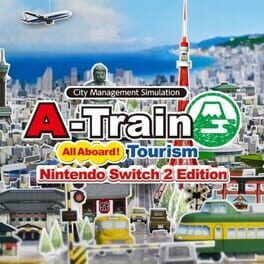
Everything you need to know about A-Train: All Aboard Tourism Nintendo Switch 2 Edition on Switch 2, from new features and performance to western physical pre-orders and import tips.
What Is A-Train: All Aboard Tourism Nintendo Switch 2 Edition?
A-Train: All Aboard Tourism Nintendo Switch 2 Edition is an enhanced re-release of Artdink’s complex rail and city management sim, rebuilt for Nintendo’s new hardware. The original A-Train: All Aboard! Tourism launched on the first Switch in 2021 as a deep, number-heavy transport and urban planning sandbox where you grow sleepy towns into tourist hubs. The Switch 2 Edition keeps that core intact while layering on technical upgrades, extra scenarios, and quality-of-life tweaks that aim to make long sessions smoother and more flexible.
With the new version landing on both the Japanese and western eShops, plus a confirmed physical release, this is the most accessible way yet to dive into modern A-Train on console. Below is a breakdown of what is new, how it should run on Switch 2, and what your options are if you want to import or grab a boxed copy.
New Features Versus The Original Switch Release
The Switch 2 Edition is not a simple resolution bump. Artdink is using the opportunity to tune the underlying simulation experience and add new content.
The headline change is a new mode that relaxes the strict object limits from the original release and lets you place a significantly higher number of trains, automobiles, and vehicle blueprints in your region. On the first Switch version, larger layouts could hit practical caps in busy cities, which discouraged truly sprawling networks. The Switch 2 Edition’s expanded placement limits are targeted directly at that problem and should make massive multi-line networks with dense road traffic more achievable.
Content-wise, the re-release includes two entirely new scenarios. These add fresh premade maps, objectives, and constraints, which is valuable in a game where the early hours of planning and building can feel daunting. Expect these scenarios to lean into the tourism and city-growth theme, giving returning players structured goals to experiment with new layouts while still feeding into the same economic and transport systems.
Several quality-of-life additions round out the feature upgrades. The Switch 2 Edition introduces full mouse support, both through Joy-Con 2’s mouse-style pointer and standard USB mice. This directly addresses one of the biggest complaints about the original Switch version, where menus and dense UI elements were functional but fussy on a stick or D-pad. With mouse input, dragging tracks, adjusting timetables, and tweaking financial sliders should feel much closer to the PC-style A-Train experience.
The game also adds auto-save functionality. A-Train scenarios can run for dozens of in-game years and hours of real-world time. On the first Switch version, a sudden shutdown or battery failure could cost huge chunks of progress if you forgot to save manually. Auto-save on Switch 2 makes long-haul sessions less stressful, especially in handheld play.
Under the hood, graphics and frame rate have been upgraded. While Artdink has not published exact resolution targets, the official materials highlight improved graphical presentation and smoother performance over the original Switch release. This is especially important when you zoom out over dense urban sprawl, where the first version could hitch as the simulation juggled trains, cars, construction, and economic data.
In short, compared to the 2021 Switch edition, the Switch 2 Edition offers bigger networks, a pair of new scenarios, mouse support, auto-save, and a more stable, better-looking presentation, on top of the full original feature set.
Performance Expectations On Switch 2
City and transport sims are some of the most demanding genres for hardware, and the original A-Train: All Aboard! Tourism on Switch reflected that. Players reported slower simulation speeds and frame drops in highly developed cities, particularly when zoomed out or running the clock at high speed. The Switch 2 Edition targets those pressure points with the extra power of the new system.
The publisher specifically calls out improved frame rate, which suggests that the game should hold steadier when the map is crowded with trains, vehicles, and buildings. That is crucial for A-Train, because a large part of late-game play involves rapidly checking multiple lines, balancing budgets, and watching how your changes ripple through traffic patterns. Even if the simulation logic remains just as heavy, more consistent performance should make the process of managing it less fatiguing.
Visual upgrades are also part of the package. Expect sharper rendering of terrain and structures, cleaner UI scaling on higher-resolution displays, and fewer jagged edges on zoomed-in trains and buildings. A-Train’s visual style is utilitarian rather than flashy, but clarity matters. Being able to clearly distinguish track types, station layouts, and zoning areas at a glance can shave minutes off micro-management.
The Switch 2 Edition’s new mode that allows more vehicles implies confidence in the hardware headroom. While any management game can be pushed to its breaking point by determined players, the fact that Artdink is explicitly lifting some limits suggests that the simulation pipeline has been retuned with Switch 2’s CPU and memory in mind. For players who bounced off the original version once their networks became too heavy, this alone could be the biggest reason to return.
Mouse support contributes to performance in a different way: it makes the human side of interaction more efficient. On Switch 2, you can plug in a USB mouse or rely on Joy-Con 2’s pointer-style mouse mode to select UI elements and drag paths far more precisely than with a stick. When combined with smoother rendering, this should make long building sessions feel closer to a traditional PC city builder, which is the ideal environment for A-Train’s spreadsheet-heavy management.
Western Release, Upgrade Path, And Physical Pre-Orders
The big news for fans outside Japan is that A-Train: All Aboard Tourism Nintendo Switch 2 Edition is not staying import-only. The Switch 2 Edition launches in the west on the same date as Japan, with both digital and physical options available.
On the digital side, Nintendo Everything’s report cites a price of $66.99 for the full Switch 2 Edition. Artdink is also offering an Upgrade Pack at $6.99 for players who already own the original A-Train: All Aboard! Tourism on the first Switch. That upgrade is the most cost-effective route if you are already invested in the series, granting access to the new features and enhancements without repurchasing the entire game.
Physical collectors and import-minded players are also covered. The Japanese release is confirmed as a retail cartridge for Switch 2, and the same article notes that the western version is getting a physical edition as well. Pre-orders are open through import-friendly storefronts such as Play-Asia, which lists the western physical run and confirms that it is a standard cartridge release rather than a code-in-the-box setup.
For players considering an import, the timing is unusually simple. With the Japanese and western launches aligned, there is less incentive to grab the Japanese version solely to play early. The main reasons to import would be cover art preferences or language practice. As with most modern releases, the Switch 2 cartridge is expected to support multiple languages out of the box, but you should check the product page on your retailer of choice for confirmed language support if you are specifically targeting Japanese or another language.
Those who plan to upgrade from the original Switch version should note that progress and save compatibility have not been explicitly detailed in the announcement materials. Until Artdink clarifies whether existing Switch saves carry over to the Switch 2 Edition, it is safest to assume you will be starting fresh scenarios on the new hardware. The generous extra content and smoother performance are designed to make those new starts feel less like a chore and more like an opportunity to build cleaner, more ambitious networks.
Should You Double-Dip For The Switch 2 Edition?
If you skipped the original A-Train: All Aboard! Tourism because of performance concerns or control friction, the Switch 2 Edition directly targets those issues. The combination of smoother frame rates, expanded vehicle limits, and mouse support makes the Switch 2 version the most comfortable way to play a modern A-Train on console.
If you already own the first Switch release and enjoyed it, the $6.99 Upgrade Pack is the key decision point. For dedicated fans who wanted to push the simulation harder, the ability to place many more trains and vehicles, along with two new scenarios and auto-save, gives you enough new toys to justify a return. The improved hardware also means that your ambitious megacity plans are less likely to be undermined by hitching and slowdown.
On the other hand, if you bounced off the 2021 release because the core loop of balancing transport networks, real estate, and municipal budgets did not click, the Switch 2 Edition does not reinvent the design. It refines rather than reimagines. The same deliberate pacing, dense UI, and focus on long-term planning are still at the heart of the experience.
For series fans and transport-sim lifers, though, A-Train: All Aboard Tourism Nintendo Switch 2 Edition looks set to be the definitive console version, pairing Artdink’s intricate systems with hardware and control options finally capable of doing them justice.